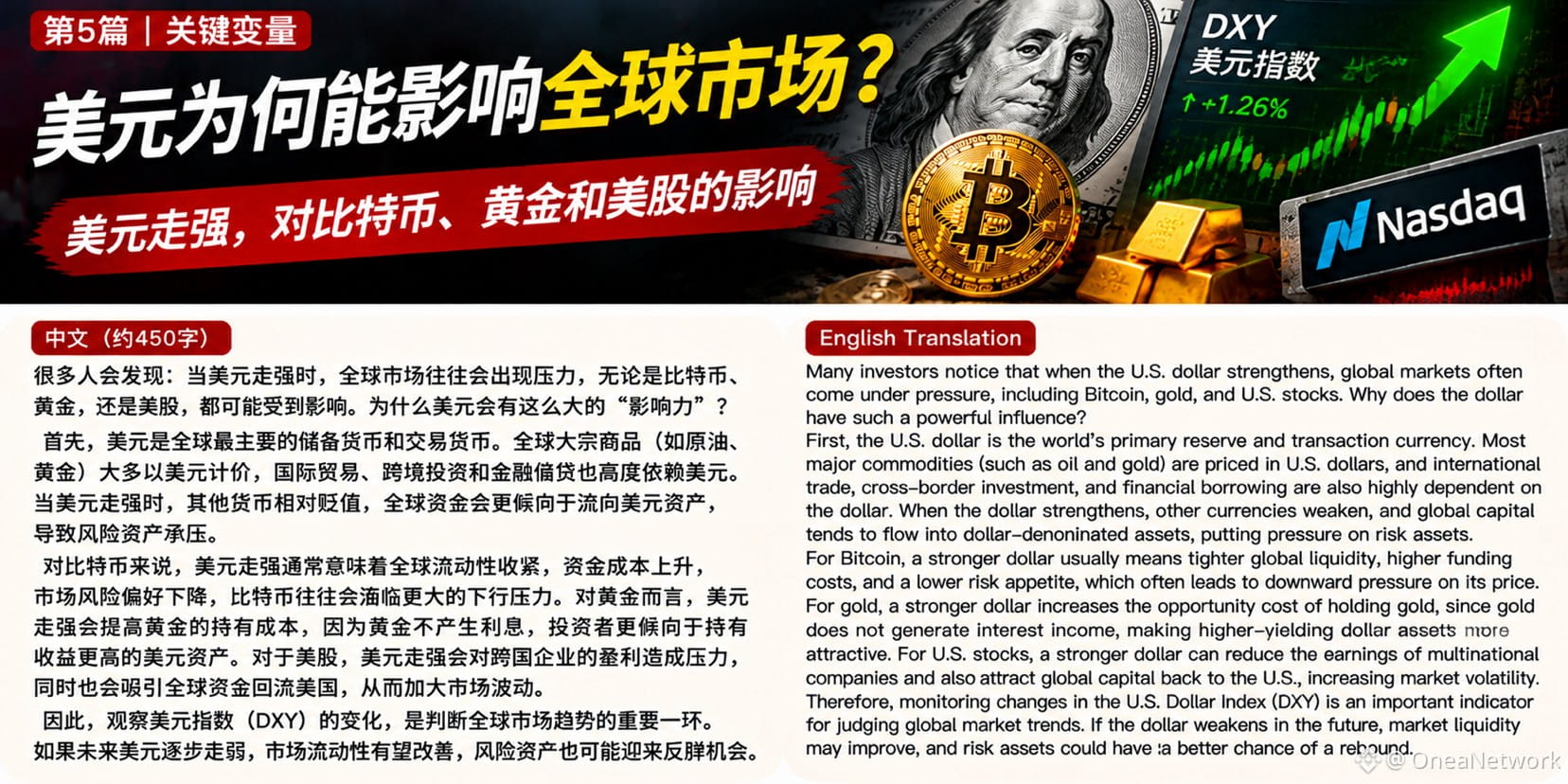
Why can the U.S. dollar influence global financial markets? What does a stronger dollar mean for Bitcoin, gold, and U.S. stocks?
Many investors notice that when the U.S. Dollar Index continues to strengthen, global financial markets often come under varying degrees of pressure. Bitcoin falls, gold comes under pressure, and volatility in U.S. stocks increases. What is the logic behind this?
First, the U.S. dollar is the world’s most important reserve and settlement currency. A large share of international trade, commodity transactions, and cross-border financing is closely tied to the dollar. When the dollar appreciates, other currencies depreciate relative to it, potentially making dollar-denominated assets more attractive and prompting global capital to flow back into dollar markets.
Second, a stronger dollar usually puts pressure on Bitcoin. A stronger dollar can sometimes signal tighter global liquidity and lower investor risk appetite, making highly volatile crypto assets more vulnerable to outflows. However, this relationship is not absolute; markets are also influenced by institutional demand and factors specific to the crypto industry.
Third, gold may also come under pressure. Gold is priced in dollars, so a stronger dollar raises the cost of buying gold for holders of other currencies. At the same time, if U.S. real interest rates rise, the opportunity cost of holding gold—which pays no interest—increases.
Fourth, U.S. stocks are also affected. A stronger dollar may reduce the dollar value of multinational companies’ overseas earnings when converted back into dollars. It can also shift the allocation of international capital, putting valuation pressure on some growth stocks.
Therefore, the U.S. Dollar Index (DXY) is one of the key indicators for monitoring global financial markets. But we cannot simply assume that a rising dollar means all risk assets will fall. We also need to consider real interest rates, economic growth, and capital flows together.
Will the U.S. Dollar Index become a key factor determining the direction of Bitcoin and U.S. stocks in the next market cycle?