
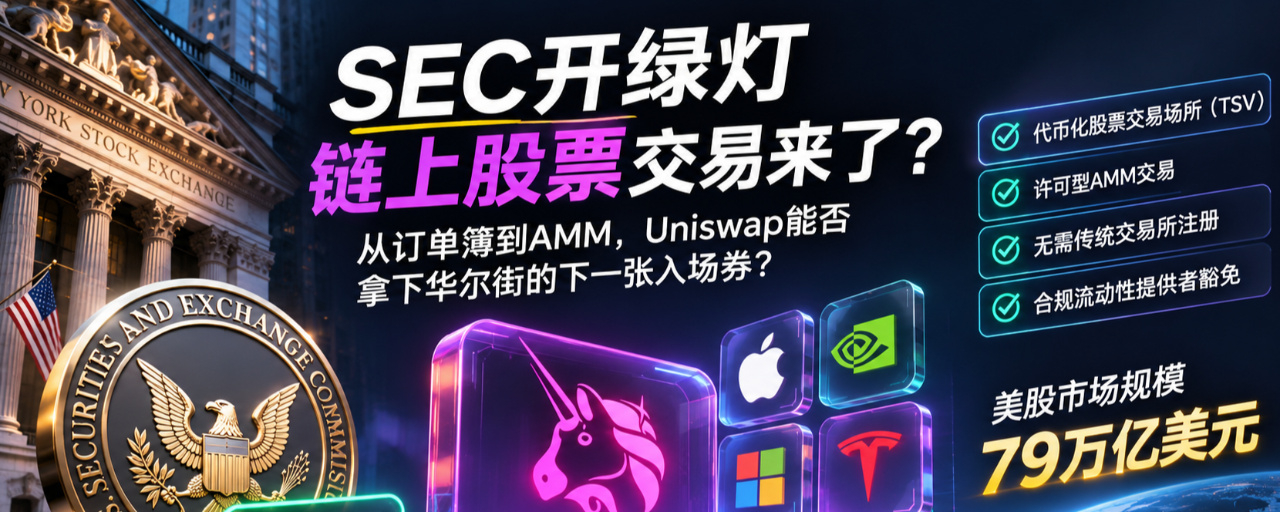
The stock trading system Wall Street has operated for decades may be getting a new player: AMMs.
On November 10, Uniswap Labs published an article (Building a Tokenized Securities Venue on Uniswap) explaining the U.S. SEC’s latest “Innovation Exemption” and publicly inviting securities issuers, trading venue operators, and liquidity providers to build an onchain securities market on Uniswap.
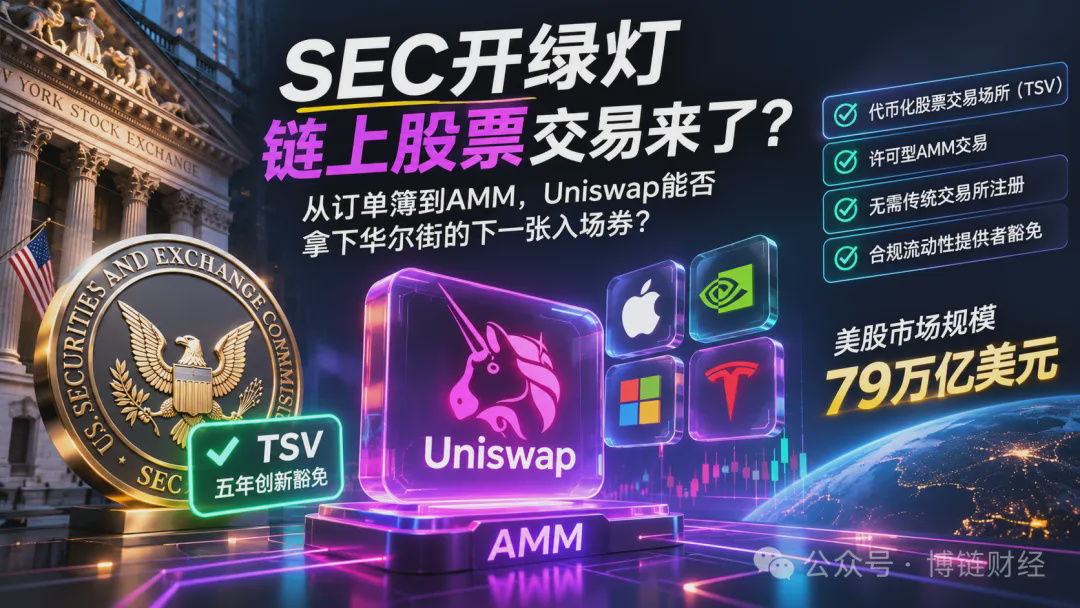
What makes this article worth paying attention to is not how many more stock tokens Uniswap is preparing to launch, but that it is beginning to position itself as trading infrastructure for traditional securities markets.
From a crypto DEX to infrastructure for U.S. stock trading, this may be the most significant expansion of Uniswap’s business boundaries since its founding.
I. The SEC has given AMMs a ticket to Wall Street
On September 17, the U.S. SEC issued a five-year regulatory exemption order, formally introducing the Tokenized Securities Venue (TSV).
Eligible TSVs can trade tokenized U.S. stocks through permissioned AMM liquidity pools on public blockchains without registering as traditional securities exchanges. Eligible liquidity providers may also qualify for specific exemptions from securities dealer registration.
The exemption is valid until September 17, 2031.
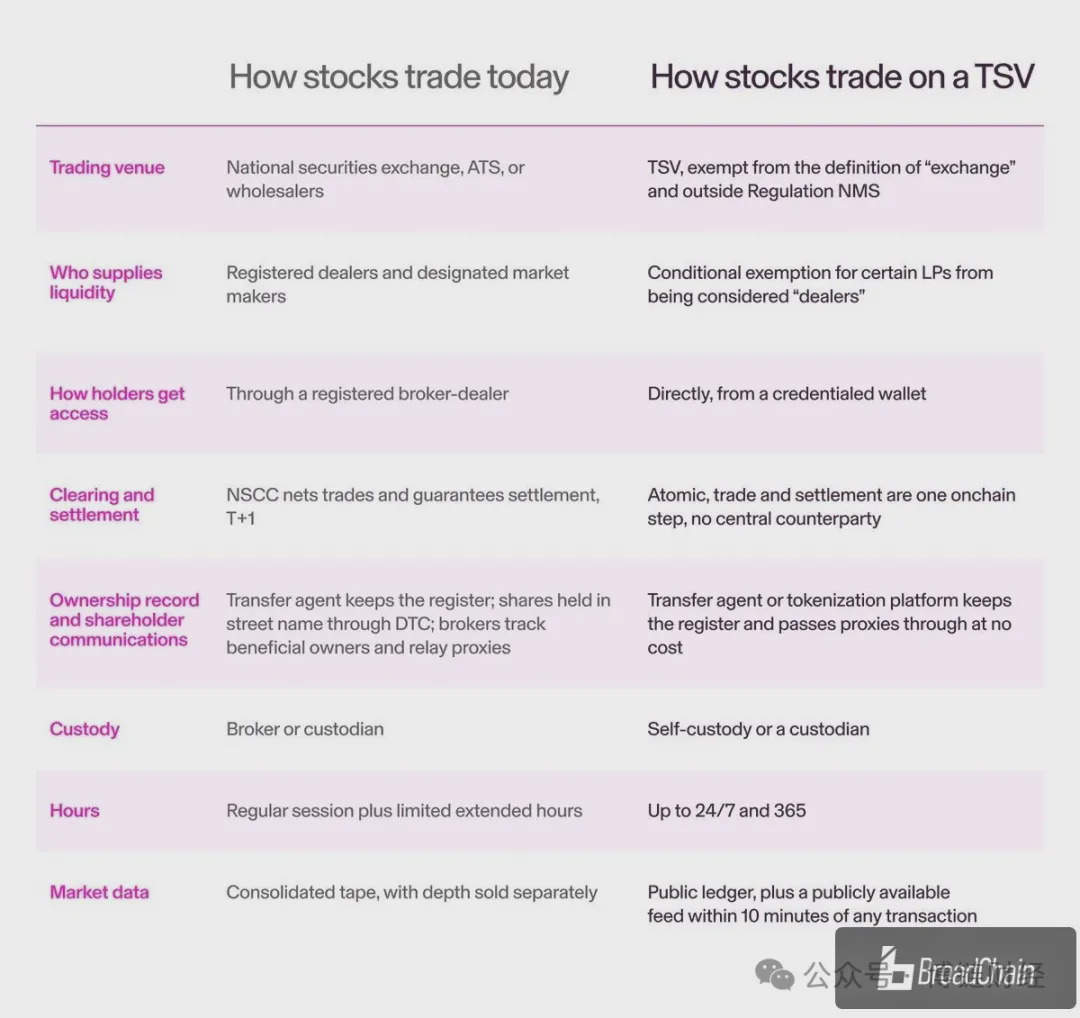
But this is not a blanket deregulation. TSVs must still comply with requirements such as participant identity and eligibility checks, trading volume limits, disclosure, coordinated trading halts, and issuer objection mechanisms.
One point is especially crucial:
Stock tokens covered by this regulatory exemption framework must grant holders the same rights as the corresponding traditional shares.
This is fundamentally different from the many tokenized products previously available on the market that offered only exposure to stock prices.
In the past, users might have held only a token tracking Nvidia’s share price. In the future, compliant tokenized securities could carry the shareholder rights attached to the corresponding stock.
This means stock tokenization is moving from price mirroring toward bringing genuine securities rights on-chain.
II. Why could Uniswap benefit?
Traditional U.S. stock trading relies on order books.
Brokerages route orders, exchanges or market makers match trades, and clearinghouses and depositories handle settlement.
Uniswap’s AMM, by contrast, uses smart contracts to manage liquidity pools and facilitate asset swaps.
This mechanism brings several noteworthy changes.
First, stocks can trade 24/7.
Liquidity pools do not need to depend on fixed trading hours like traditional exchanges. They can technically operate around the clock, but actual trading must still comply with trading halts and other securities regulations.
Second, market making would no longer depend entirely on traditional professional firms.
Eligible participants can supply assets to liquidity pools, participate in market making, and earn fee revenue.
This could expand the supply of liquidity, but it also means liquidity providers must bear price volatility, arbitrage losses, and smart contract risks.
Third, stocks would not necessarily have to trade only against U.S. dollars.
For example, a tokenized Nvidia share could be paired with a tokenized S&P 500 fund, a money market fund, or even a crypto asset.
This could create asset combinations and liquidity management approaches rarely seen in traditional securities markets.
However, AMMs are not inherently superior to order books. For high-frequency, large-volume stock trading, price discovery, slippage, liquidity depth, and MEV remain real challenges.
III. Uniswap v4 Hooks may be the key
Traditional DeFi emphasizes permissionlessness: anyone can participate.
But securities markets are different.
Who can trade, which stocks can be listed, and when trading must be halted are all subject to regulatory requirements.
Uniswap v4 Hooks provide programmable market rules that are ideally suited to this.
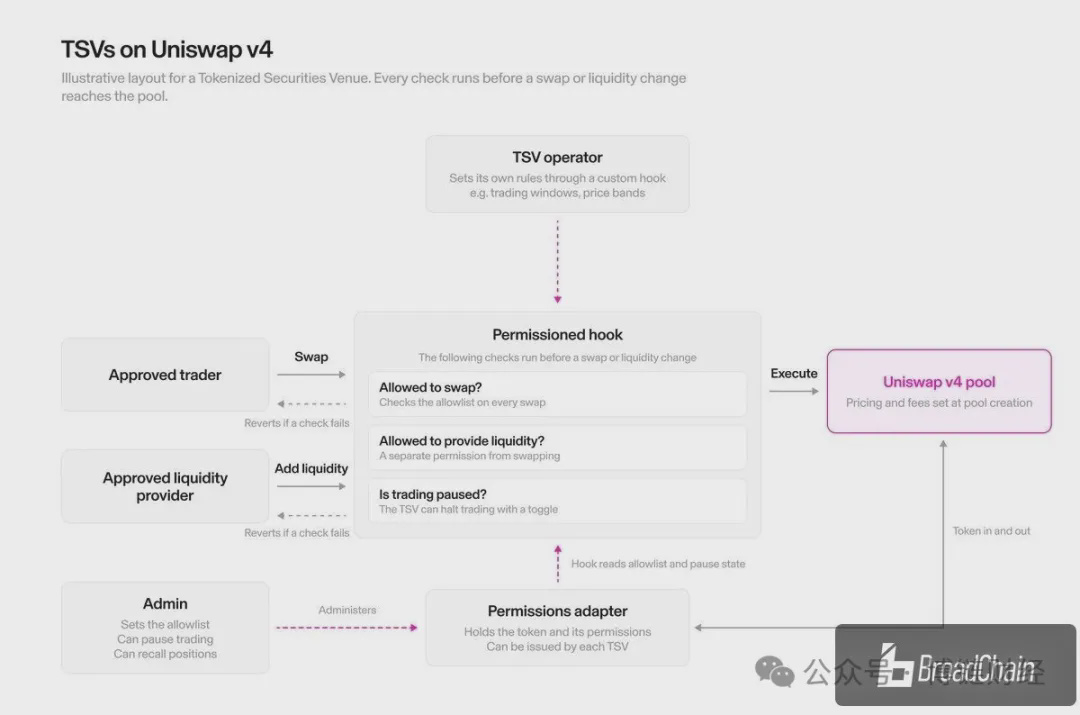
Through Permissioned Pools Hooks, operators can set:
Trading eligibility limited to addresses that have completed KYC or meet qualification requirements;
Access requirements for specific securities and trading pairs;
Trading suspensions in accordance with regulatory requirements;
Customized rules for trading behavior, fees, and liquidity pools.
In other words, Uniswap can support regulated securities markets without abandoning its AMM architecture.
This is also an important step in Uniswap’s evolution from an open DeFi protocol into institutional-grade financial infrastructure.
IV. $20 billion in trading volume is just the beginning—the real competition is only just emerging
According to Uniswap Labs, cumulative trading volume for stock tokens on the Uniswap protocol has exceeded $20 billion, involving projects such as Robinhood Stock Tokens, xStocks, Ondo, and Dinari.
The stock token market on Robinhood Chain is also developing rapidly.
Uniswap disclosed that more than 40 stock tokens and ETFs have established SPY trading pools, with cumulative trading volume exceeding $900 million and approximately 130,000 wallets involved.
These figures show that on-chain stocks have moved beyond the purely conceptual stage.
However, current trading volume does not mean that all activity falls under the SEC’s new exemption framework, nor does it mean these products all grant users full shareholder rights.
More notably, traditional financial institutions have already begun entering this field.
As of November 9, the SEC website listed four institutions that had submitted notices of intent to operate as TSVs:
TSV LLC, OKXICE TSV, Kephas Corporation, and Formation Securities LLC.
This means that real participants are beginning to emerge in the competition to operate on-chain securities trading venues.
The future competition will involve not only Uniswap and other DEXs, but also exchanges, brokerages, custodians, security tokenization platforms, and traditional market makers.
V. A major opportunity for UNI—but not automatically a token catalyst
This is what investors most need to distinguish.
Adoption of the Uniswap protocol does not mean UNI holders automatically earn revenue.
If a large volume of stock trading is conducted through Uniswap v4 in the future, the most direct beneficiaries may be:
First, trading venue operators, which earn revenue from trading services;
Second, liquidity providers, which earn fees by supplying assets;
Third, the Uniswap ecosystem, which expands its network effects through growth in trading volume and developer activity.
Whether UNI can capture value will depend on the protocol’s fee mechanisms, governance decisions, and whether revenue from new business lines actually flows to the token.
The fact that the U.S. stock market is worth $79 trillion does not mean that figure can be used directly to derive a valuation for UNI.
Nor should all stock trading volume be treated as a market that Uniswap can capture in the future.
What’s really worth tracking is: How many TSVs actually adopt Uniswap v4? How much trading volume and how many fees will they generate? How much revenue will the protocol ultimately retain?
These figures matter more than any RWA narrative.
VI. Uniswap is vying not for stock trading volume, but for market infrastructure
In recent years, discussions of stock tokenization have focused primarily on issuance.
Who can turn Apple, Nvidia, and Tesla shares into tokens?
But securities issuance is only the first step.
What will really determine whether the market can scale is what comes next: trading, market making, clearing, settlement, and integration with other financial assets.
The SEC’s innovation exemption effectively provides a new framework in which these activities can be tested.
For Uniswap, the opportunity is not merely to add a few stock trading pools, but to make AMMs and Hooks into trading infrastructure that other financial institutions can use directly.
Of course, this path still faces regulatory, liquidity, securities-rights, and commercialization challenges.
But one thing is already clear: Uniswap is no longer content with handling only crypto trading.
It is beginning to venture into the most central trading activities of traditional capital markets.
In the past, Wall Street traded stocks using order books.
In the future, AMMs could become an alternative market structure alongside order books.
What’s truly worth watching is not whether all U.S. stocks will move on-chain, but who might become the underlying protocol for the next generation of securities trading systems.