
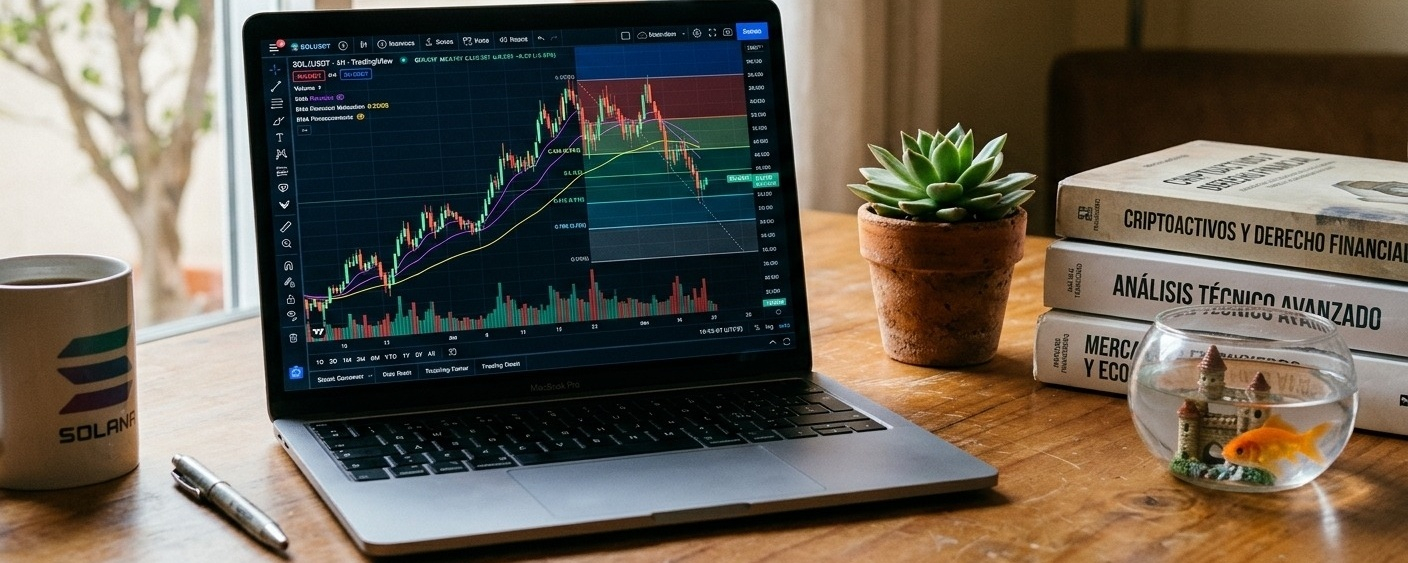

Hello everyone. I want to be completely honest from the very first line: I’m not a professional trader living on a yacht, and I’m not here to sell you a miracle indicator. I’m an everyday worker who, like many of you, has made mistakes in the market, seen my account in the red, and had to learn the hard way.
Today I want to share my current strategy with you. It’s still very much in the building and testing phase, but it’s helping me keep a cool head and, most importantly, accumulate real value while we wait for the real bull market. I call it the Snowball Strategy. I use it with Solana ($SOL), but I’m convinced its logic works for any asset with good liquidity.
The Snowball Theory
The goal of this system isn’t to make dollars today to spend tomorrow. The goal is to maximize my number of free tokens by taking advantage of market pullbacks, without having to constantly inject new money from my salary.
To put it into practice, I use a combination of simple but powerful technical tools:
1. The Macro Compass (Trend Filter): I check the 50- and 200-period Exponential Moving Averages (EMA) on the weekly chart. If the price is above them, I know the main trend is bullish and that it’s worth playing along.
2. The Trigger (Identifying the Top): When the price rises, I look for key resistance zones using price action and combine them with the 14-period RSI on daily and 4-hour charts to spot bearish divergences (when the price rises but buying strength falls).
3. The Sale: Once I identify overbought resistance, I sell some of my tokens for stablecoins (USDT). Lesson learned: I used to sell 75% all at once, but the market punished me by continuing to rise. Now I prefer to be less aggressive so I’m not left out if the price goes parabolic.
4. The Buyback (The Fibonacci Map): I draw the Fibonacci Retracement on the daily chart and place three limit buy orders at the key levels: 0.382, 0.5, and 0.618 (executing on the 4-hour chart). Since we buy at a lower price with the same dollars we made on the way up, by the end of the retracement we have more tokens than we started with. The snowball grew.
Reacting to the Real Market
Recently, I went through the ultimate test. I sold some near the top, the price kept rising (which would make anyone panic), but I stayed calm, used some remaining funds at a higher resistance level, and waited. The market finally pulled back, touched my three Fibonacci levels (the last one near $108 USDT), and continued falling to the 0.786 level near $102 USDT.
What did I do? Instead of panicking, I recognized extremely strong psychological and institutional support around $100 USDT and injected new capital from my savings. The price moved around there for a while but continued to pull back; in response, I identified other support zones further down and placed buy orders in those zones with new money, accumulating more tokens. This made me realize that although I miscalculated the drop, the strategy helps me understand that every dip is a discount, an opportunity. I record all of this meticulously in an Excel spreadsheet to track my exact average purchase price.
The Key Is Spot
I do all of this strictly in the Spot market. After losing money in the past, I realized that leverage and futures are the fastest way for big players to wipe out your account. In Spot, time is on my side. If the price falls, I still own my SOL and just have to wait for the market structure to recover.
This is my real experience, shared openly, and I’m constantly learning.
What do you think of this accumulation strategy? Do you think selling in stages based on Fibonacci is the best option, or do you prefer the classic Hold approach of not touching anything until the end? I’d love to read your analysis and discuss it below!
If you liked this honest and educational approach, leave me a Like 👍, share this post, and hit the Follow button to join me as this snowball grows. See you in the comments!
