
@Chen Kai

Post

宸恺
·
--
November 11–12 Crypto Intelligence | Macro Sledgehammer · ETF Redemption Concentration · Credentials Compromised
CPI rose 0.4% month over month, above the 0.3% expected. Core CPI has held at 0.3% for the third consecutive month. The probability of no rate hike in December has fallen to zero, with a 50 bp hike now a tail-risk scenario. BTC plunged from 74,700 to 72,800. More than $600 million was liquidated in 24 hours, including over $500 million in long positions.
But this was a two-way shakeout. There are $1.895 billion in short positions waiting at 76,896 above, and $911 million in long positions waiting at 69,876 below. Price is trapped between two liquidation pools, and whichever way it moves, someone gets squeezed. This isn't about bulls versus bears; it's leverage being forced to reprice in the face of macro conditions.
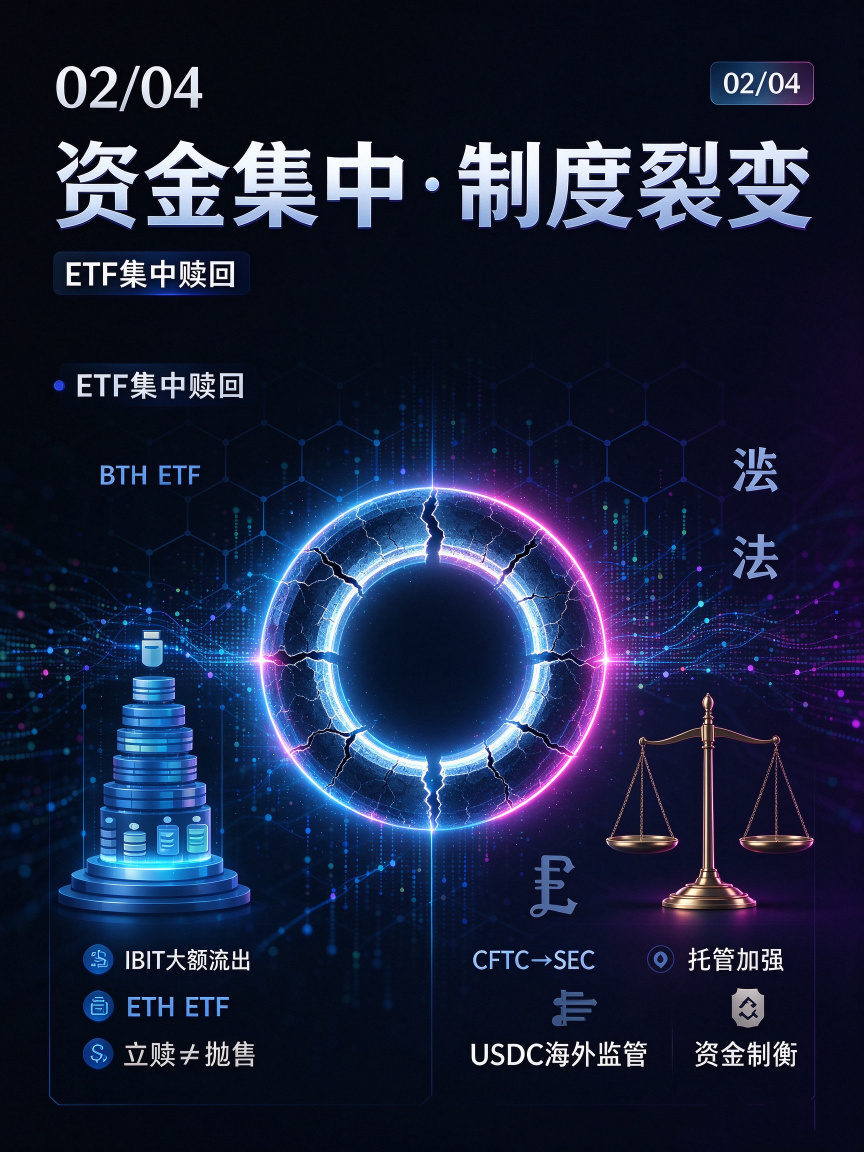
ETF money isn't flowing out evenly: on November 9, IBIT alone saw $213.2 million in outflows—more than the total net outflows from all BTC ETFs. That suggests large accounts are making concentrated redemptions, while other products are seeing small net inflows. Net outflows track creations and redemptions; they don't necessarily mean selling. What really matters is next week: if IBIT continues to see large outflows while the others stay flat, portfolio rebalancing could turn into a trend.
The regulatory landscape is shifting: Democrats are proposing a market structure bill that would expand the SEC's role and weaken the CFTC's, taking the opposite approach to CLARITY. Starting November 12, USDC will be subject to dual oversight by the EBA and France's ACPR. The vacuum left by CLARITY hasn't been filled—it's being filled by a different logic.
On the security front, Initia was attacked not because of a smart contract vulnerability, but because the GCP credentials used to configure a private node were leaked. The attacker obtained the credentials, injected commands, gained access to GitHub and Rollup hosting permissions, forged withdrawals, and transferred out $3.27 million. From the supply-chain compromise at Ledger, to the upstream vulnerability at Web3Auth, to today's cloud credential leak—the attack surface is increasingly concentrated in upstream infrastructure.
Code can be audited, but you can't audit “who got the keys to the configured node.”
A single concentrated bet is fragile in the face of macro forces. Being in it together doesn't mean we're all bullish; it means not staking everything on one direction. Positions, cash flow, sources of income—if any one of them rests on a single pillar, it's a gamble.
That's all for this edition. I'm Chen Kai. See you next time.