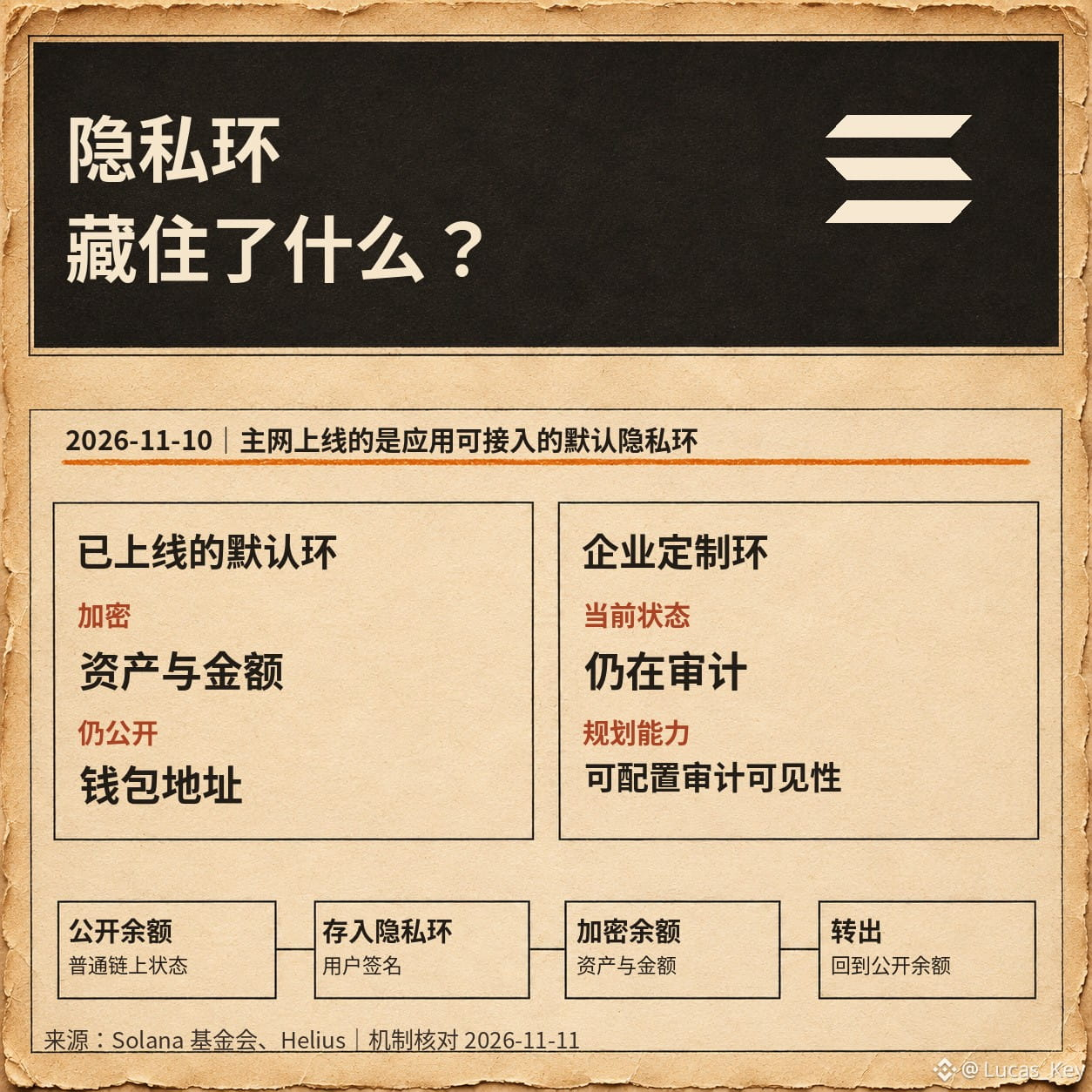
Yesterday, Privacy Rings announced its mainnet launch on $SOL . It would be easy to misread this as “Solana transfers are now anonymous by default.” The Solana Foundation and developer Helius describe it more narrowly: what has launched is a permissionless privacy pool that applications can integrate. After depositing assets into an encrypted balance, users can make private transfers; in the default mode, the asset and amount are encrypted, while wallet addresses remain visible. This expands the privacy options available to applications; it does not make all ordinary on-chain transactions private.
This is also where comparisons with $ZEC should stop. Zcash’s official documentation says that transactions between two shielded addresses can conceal the sender, recipient, and amount. However, ZEC also has transparent addresses, and moving funds into or out of the shielded pool reveals some boundary information. Privacy Rings’ current default pool does not offer the same degree of counterparty concealment. Helius says that custom enterprise pools with configurable counterparty visibility and audit permissions are still under audit, so plans should not be treated as features that have already launched.
Ordinary transactions on the $ETH mainnet likewise expose addresses and on-chain relationships, while privacy applications in the Ethereum ecosystem add protection on top of this public ledger. The key question in comparing the three is not whose slogan claims “the most privacy,” but what a specific transaction actually conceals—addresses, amounts, or assets—who holds the viewing keys, and whether wallets and applications have truly integrated the feature. I’m more interested in which fields are visible in actual use of the default pool and in cross-application compatibility than in inferring from a launch announcement alone that fund flows will become completely invisible.
Sources: Official materials from the Solana Foundation, Helius, Zcash, and Ethereum, reviewed as of November 11, 2026. Risk notice: Privacy features have limits, and misjudging what information is visible can expose transaction relationships. This article does not constitute investment advice.