
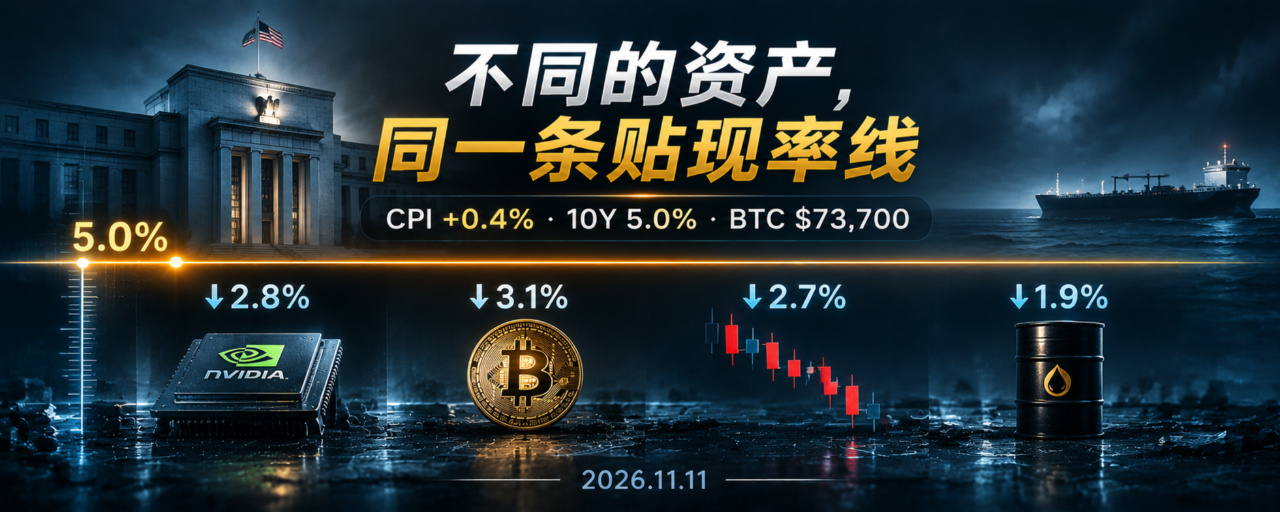

On November 10, the U.S. Bureau of Labor Statistics reported October CPI: it rose 0.4% month over month, above the expected 0.3%; core CPI rose 0.3% month over month, also above the expected 0.2%. Because last year’s federal government shutdown left October 2025 data unavailable, the report did not include year-over-year figures.
After the data came out, the 10-year Treasury yield briefly topped 5.0%, while the 2-year yield rose above 4.68%. Waller had set a condition before the release: if core CPI came in at 0.3% or higher, a 50-basis-point rate hike in December might be needed. The data triggered that condition.
Inflation hasn’t cooled, rate hikes are all but certain, and yields haven’t fallen. With all three confirmed at once, risk assets no longer have separate stories to tell.
Core inflation has been stuck at 0.3% for three consecutive months, triggering Waller’s condition
The drivers of October CPI were more spread out than in September. Energy rose 0.7% month over month, a notable slowdown from September’s 5.2%. But food rose 0.5%, shelter rose 0.3%, medical services rose 0.3%, and transportation services rose 0.8%.
More importantly, core CPI has now risen 0.3% month over month for the third consecutive month, with no sign of converging toward the 2% target. Waller had previously made his position clear: if core CPI is around 0.3% or higher, the Fed may need to raise rates by 50 basis points in December “to maintain the Fed’s credibility.” Now that the data is in, this condition is no longer a remote possibility.
Inflation doesn’t explain Nvidia’s decline
All three major U.S. stock indexes closed lower: the S&P 500 fell 0.38%, the Nasdaq fell 0.74%, and the Dow fell 0.30%. The real story is in the market’s composition.
Nvidia fell about 4.3% in a single day, wiping out roughly $193 billion in market value, and is down more than 9% over two days. The catalyst wasn’t inflation, but a scandal involving Jensen Huang combined with a class-action lawsuit brought by shareholders. Media reports are still the main source for attributing the move to this event, but alongside position adjustments in the AI trade, it amplified the decline.
Semiconductor stocks are diverging. Broadcom rose nearly 4%, TSMC gained more than 2%, and AMD and Qualcomm rose more than 1%; memory stocks were weak, with SK Hynix down more than 3%. Nvidia’s decline is more a combination of its own company-specific story and crowded positioning than a repeat of an “AI trade collapse.”
There was an interesting contrast after the bell: CoreWeave reported Q3 revenue of $3.66 billion, above expectations of $3.56 billion, and raised its full-year guidance; shares rose more than 7% after hours. Revenue beat expectations, but its net loss widened to $709 million, with interest expenses of $850 million. Demand for AI computing power is real on the books, and so is the cost of financing.
Bitcoin: In the $73,700 range, with more than $1 billion in liquidations
After the CPI data was released, Bitcoin quickly fell from around $74,000. During the November 8–9 selloff, Bitcoin touched an intraday low of $73,708, its lowest level since August. Crypto liquidations over 24 hours totaled around $1 billion to $1.1 billion.
Bitcoin had previously rebounded to $81,000, but then gave back its gains, with the weekly close below its 50-week moving average at around $75,500. A 10-year yield of 5% doesn’t mean “safe-haven assets should rise” for Bitcoin; it means “the discount rate for long-duration risk assets just got more expensive.” Bitcoin generates no cash flow; its valuation depends on opportunity costs and liquidity expectations. When risk-free yields break above 5% and a 50-basis-point rate hike is priced back in, Bitcoin is reassessed along the same discount-rate curve as the Nasdaq, Nvidia, and all assets whose value depends on “discounting future cash flows.”
Oil prices are falling, but ships in the Strait of Hormuz are still under attack
Brent crude fell to around $92, its lowest level since late August. The trigger was Trump saying that new strikes against Iran were “highly unlikely,” easing concerns about a prolonged disruption to Middle Eastern supplies.
But one line in the same batch of reports shouldn’t be overlooked: ships in or near the Strait of Hormuz are still being attacked. Oil prices are trading on expectations of “no escalation,” while geopolitical events remain on the brink of “escalation.” If that line is crossed, the impact won’t just be on oil prices; it will affect the physical security of AI infrastructure. For now, it’s background noise, but it shares the same “computing power–electricity–geopolitics” chain as Nvidia, CoreWeave, and Bitcoin.
What to watch next
Can the 10-year yield hold above 5%? If a break above 5% intraday becomes a weekly closing anchor, the discount-rate benchmark for global risk assets will shift systematically higher.
Will December bring a 25- or 50-basis-point hike? Waller’s condition has been triggered. If more officials echo the 50-basis-point option, current rate-hike pricing will need to be rewritten.
Will Nvidia’s decline spread? If selling pressure doesn’t spread to semiconductor names that have already risen, such as Broadcom and TSMC, ahead of the November 17 earnings report, the move is more likely to be company-specific. If it does spread, the pricing logic behind the AI trade will need to be reassessed.
Can Bitcoin reclaim the 50-week moving average at $75,500? This is the first technical hurdle separating a short-term “CPI shock” from a trend reversal.
Will attacks on ships in the Strait of Hormuz escalate into direct strikes on infrastructure? Oil prices are currently pricing in “no escalation.” If data centers or cables become actual targets, it won’t just be crude oil that gets repriced.
Inflation, rate hikes, and yields—all three point in the same direction. Nvidia has its own troubles, CoreWeave has its own balance sheet, and Bitcoin has its own liquidations, but they’re all being repriced along the same discount-rate curve. 5% isn’t just a round-number threshold; it’s a line that brings different assets back to the same measuring stick.
Disclaimer: This content is for informational purposes only. Please do your own research.