
A Bridge Between TradFi and DeFi
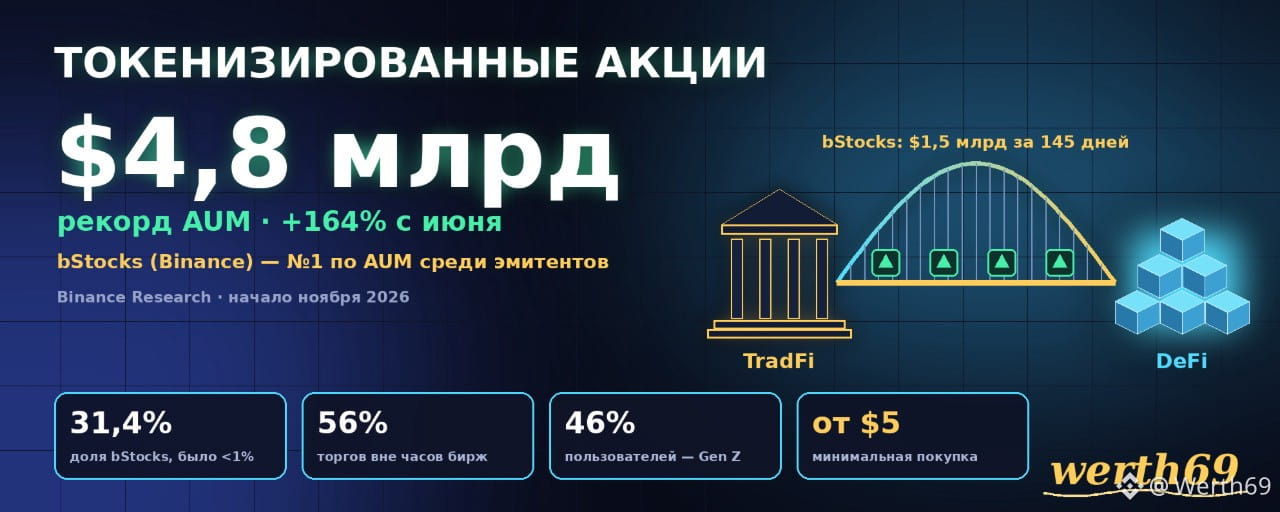
A quiet but tectonic revolution is unfolding in the world of finance. While the crypto community debates memecoins and the next halvings, traditional financial instruments are rapidly moving onto the blockchain. Assets under management (AUM) in the tokenized stock sector reached an all-time high of $4.8 billion in early November 2026. According to Binance Research, this figure has surged by a remarkable 164% since June.
These are more than just numbers. They signal that the infrastructure of traditional finance (TradFi) and decentralized finance (DeFi) has finally found common ground. One of the main drivers of this growth has been Binance’s bStocks platform, which surpassed $1.5 billion in AUM just 145 days after launch, taking first place among tokenized stock issuers.
Let’s take a detailed look at this report to understand how stock tokenization is changing the rules of the game, who is behind this growth, and what it means for investors around the world.
The bStocks Phenomenon: $1.5 Billion in 145 Days
The bStocks success story is a textbook example of capturing market share. The platform launched in June 2026 and became a genuine breakthrough.
According to Binance Research, the product reached $1 billion in AUM in just **125 days**, and surpassed the $1.5 billion mark 145 days after launch. By comparison, another major market participant, the Ondo platform, took 265 days to reach its first billion dollars. The difference in pace is clear.
bStocks’ share of the tokenized stock market grew from less than 1% in June to 31.4% in early November.
Growth is not limited to a single product:
Although bStocks has become the leader, the market is expanding across the board. Excluding bStocks, the combined AUM of the segment’s other participants increased by 81% over the same period. This means the entire sector is on the rise.
What is the secret to this success? The answer lies in bStocks’ ability to offer users exactly what they were missing: 24/7 access to the US stock market, a low entry threshold, and transparency.
Market Evolution: From Experiments to Mass Adoption
The tokenized stock market did not appear overnight. The Binance report notes that the sector developed gradually as infrastructure was built to tokenize traditional financial instruments.
Early stages:
One of the first steps was the Franklin Templeton FOBXX fund, which uses blockchain to record ownership rights in its shares. In addition, Singaporean bank DBS issued digital bonds worth 15 million Singapore dollars. These were pilot projects that proved the technology worked.
The RWA (Real World Assets) boom:
Later, the real-world assets (RWA) market developed alongside the launch of new products, including BlackRock’s tokenized BUIDL fund. This brought institutional capital into the sector and gave it legitimacy.
Current stage (2025–2026):
According to Binance, by 2025–2026 the industry had moved into a stage of broader practical use of these instruments, alongside the development of regulatory infrastructure. Tokenized stocks were no longer an exotic novelty for enthusiasts and had become a working tool for investors.
Nevertheless, it is important to note that tokenized stocks still account for a small share of the global stock market. The figure is $4.8 billion, while the market capitalization of the US stock market alone is measured in tens of trillions. This means we are still at the very beginning, and the potential for growth is enormous.
Who Uses bStocks? An Investor Profile
One of the most interesting aspects of the report is its analysis of the audience using bStocks. Binance Research identified several unique behavioral patterns that set this product apart from traditional stock trading.
Trading outside stock market hours:
Transactions outside standard US stock exchange sessions account for 56% of the product’s total trading volume. This points to enormous user interest in instruments that provide access to assets linked to US stocks and ETFs when traditional exchanges are closed. People want to trade when it suits them, not only when the NYSE is open.
Age breakdown:
Generation Z (Zoomers): They account for 46% of bStocks users and make up a higher share of trading volume on weekends than other age groups. They are more active at non-standard hours.
Millennials: They hold positions longer than other groups and account for 78% of total trading value. They are the core audience that takes investing more seriously.
Geography:
Users from emerging countries and frontier markets accounted for around 70% of trading volume since the product launched. Binance attributes this to demand for more accessible tools for investing in the US stock market.
For eligible users outside the US, the minimum purchase amount for some tokenized instruments starts at $5. This makes the US stock market accessible to millions of people who cannot open a US brokerage account or buy an entire share for hundreds of dollars.
However, 24/7 trading does not mean constant liquidity or an absence of price risks. Analysts have also warned about this.
#BStocks #RWA #Binance #stockmarket
$BTC

