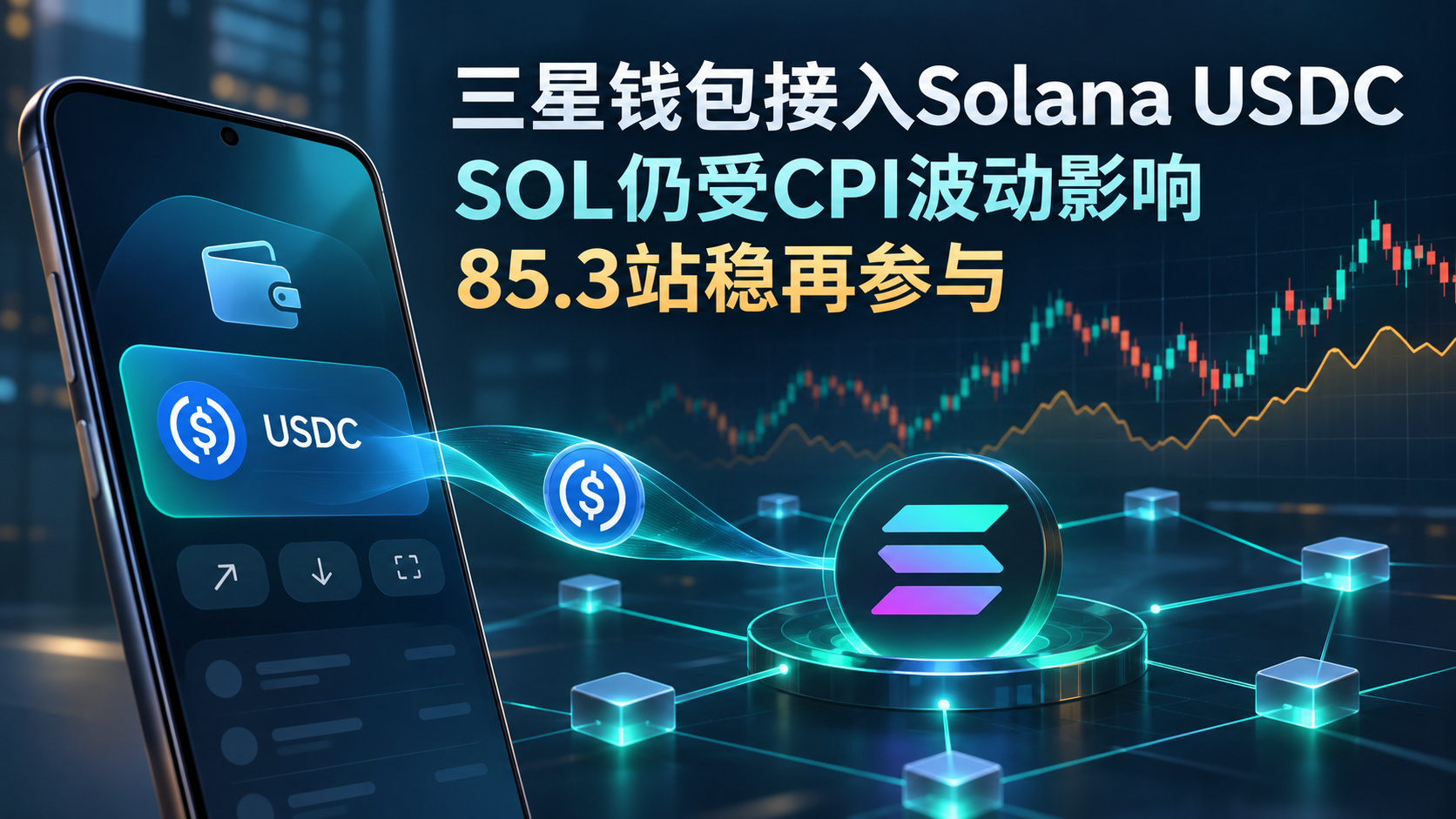
Samsung Wallet Adds Solana USDC|SOL Still Hasn’t Escaped CPI Volatility|I’m Waiting for 85.3 Confirmation
My view is that payment use cases have long-term value worth validating, but I’m not chasing SOL higher tonight just because a product has launched. #HotCPIDecemberHikePriced is a trending topic on Binance Square, and SOL is also among the top six-hour searches. The buzz reflects how the market is pricing December interest rates, not a decision already made by the Federal Reserve. The U.S. Bureau of Labor Statistics reported that overall CPI rose 0.4% month over month in October, while core CPI rose 0.3%; the headline figure was higher than the market’s prior forecast of about 0.3%. This data more directly affects expectations for U.S. interest rates and positioning in volatile assets, and is enough to outweigh project-level positive news in the short term.
There is one development worth verifying. A November 5 article from the Solana Foundation says that stablecoin accounts in Samsung Wallet became available on November 2 to eligible U.S. Galaxy users, who can buy, hold, send, and receive USDC on the Solana network through the wallet. Samsung’s October 7 U.S. announcement confirmed the stablecoin feature for eligible devices in the United States, Bastion and Coinbase’s involvement in custody, and support for networks including Solana. These two primary sources corroborate the direction of the partnership; however, the roughly 82 million compatible devices cited in the Foundation’s article represent potential reach, not the number of users who have actually activated the feature, much less 82 million active wallets. For now, users mainly have transfer functionality. In-person payments and expansion to more regions are future possibilities, not features already rolled out everywhere.
The impact mechanism also needs to be broken down. USDC transfers settle on Solana, and if the number of real users and transaction volume increases, value could gradually show up in on-chain fees, developer demand, and network usage metrics. But a USDC payment does not mean an equivalent amount of SOL is being bought, and launching a payment feature does not automatically reduce the token supply. What really matters is the number of stablecoin transfers, sustained active users, actual fees, and subsequent merchant usage—not just the number of devices that could access the feature. When macro risk appetite is weak, the market may sell volatile assets first and assess long-term adoption later.
Price action shows that these two narratives have not yet converged. The 15-minute Binance SOL/USDT candle at 21:30 hit a low of $82.61 before rebounding; at the time of writing, SOL was around $84.67, still down about 2.9% over 24 hours. The day’s high of $88.07 shows that pressure from the pullback remains. My short-term levels are the $82.6 news-driven low, the $83.7–$84.2 retest zone, and the recovery level near $85.3. Only a move back above $85.3 followed by a successful retest would suggest that macro selling pressure has temporarily eased. If $82.6 breaks again, even a strong payments narrative won’t make me ignore my stop loss. Farside’s November 9 SOL fund data provisionally shows net outflows of $7.7 million and has missing entries; the November 10 column is still blank, so an unfinished daily table cannot be used to infer inflows tonight.
If I were trading this myself: I wouldn’t enter right now; I’d only consider an unleveraged spot long with conditions. If SOL has two 15-minute candles close above $85.3, then retests and holds $84.8, I’d use no more than 3% of my total funds for a trial position. I’d sell half at $86.5 and close the rest near $87.8. If it falls below $83.6 after entry, I’d stop out and close the entire position. If it first breaks below $82.6 and the rebound fails to regain $84.2, I’d cancel the long plan and keep waiting. This is not a review of a trade that has been filled or made a profit; these are conditions still awaiting market confirmation.
#HotCPIDecemberHikePriced #SOL
The above is solely my personal market observation and does not constitute investment advice.