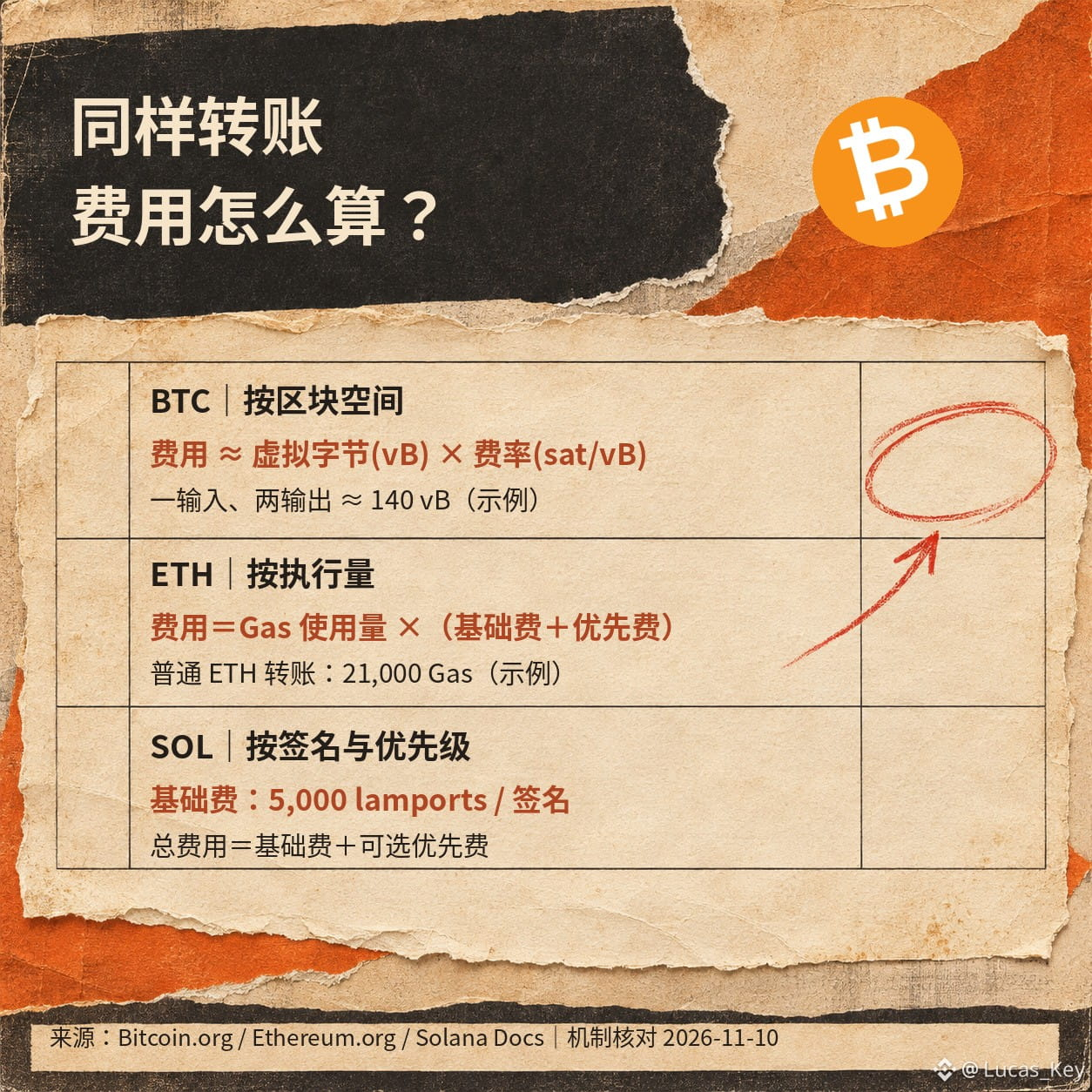
Why can the on-chain fees differ so much when sending coins of the same value? Looking at $BTC , $ETH , and $SOL , don’t assume that the “transfer amount” is a common basis for calculating fees. Each chain sells users a different kind of blockspace, and the final quote shown in a wallet also varies with congestion and transaction details.
BTC fees are mainly bid based on the virtual bytes a transaction occupies, commonly measured in sat/vB. Bitcoin.org gives an example of a typical payment with one input and two outputs taking about 140 vB, but more inputs can increase its size. Transferring 0.01 BTC versus 10 BTC does not, by itself, change the miner fee proportionally. ETH fees, by contrast, are based on the Gas actually used multiplied by the “base fee + priority fee.” Ethereum.org’s example of a standard ETH transfer uses 21,000 Gas; contract interactions consume more, and the base fee adjusts with block demand.
Solana’s official documentation lists a base fee of 5,000 lamports per signature, with an optional priority fee. Looking only at this base fee and concluding that it “must be cheap even during peak periods” ignores whether the transaction can be included promptly and the price of computational resources. Conversely, if you see a high fee for a particular BTC or ETH transaction, first check the network load at the time, the transaction size, or the amount of computation required.
To compare fees across the three chains, you need to align at least the type of operation, the network conditions at the same point in time, and the expected confirmation speed. I care more about the total cost and success rate of completing a transaction than an isolated fee line in a screenshot. Basis for the mechanisms: Bitcoin.org, Ethereum.org, and Solana’s official documentation, checked as of November 10, 2026. Risk notice: Fee estimates can change, and congestion may cause delays or additional costs.