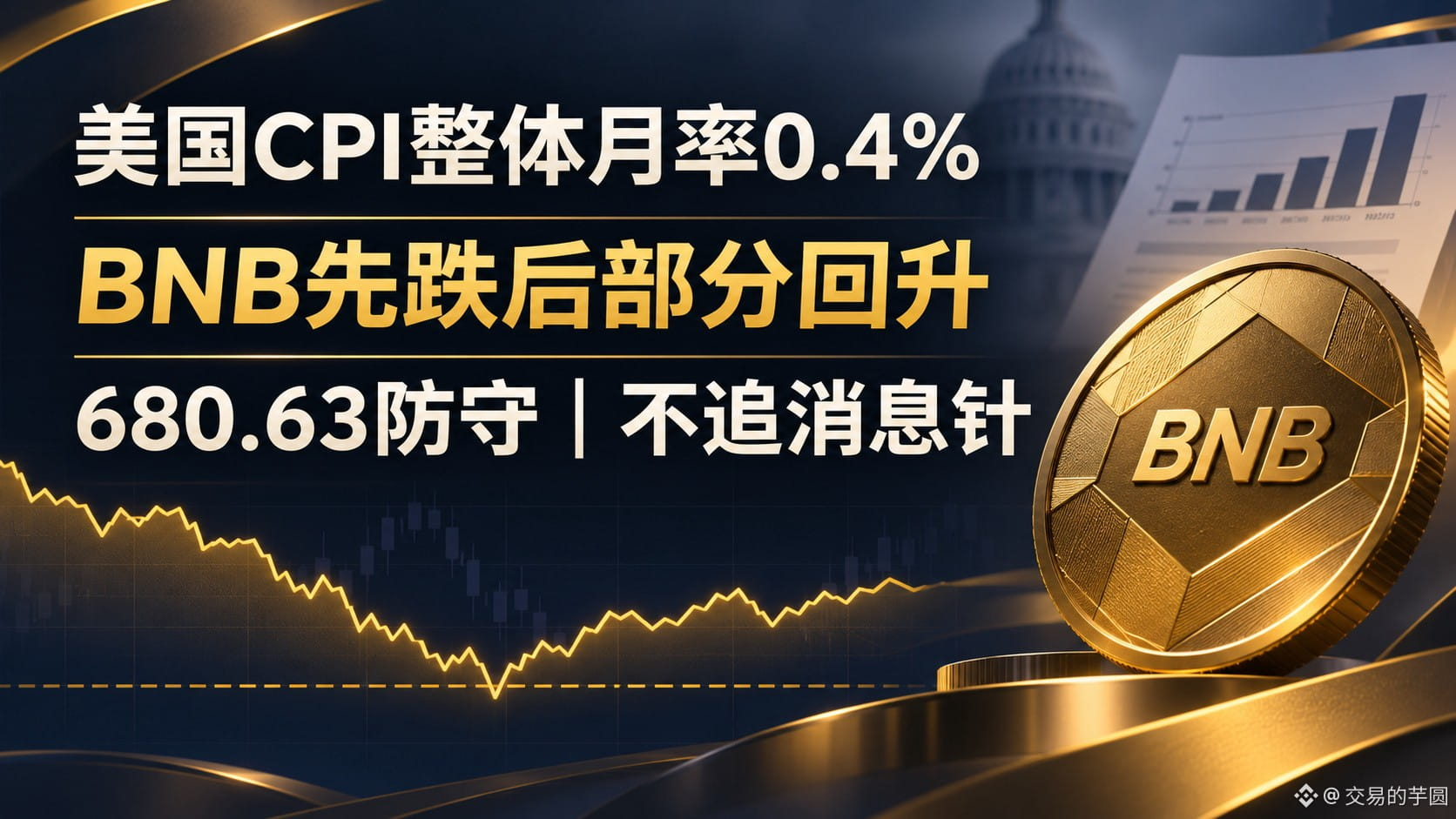
US headline CPI MoM 0.4% | BNB fell, then recovered half its losses | I don’t chase news spikes
My stance is to watch how BNB is supported, but not to treat one rebound as the start of a new uptrend. The trending topic on Square, #CPITestsDecemberRateOutlook, has moved from the expectations stage to the results stage: the US Bureau of Labor Statistics officially reported that seasonally adjusted headline CPI rose 0.4% month over month in October, while core CPI rose 0.3%. Headline inflation slowed from 0.6% in September, but was above the roughly 0.3% forecast compiled earlier by Dow Jones; core CPI also came in above its roughly 0.2% forecast. The BLS specifically explained that some sampling was missing in October 2025, so most year-over-year data for October 2026 cannot be published. I’ll cite only the official month-over-month figures, rather than inventing an official year-over-year figure, and I won’t claim that CPI means the Fed has already raised rates in December.
Why could the data affect BNB? BNB is both a Binance ecosystem asset and part of global risk-asset portfolios. When inflation is hotter than expected, traders may reassess the path of interest rates and reduce high-volatility positions, which can also affect exchange tokens. At the same time, demand to hold BNB is tied to platform usage, on-chain activity, and market confidence, so one macro factor alone cannot explain the entire price move. The Fed’s official decision on October 28 was still to maintain its target range at 3.75% to 4%; the next decision will come after another meeting, and there is no policy action tonight. Binance’s announcement in early November about the recovery from the security incident and its follow-up verification arrangements remain separate operational factors; the price volatility should not be described as a new development in the security issue.
I checked Binance’s one-minute BNB/USDT candles: at 21:29 Beijing time, the candle closed at about $687.80; during the 21:30 data-release minute, the price first touched $690.00, then fell to $680.63, and closed at $684.11. At the time of writing, it had returned to about $684.39, with its 24-hour change close to zero. Compared with SOL, which just fell to a low of $82.61 during the news-release minute, BNB’s move was a sharp drop followed by a partial recovery, but it still hasn’t reclaimed the pre-release level of $687.80. The levels to watch, in order, are $680.63, around $684, and $687.80. If BNB gets back above $687.80 and holds there, I’ll need to revise my short-term bearish view; if it falls below $680.63 and its rebound fails to get past $684, that would suggest the initial support is unstable. “It didn’t keep crashing” does not mean buyers have already won.
The easiest mistake to make right now is treating the high and low during the news spike as stable prices that could be traded under normal liquidity conditions. BNB’s one-minute range at 21:30 was about $9.37, and slippage can affect execution. To judge whether macro pressure is persisting, I’ll keep watching whether US yields and BTC stabilize at the same time, and whether BNB can establish acceptance above $687.80 over a window of at least half an hour. Binance Research’s weekly report today noted that risk sentiment in tech stocks can spill over into crypto markets; whether that continues will depend on subsequent trading.
If I were trading this myself, I wouldn’t enter now; I’d first watch two 15-minute candles. Only if BNB gets back above $687.80 and holds $686 on a retest would I consider a conditional spot long using no more than 4% of my total capital. I’d sell half at $690 and close the rest around $696. If it falls below $681 after entry, I’d stop out immediately and close the entire position. If $680.63 is decisively broken first and the rebound fails to reclaim $684, I’ll cancel the long plan, stay in cash, and won’t flip into a leveraged short. The plan has not been triggered, and no trade has been executed or profit made.
#CPITestsDecemberRateOutlook #BNB #SOL
The above is solely my personal market observation and does not constitute investment advice.