UNI at $6.9—what are you waiting for?
Daily active addresses hit a new high for the year, CME has listed UNI futures, and the fee switch and burn mechanism are now in place—yet the price has fallen from $11 in September to $6.9. All these bullish catalysts have landed, but the price still won’t budge. Has the market abandoned DeFi’s leading project, or is this the last calm before the storm?
First, the surface picture: the good news is out, but the price is flat.
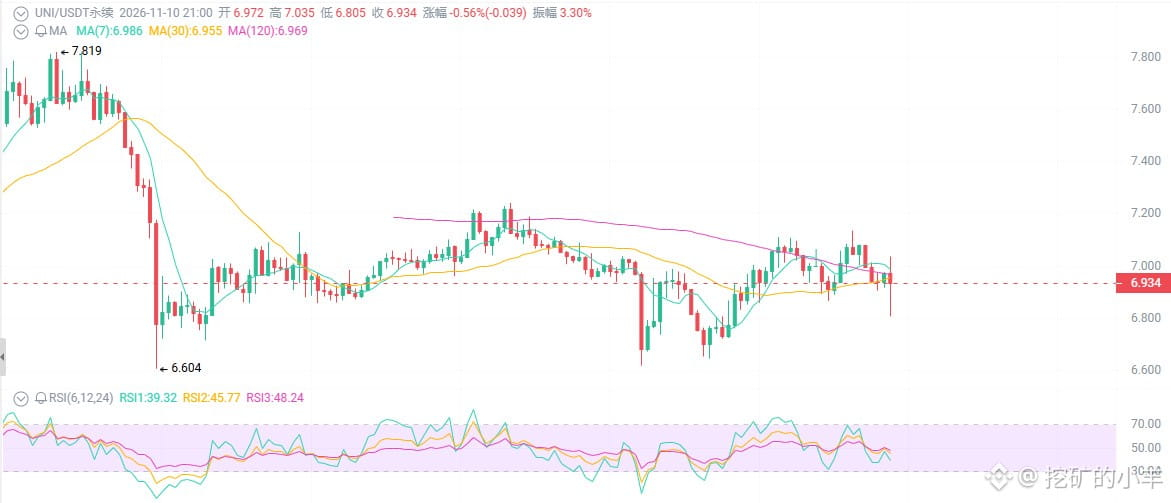
After surging to nearly $11 in September, the price pulled back all the way to a range of $6.5–$7.5. It’s now stuck hovering around $6.9. The daily RSI is 49, in neutral territory. The MA20 is at $7.0, and the price keeps testing it. Volume hasn’t picked up; the market seems fast asleep. Is UNI still worth holding?
First thing to note: the fundamentals are moving, while the price is flat.
Daily active addresses: 14,600, a year-to-date high
New addresses have seen their biggest growth since 2020
TVL is around $3.4–$3.5 billion, making Uniswap the undisputed leader in the DEX sector
v4 has launched on multiple L2s. Aggregator Hooks can route external liquidity, generating protocol fees that directly burn UNI
Trading volume in tokenized stocks is making a significant contribution, and the RWA narrative is starting to feed back into DEXs
The number of people using Uniswap is surging, and the UNI burn mechanism is working—but the price hasn’t caught up.
That’s a divergence between positive fundamentals and price.
Second thing to note: CME listing UNI futures is no small matter.
CME, the Chicago Mercantile Exchange, is the world’s largest derivatives exchange. BTC and ETH futures are already listed there.
Now UNI futures are too.
This means Wall Street institutions can hedge and take long positions in UNI using regulated instruments. Previously, institutions looking to invest in a DeFi leader had to buy spot tokens on-chain—a hassle, with custody risks. Now CME has given them a regulated way in.
It’s the same playbook as when CME launched BTC futures in 2017, when BTC was at $10,000. What happened next?
Institutions don’t enter the market to hand out free money, but their arrival alone is the biggest narrative of all.
Third thing to note: the fee switch and burn are now live. UNI is no longer a governance token with “no value capture.”
A lot of people have criticized UNI: “What’s the point of a governance token? It doesn’t even pay dividends.”
That’s outdated thinking.
The fee switch has been activated, and protocol fees are being used directly to burn UNI. Q3 protocol fees hit a multi-year high, with new chains like Robinhood Chain contributing substantial revenue.
Around 608 million tokens are in circulation, out of a maximum supply of 1 billion, with no major unlock pressure. Supply is shrinking while demand is growing—the logic is exactly the same as HYPE’s flywheel. The market just hasn’t caught on yet.
Daily active addresses hit a new high for the year, CME has listed UNI futures, and the fee switch and burn mechanism are now in place—yet the price has fallen from $11 in September to $6.9. All these bullish catalysts have landed, but the price still won’t budge. Has the market abandoned DeFi’s leading project, or is this the last calm before the storm?
First, the surface picture: the good news is out, but the price is flat.
After surging to nearly $11 in September, the price pulled back all the way to a range of $6.5–$7.5. It’s now stuck hovering around $6.9. The daily RSI is 49, in neutral territory. The MA20 is at $7.0, and the price keeps testing it. Volume hasn’t picked up; the market seems fast asleep. Is UNI still worth holding?
First thing to note: the fundamentals are moving, while the price is flat.
Daily active addresses: 14,600, a year-to-date high
New addresses have seen their biggest growth since 2020
TVL is around $3.4–$3.5 billion, making Uniswap the undisputed leader in the DEX sector
v4 has launched on multiple L2s. Aggregator Hooks can route external liquidity, generating protocol fees that directly burn UNI
Trading volume in tokenized stocks is making a significant contribution, and the RWA narrative is starting to feed back into DEXs
The number of people using Uniswap is surging, and the UNI burn mechanism is working—but the price hasn’t caught up.
That’s a divergence between positive fundamentals and price.
Second thing to note: CME listing UNI futures is no small matter.
CME, the Chicago Mercantile Exchange, is the world’s largest derivatives exchange. BTC and ETH futures are already listed there.
Now UNI futures are too.
This means Wall Street institutions can hedge and take long positions in UNI using regulated instruments. Previously, institutions looking to invest in a DeFi leader had to buy spot tokens on-chain—a hassle, with custody risks. Now CME has given them a regulated way in.
It’s the same playbook as when CME launched BTC futures in 2017, when BTC was at $10,000. What happened next?
Institutions don’t enter the market to hand out free money, but their arrival alone is the biggest narrative of all.
Third thing to note: the fee switch and burn are now live. UNI is no longer a governance token with “no value capture.”
A lot of people have criticized UNI: “What’s the point of a governance token? It doesn’t even pay dividends.”
That’s outdated thinking.
The fee switch has been activated, and protocol fees are being used directly to burn UNI. Q3 protocol fees hit a multi-year high, with new chains like Robinhood Chain contributing substantial revenue.
Around 608 million tokens are in circulation, out of a maximum supply of 1 billion, with no major unlock pressure. Supply is shrinking while demand is growing—the logic is exactly the same as HYPE’s flywheel. The market just hasn’t caught on yet.