
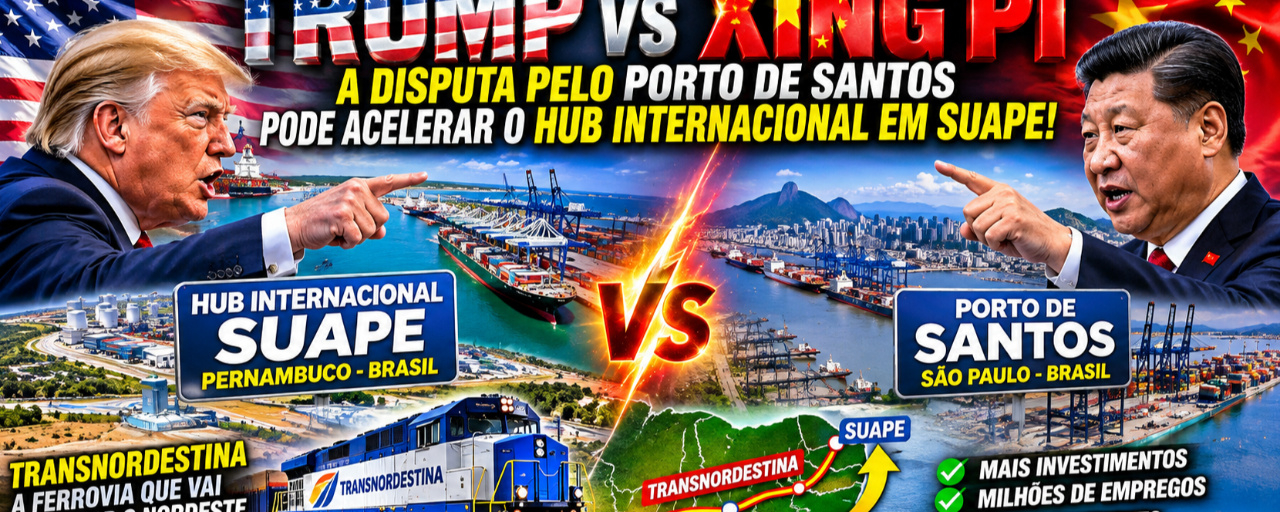

🌎 CHINA VS. THE UNITED STATES: THE DISPUTE OVER THE PORT OF SANTOS COULD ACCELERATE SUAPE'S TRANSFORMATION INTO AN INTERNATIONAL HUB!
The geopolitical rivalry between the world's two largest economic powers could open up a historic opportunity for Pernambuco. And the Transnordestina could be the key to transforming the Northeast into a logistics and industrial powerhouse.
Brazil is entering a new phase of strategic competition over its port infrastructure. The Port of Santos, Latin America's largest port complex, has become the focus of growing interest from Chinese companies and concerns voiced by U.S. representatives.
In January 2026, China Merchants Port and Cosco Shipping expressed interest in the Tecon Santos 10 megaterminal, a project involving approximately R$ 6.4 billion in investments.
The issue took on geopolitical significance when U.S. representatives voiced concern about the possibility of Chinese companies expanding their influence over infrastructure considered strategic to Brazilian trade.
The U.S. Council on Foreign Relations (CFR) also reported concerns expressed by the American consul in São Paulo about the competition for the terminal.
We are not talking just about a container terminal. We are talking about economic influence, trade routes, international investment, and strategic positioning on the South American continent.
And it is precisely in this context that Pernambuco could find a historic opportunity.
🇺🇸 1. COULD AMERICAN GOODS START USING SUAPE INSTEAD OF SANTOS?
Imagine a scenario in which American companies, amid uncertainty surrounding the geopolitical dispute over Santos, begin diversifying their logistics operations in Brazil.
One option would be to expand the use of the Port of Suape as a gateway for goods destined for the Northeast and other regions served by its logistics network.
This could happen in several ways:
1. American imports destined for the Northeast
Industrial products, technological equipment, machinery, electronic components, chemicals, and agricultural inputs could arrive directly at Suape, avoiding unnecessary trips to Santos and long return journeys by road to the Northeast.
2. New international maritime routes
Maritime transport operators could expand services between American ports and Suape, depending on cargo volumes, importer demand, and the commercial viability of the routes.
3. International distribution centers
American companies could establish warehousing and distribution centers in Pernambuco to serve northeastern markets, reducing transport costs and delivery times.
4. Transshipment operations
Suape could expand its role in container transshipment, receiving goods from large vessels and redistributing cargo by smaller ships to other ports.
5. Diversification of investment
American companies interested in reducing their exposure to a single logistics corridor could consider Suape as a complementary alternative.
It is important to note: this does not mean American goods would automatically stop using Santos. Any change would depend on final destinations, maritime contracts, port costs, and route availability.
The main goal would be to capture a growing share of international cargo traffic destined for the Northeast.
🚢 2. SUAPE COULD BECOME ONE OF THE SOUTH ATLANTIC'S MAJOR INTERNATIONAL HUBS
The Port of Suape is strategically located to connect Brazil's Northeast with markets in North America, Europe, Africa, and Asia.
And there is an important detail: Suape is already receiving concrete investment.
In June 2026, APM Terminals delivered its new container terminal in Pernambuco, with an investment of more than US$ 350 million.
The project:
Will have an initial capacity of up to 400,000 TEUs per year.
Could increase Suape's container capacity by approximately 55%.
Has fully electrified infrastructure.
Has the capacity to receive large vessels.
Strengthens connections with international markets.
A study associated with the project estimates the potential for R$ 4.8 billion in additional exports, R$ 4.9 billion in GDP impact, and more than 43,000 jobs in production chains related to foreign trade.
These figures are economic estimates, not direct jobs guaranteed by the terminal.
🚆 3. TRANSNORDESTINA: THE RAILWAY THAT COULD PUT SUAPE ON THE INTERNATIONAL STAGE
This is perhaps the most important point of this entire project.
There is little point in building a major port terminal if there is no efficient infrastructure to transport goods from inland areas to the coast and distribute imported products to different regions.
This is exactly where the Transnordestina Railway comes in.
The connection between Salgueiro and Suape could link the port to important producing regions in Pernambuco and neighboring states.
The railway could transport:
Grain from Matopiba.
Gypsum from the Araripe gypsum-producing hub.
Ores.
Agricultural products.
Fertilizers.
Fuels.
Steel products.
Containers and imported goods.
Its distinguishing feature will be two-way logistics.
In the inland-to-coast direction, trains could carry grain, ores, gypsum, and industrial products to Suape, enabling exports and transshipment operations.
In the coast-to-inland direction, they could carry imported fertilizers, fuels, machinery, industrial components, and consumer goods to supply Pernambuco and other northeastern markets.
This would reduce empty trips, improve railway utilization, and increase the competitiveness of the goods being transported.
A study presented by Sudene to the Federal Court of Accounts in July 2026 estimated the potential for moving between 18 million and 24 million tonnes a year along the Salgueiro–Suape section, taking different economic sectors into account.
The study also estimated approximately 13,000 jobs during construction and 9,600 jobs in operations and related activities.
However, there is an obstacle: the section in Pernambuco still faces questions about its feasibility and funding. On November 4, 2026, the Federal Court of Accounts once again postponed its ruling on the case, maintaining the restriction on new federal transfers until the necessary analyses are complete.
Therefore, completing the Transnordestina to Suape is a strategic goal that still needs to be made viable.
🏭 4. THE NORTHEAST COULD BECOME A MAJOR INDUSTRIAL HUB
Imagine combining an international port, a regional integration railway, distribution centers, and a major industrial zone.
American, Chinese, European, and Brazilian companies could establish factories and logistics centers near the port complex.
This would open up opportunities in several sectors:
Automotive industry.
Technology and electronic components.
Industrial equipment.
Fertilizers and chemicals.
Shipbuilding industry.
Renewable energy.
Storage and distribution of goods.
Processing of agricultural products.
The result would be an economic transformation extending beyond Pernambuco.
Ceará, Paraíba, Rio Grande do Norte, Alagoas, Piauí, Maranhão, and Bahia could benefit from a more integrated logistics network.
The Northeast would no longer be seen merely as a destination for goods and would take on a more important role in international production, distribution, and exports.
💰 5. WHAT COULD THIS MEAN FOR THE NORTHEAST'S ECONOMY?
The expansion of Suape, combined with the Transnordestina, could create a development cycle:
More port activity.
More international companies.
More industrial investment.
Greater demand for rail and road transport.
Expansion of distribution centers.
Growth in exports.
Creation of direct and indirect jobs.
Increased tax revenue and regional economic activity.
The long-term goal could be to develop an economic corridor capable of creating hundreds of thousands of job opportunities and, with several additional industrial and logistics projects, reach a scale of millions of jobs over the course of decades.
This would not be the result of a single terminal, but of a structural transformation of the entire regional economy.
🇧🇷 6. BRAZIL DOES NOT HAVE TO CHOOSE BETWEEN CHINA AND THE UNITED STATES
Brazil has an important opportunity: to leverage international competition to attract investment from different countries.
Brazilian port infrastructure should operate under transparent rules, with legal certainty, competition, and protection of national interests.
Suape could receive investment from the United States, China, Europe, and Asia without relying exclusively on a single economic power.
While Santos continues to play its vital role in Brazilian trade, Suape can establish a complementary strategic position, particularly in serving the Northeast and on international routes.
CONCLUSION: SUAPE COULD BE THE NEXT MAJOR CHAPTER IN BRAZILIAN DEVELOPMENT!
The competition for Tecon Santos 10 shows how Brazilian ports have come to occupy an important place in international geopolitical discussions.
But Pernambuco has an opportunity of its own.
With APM Terminals' new terminal, the modernization of port infrastructure, industrial expansion, and completion of the Transnordestina, Suape could establish a much more significant position in international trade.
The railway will be essential to transforming the port into a distribution platform connecting the coast with the interior of the Northeast.
The question Brazil needs to ask now is: are we ready to turn Suape into one of the South Atlantic's largest logistics and industrial corridors?
The competition between China and the United States could change investment strategies and accelerate the search for logistics alternatives. If Pernambuco can turn this opportunity into infrastructure, legal certainty, and productive investment, the Northeast could experience one of the greatest economic transformations in its history.
SUAPE DOES NOT NEED TO REPLACE SANTOS TO BECOME A GIANT. IT NEEDS TO CLAIM ITS PLACE IN GLOBAL TRADE.
#Suape #Transnordestina #Pernambuco #Northeast #PortOfSantos #China #UnitedStates #Logistics #Infrastructure #EconomicDevelopment