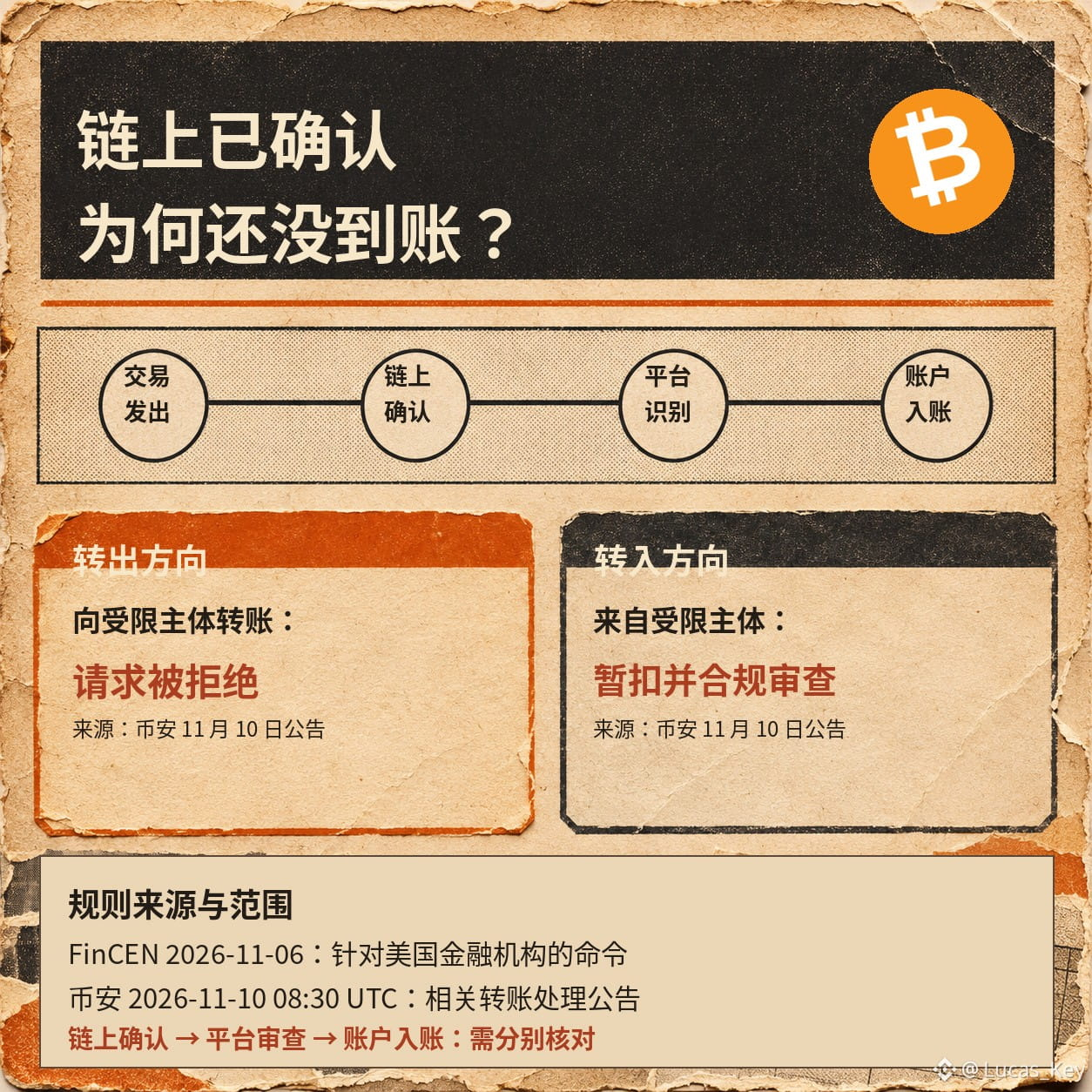
Tonight, what’s worth watching isn’t which chain is faster, but who decides whether funds are credited. $BTC An on-chain confirmation does not mean an exchange will necessarily credit the assets to your account. In an announcement on November 10, Binance said that transfer requests sent to entities associated with MEXC, which was designated by the US FinCEN, would be rejected; deposits received from those entities would be temporarily held and subject to compliance review.
This can easily be read in two opposing ways. One view is that once an on-chain transfer is confirmed, the platform should credit it automatically; the other is that custodial platforms have separate obligations to identify counterparties and update account ledgers. Technically, the latter explains the difference we’re seeing: on-chain confirmations for $ETH on Ethereum and $BNB on BNB Smart Chain are separate processes from updating an internal platform balance. BTC UTXO records likewise only prove the on-chain status and cannot guarantee that the platform will release the funds. The restrictions target the relevant platforms and transfer routes; they do not mean these three coins themselves have been delisted or had trading suspended.
One more distinction matters: FinCEN’s November 6 order applies to US financial institutions, while Binance’s November 10 announcement describes its own rules for handling related transfers. Their scopes cannot be treated as equivalent. I’m more interested in whether the platform will later publish updates on the review process and how affected deposits will be handled. Before transferring, verify the counterparty and check the platform’s latest announcements. Don’t treat on-chain success as proof that funds have been finally credited. Risk warning: cross-platform transfers may be delayed, rejected, or reviewed. Do not use unverified routes to circumvent restrictions.