
Friends, I've been keeping an eye on Anthropic's IPO lately, and honestly, I have mixed feelings about it.
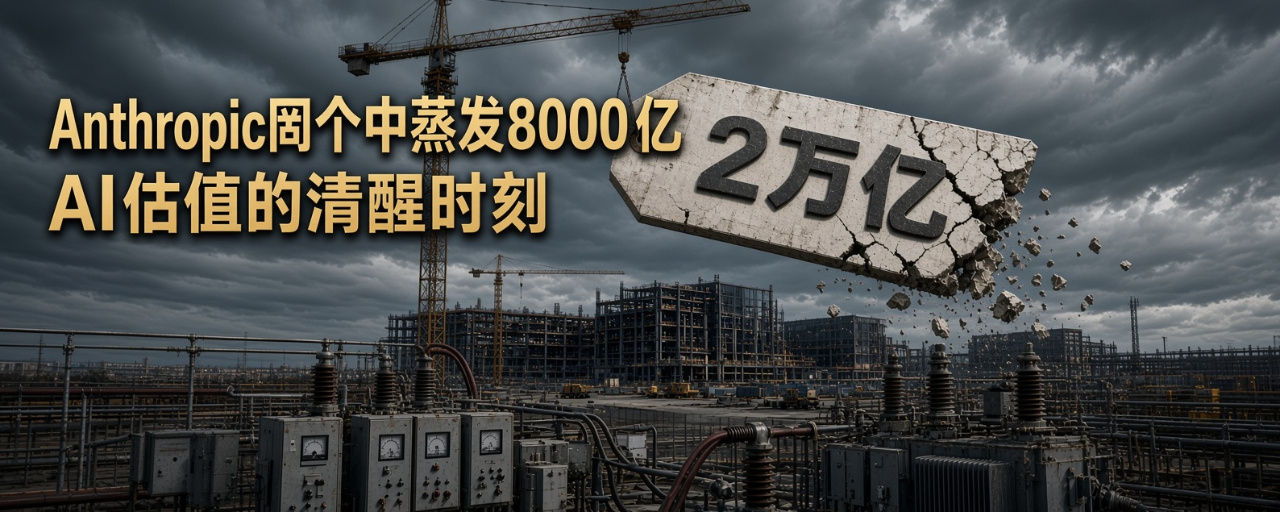
The market had originally given it a valuation close to $2 trillion, and it was almost wearing the crown of the biggest IPO in history. But in just a few weeks, the range potential investors were discussing had dropped to around $1.2 trillion to $1.3 trillion. Do the math, and almost exactly $800 billion has disappeared.
This isn't just an ordinary swing in sentiment. The market is using real money to tell everyone: it's time to cool down the AI frenzy.
I've always felt that the $2 trillion figure carries a kind of “faith premium” all on its own. Anthropic's Claude is genuinely powerful, and its revenue explosion is real too: over $10 billion in the first half of the year, with Q3 set to climb even higher. But to justify $2 trillion, you need a lasting myth of high growth—and a market willing to ignore the cost structure indefinitely. Now the myth is starting to lose steam. Q3 quarter-over-quarter growth fell from doubling to just over 40%, and investors immediately came to their senses.
What really stings is that compute bill.
The prospectus includes long-term compute commitments running into the hundreds of billions—$600–700 billion, and even close to $900 billion. Many contracts say, “You pay whether you use it or not.” That amounts to betting short-term, volatile token revenue against ultra-long-term, fixed costs. No matter how much cash is on the books, it’s hard to fully hedge this kind of structural risk. To some extent, the $800 billion wiped off the market cap is a discount on that future bill.
This is just my personal take: over the past two years, AI company valuations have been far too driven by narratives. Whoever could tell the bigger story and sign more compute contracts got the higher multiple. Now power supply constraints, hurdles in data center construction, and intensifying competition are pulling those narratives back down to earth. Anthropic is just the first major player to be thrust into the spotlight.
That doesn’t mean Anthropic isn’t doing well. Its technical strength, safety positioning, and sticky enterprise customers are still competitive advantages. Improved margins and positive cash flow also show that its unit economics are getting better. But the capital markets are no longer willing to pay for “assumptions of unlimited growth.”
From a value investor’s perspective, this isn’t actually a bad thing.
Having some of the bubble deflate may bring valuations closer to reality. If the models continue to lead, compute utilization improves, and pressure from fulfilling contracts remains manageable, the $1.2–1.3 trillion range may not be the bottom. Conversely, if growth continues to slow, or power and delivery issues worsen, the market will keep voting with its feet.
AI is still one of the biggest long-term structural opportunities, and I haven’t changed my mind about that. But opportunity and valuation are two different things. From here on, people need to pay closer attention to actual profit margins, cash flow quality, and the risks of long-term contracts—not just ARR and the story.
$ANTHROPIC This valuation pullback is like a wake-up call for the entire AI sector: no matter how compelling the story, it ultimately comes down to the power meter and the bill.
Let’s keep an eye on the roadshow and the final pricing. The real test is only just beginning.#Anthropic拒绝延期IPO,本周路演估值几何?