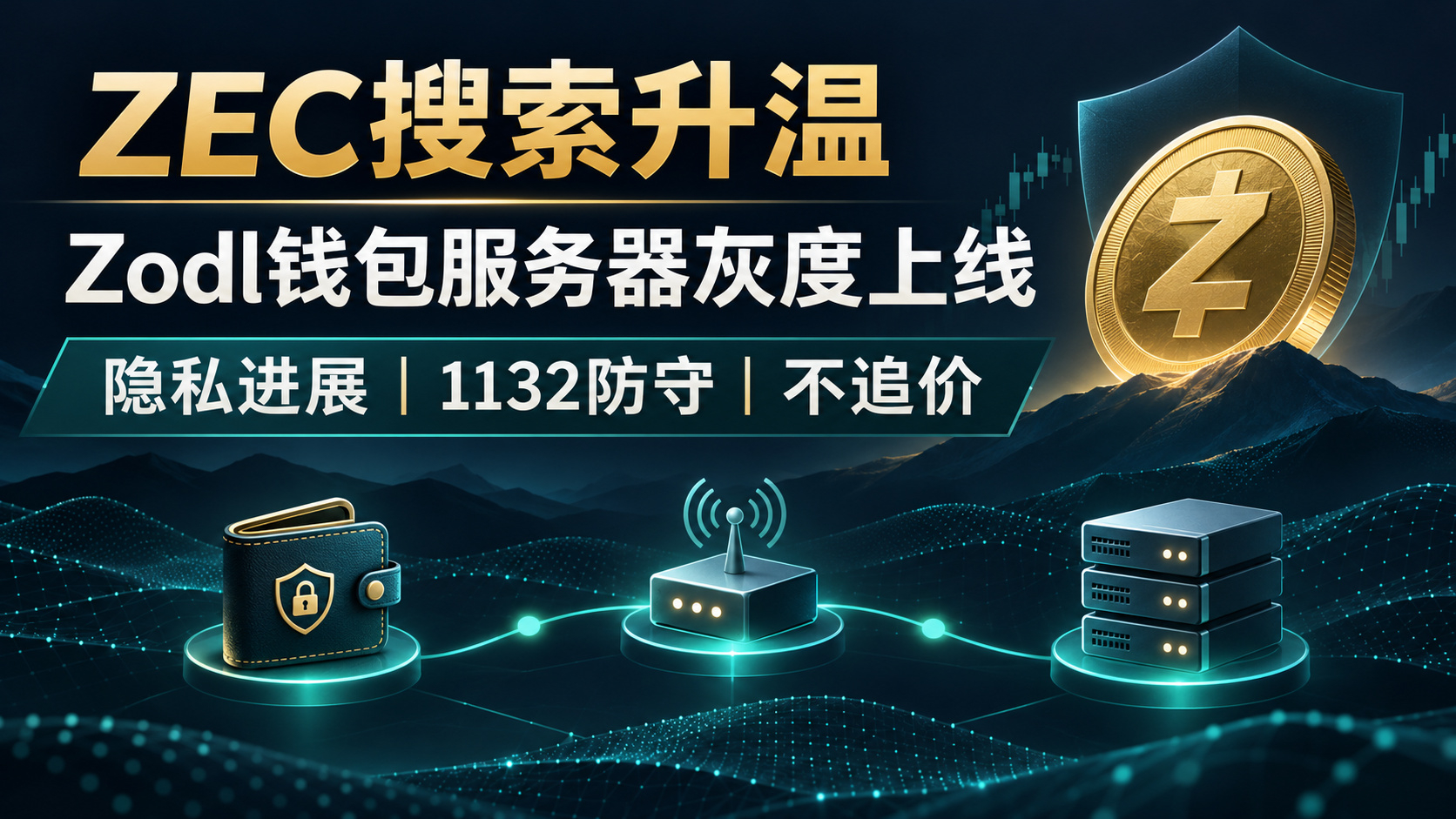
ZEC searches heat up | Zodl wallet servers begin shifting gears | Privacy progress depends on real-world rollout—not chasing a rally
My stance is cautiously positive, but I’m not adding to my position just because of the words “privacy upgrade.” Binance Square’s Most Searched list named ZEC a Rapid Riser over the past six hours, indicating growing interest; there are also tangible project updates worth following. On November 9, the Zcash Open Development Lab announced that it had begun gradually rolling out its own lightweight wallet servers, paired with relays from Cloudflare and Fastly. OHTTP is used to separate wallet request contents from users’ original IP addresses. The initial rollout starts with the Android and iOS versions of Zodl 3.20.0 and will expand gradually this week; the F-Droid and GitHub versions will follow. This is a phased rollout of wallet infrastructure—not an upgrade to the network-wide protocol, and certainly not a guarantee that all ZEC wallets automatically receive the same protection.
In the previous setup, when a lightweight wallet connected to a server to sync blocks or query data, a single server operator might be able to see both the connection IP and request details. In the new design, the relay can see the IP but not the encrypted request; the Zodl server processes the request but does not directly see the original IP. This reduces default metadata exposure, which matters for the real-world user experience of a privacy coin. However, discussions on the official forum have also pointed out the limitations: the relay can still see the IP, and the risk of linking information is not eliminated if the parties collude or are subject to legal process. Zodl explicitly said that OHTTP is not a replacement for Tor, and that Tor can still be used on top of it. I care more about the mobile rollout’s stability, whether users actually update, the ability to switch servers, and progress toward independent operation than about turning a single announcement directly into token buying pressure.
The market has already given a mixed response. At the time of writing, ZEC/USDT on Binance is around $1,146, still down about 5.3% over 24 hours. It has retreated from an intraday high of around $1,236, with a low near $1,132. Rising search interest alongside a falling price is enough to remind me that attention does not equal buying support. The $1,132 level is an intraday line to watch for support; to the upside, the first levels to watch are around $1,165, $1,185, and $1,200. These are conditional price levels only. The US October CPI report is due at 21:30 Beijing time tonight, and changes in overall risk appetite driven by interest-rate expectations may outweigh project news. If ZEC continues to underperform the broader market after the data, or a clear issue emerges during the wallet’s phased rollout, I’ll need to withdraw my cautiously positive view.
If I were trading this myself: I wouldn’t chase the price now. I’d only consider a conditional spot long, with a maximum of 3% of total capital. I’d wait until at least one round of sharp volatility has passed after the CPI release, then consider entering only if ZEC regains and holds $1,165, pulls back without losing $1,150, and BTC has not also broken below its intraday low at that time. If all these conditions aren’t met, I stay out. I’d sell half at $1,185 and reduce the rest near $1,200; a break below $1,128 means an unconditional stop-loss and full exit. If the price first breaks below $1,132 and then rebounds weakly, I’d cancel the entire long setup rather than use the “privacy narrative” to excuse a failed price structure. Even if I enter, I won’t use leverage, claim that the phased rollout has already been a complete success, or count a plan that hasn’t been triggered as a profit.
#ZEC
The above is solely my personal market observation and does not constitute investment advice.