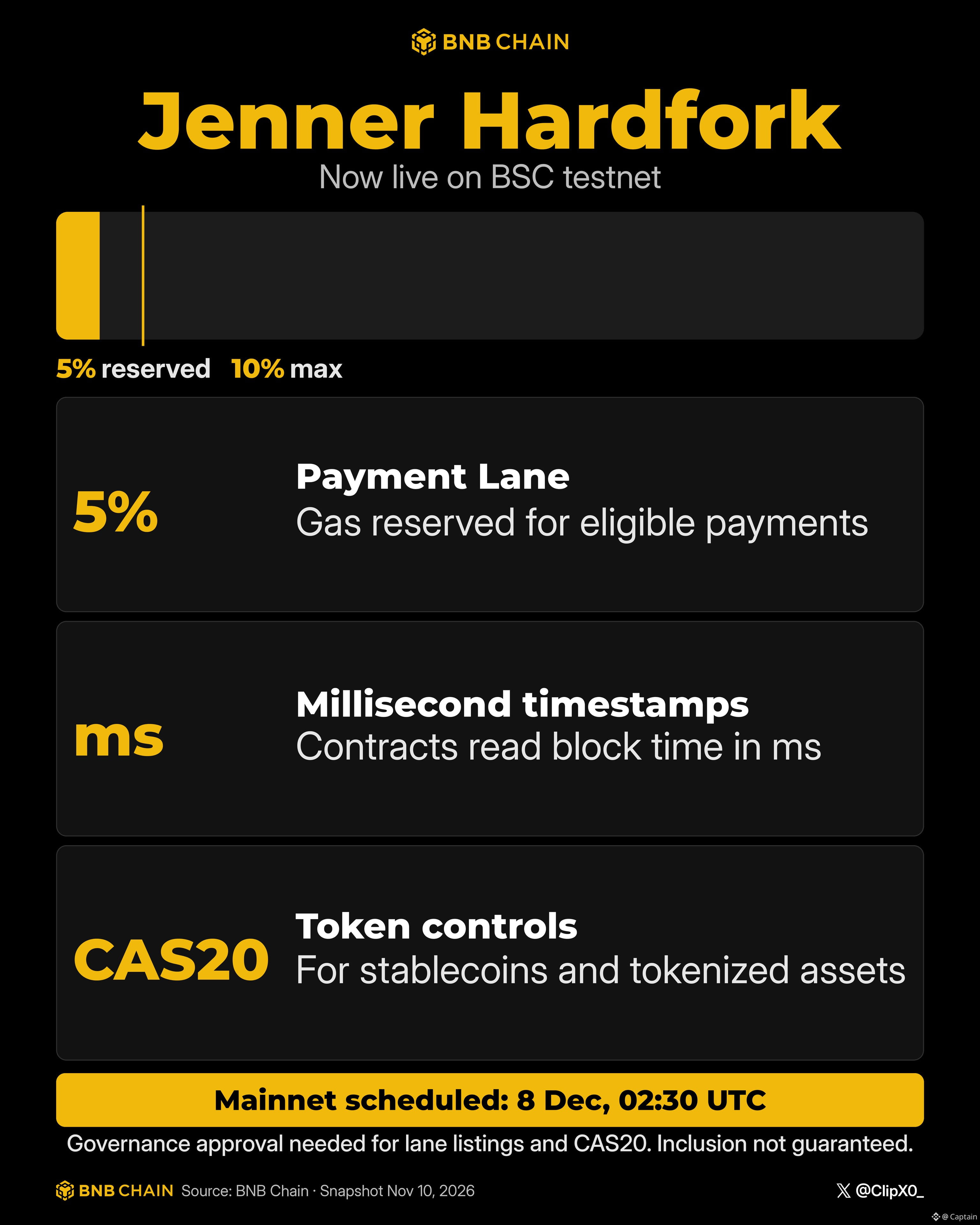
Jenner is the next BSC upgrade, with three changes for payments, timing and tokens. It's been live on testnet since Oct 29, and mainnet is scheduled for Dec 8, 2026, 02:30 UTC, so it isn't on mainnet yet.
• Payment Lane: 5% of each block's gas is reserved for payments as a group, and other transactions can't use that slice. When blocks get busy, payments still have reserved room. It covers payments as a group, not any single payment, and fees and ordering don't change.
• What qualifies: nonzero $BNB transfers to wallets with no code. Token and stablecoin payments qualify only after governance lists their contracts, and that list starts empty. Governance can raise the share to 10% max.
• Millisecond timestamps: contracts can read block time in milliseconds via a precompile at 0x70, while block.timestamp still returns seconds. Apps that depend on timing, like quote expiry or auction cutoffs, get a finer clock. Blocks are not any faster.
• CAS20: a token standard built into the protocol, with allowlists, blocklists, pausing and separate mint, burn and seizure roles, and it stays BEP-20 compatible. Issuers of stablecoins and tokenized assets get these controls built in, and wallets that already support BEP-20 can work with them. Token creation opens only after governance appoints an admin, and the controls alone don't make a token legally compliant.
Which of the three matters most for what you're building?