ZEC at $1,145—Did the NU7 upgrade bait you into a fake-out?
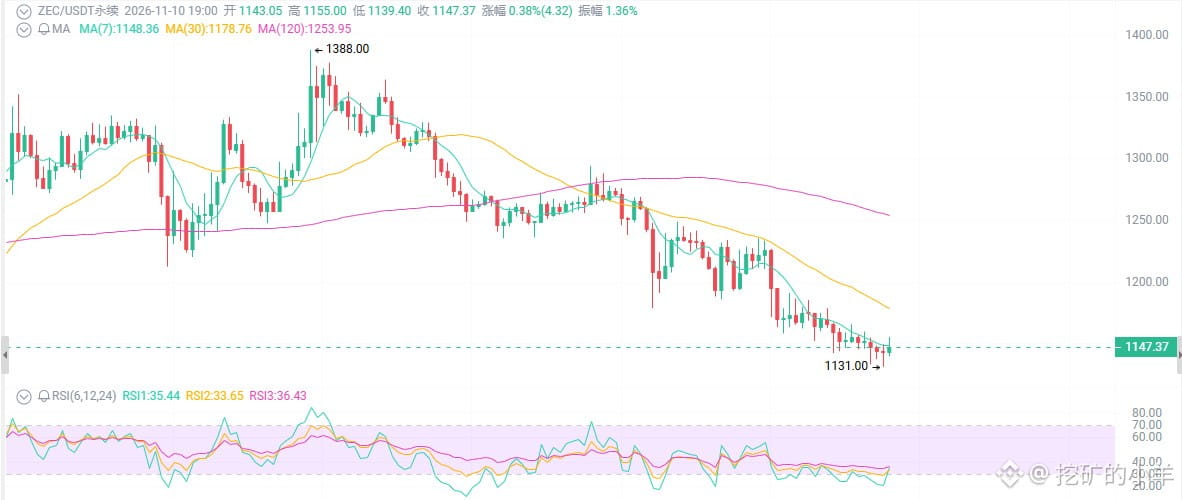
The NU7 upgrade is live. Block times have been slashed from 75 seconds to 25, and the whole market is shouting, “The king of privacy is back.” So what happened? ZEC plunged from $1,380 to $1,145, down another 5% in 24 hours, with bulls getting wiped out left and right. Where’s the promised rally on good news? Was this a whale dump disguised as an upgrade, or the harshest shakeout of the bull market?
First, the obvious: the good news came out, and the price turned against it.
The NU7 mainnet activated on November 5–6, cutting block times by two-thirds and launching a fee-recovery mechanism. Developers have even proposed cutting block times further to 20 seconds. It all sounds like a series of big wins. Then ZEC retraced all the way from $1,350–$1,380 to $1,145. The good news is here, but the price isn’t—that’s the crypto market’s classic playbook for taking traders to the cleaners.
First point: the upgrade is real, and so is the sell-off.
NU7 isn’t empty hype. Block times are down to 25 seconds, the Network Sustainability Mechanism recovers 60% of fees, and the old Sprout pool is being cleared out. The technology has been implemented, and the network is running normally.
But how did the market move? ZEC climbed to $1,380 before the upgrade, then fell back to $1,145 afterward.
Think the upgrade didn’t work? Wrong. Smart money had already positioned itself before the upgrade. On launch day, they sold their holdings to you—the traders who bought in after seeing the news.
That’s what “sell the news” means. Good news isn’t for chasing; it’s for selling into.
Second point: bulls are getting liquidated, open interest is at $2.5 billion—who’s bleeding whom?
The 24-hour low was $1,130–$1,135, and the high was $1,230–$1,235, with long liquidations dominating. Open interest is still sitting at $2.5 billion, and perpetual futures volume is in the tens of billions. Leveraged bulls have just been through a bloodbath.
But take note—this doesn’t mean ZEC is finished. Quite the opposite: liquidations are a shakeout, not a collapse. What’s being flushed out is the leveraged money that chased the rally; what remains is true conviction.
The daily RSI is at 40–45, neutral to weak, but nowhere near extremely oversold. The price is below the 20-day and 50-day moving averages, but still well above the 200-day average—the long-term trend remains intact.
The short term has taken a hit; the medium term is still standing.
Third point: Is $1,130–$1,145 support—or a trap?
The price is currently stuck around $1,130–$1,145, near the intraday low and a psychological level. Below that, $1,100–$1,120 is a previous consolidation zone, while $1,050–$1,080 offers stronger support.
Above: $1,180–$1,200 is the recent rebound high, followed by $1,230–$1,250, then the previous highs at $1,300–$1,350.
Hold $1,130 and rebound on strong volume → recovery to $1,200+, with a possible retest of $1,250.
Break below $1,100 → look for support at $1,050; the shakeout will go deeper.