
Inside #Binance’s Historic Recovery Effort
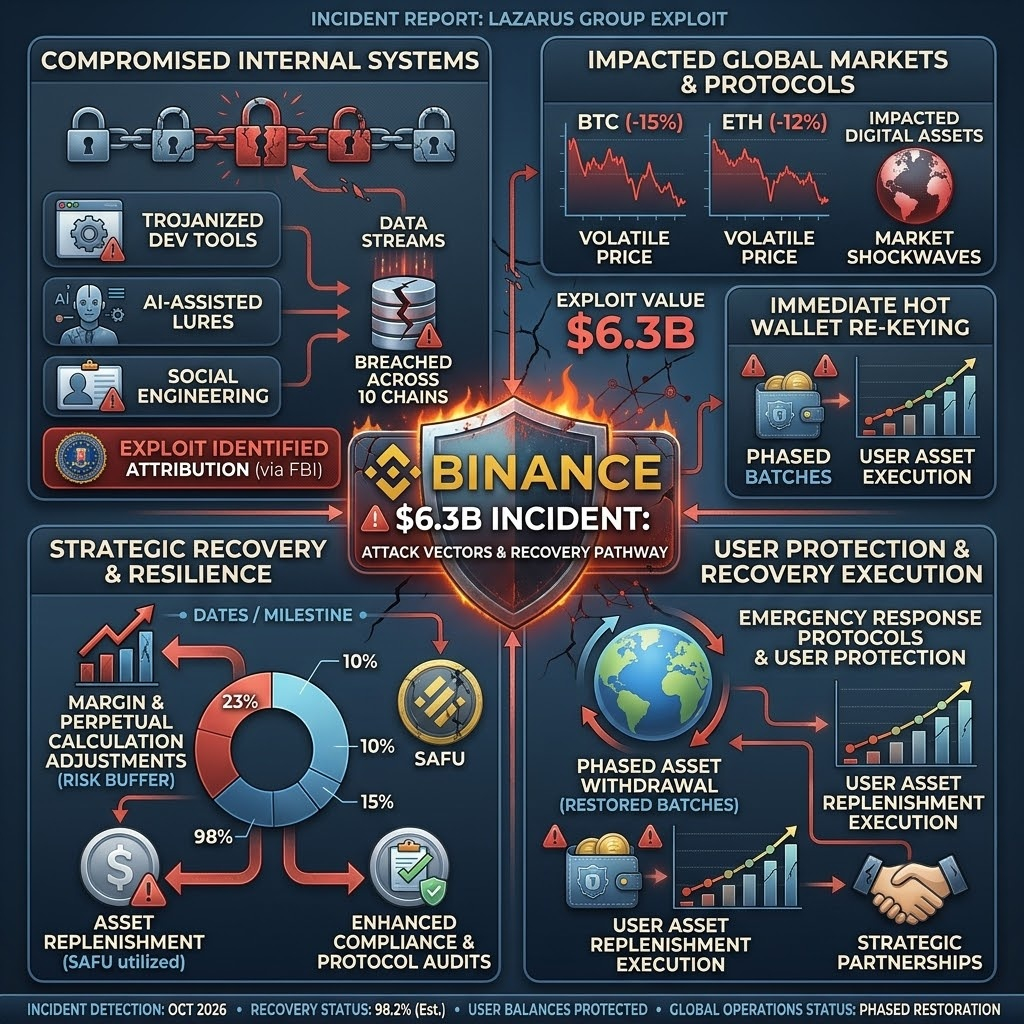
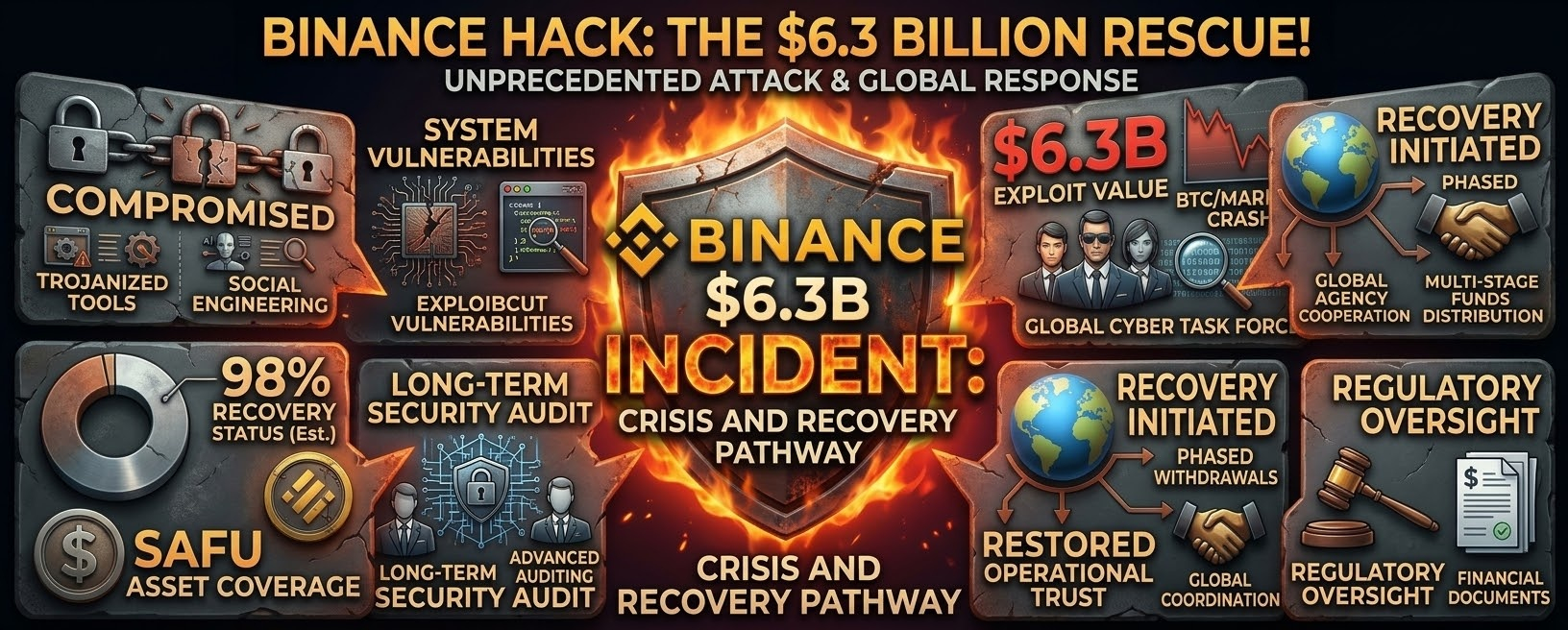
The global cryptocurrency ecosystem recently experienced one of its most pivotal moments to date. In late October 2026, #BİNANCE —the world’s largest digital asset exchange—was targeted in a sophisticated cyberattack resulting in an unprecedented $6.3 billion exploit.
Investigative disclosures from the Federal Bureau of Investigation (FBI) linked the incident to TraderTraitor, a high-profile threat actor operating under North Korea’s Lazarus Group. Using trojanized developer tools, AI-assisted recruitment lures, and targeted social engineering, the attackers breached internal systems across ten blockchains.
While the event sent shockwaves across major digital assets like $BTC and $ETH the aftermath has put Binance’s operational resilience, asset reserves, and multi-chain infrastructure to a direct stress test.
🛠️Technical Vectors: How the Breach Unfolded
Between 8:05 PM and 11:56 PM UTC on October 29, 2026, malicious actors initiated multi-chain transfers across networks including the $XRP Ledger, Ethereum Avalanche, Polygon, and Solana.
Security teams and stablecoin issuers reacted within hours. Tether (USDT) and Circle (USDC) froze suspicious wallet addresses, locking approximately $2.7 billion to $3.0 billion in stablecoins before they could be laundered through decentralized finance (DeFi) protocols and instant swap services.
💪Token Restorations & Phased Asset Withdrawals
In the days following the event, #Binance implemented a phased rollout to restore full functionality while conducting comprehensive protocol audits. According to official exchange updates, over 98% of stolen tokens were replenished to maintain 1:1 user balance backing.
🪙Major Restored Chains & Featured Tokens
Ethereum (ETH): Restored access for key ecosystem tokens including AAVE, Uniswap (UNI), Pax Gold (PAXG), Lido DAO (LDO), Maker/Sky, Render (RNDR), The Graph (GRT), and FLOKI.
BNB Smart Chain (BSC):
Enabled withdrawals for Filecoin (FIL), Trust Wallet Token (TWT), Injective (INJ), IOTA, and DeXe.
Base & Layer-2 Networks:
Re-established liquidity routes across Base (including Aerodrome [AERO] and Morpho), Arbitrum (ARB), and Optimism (OP).
Alternative Layer-1s:
Phased restoration for Tron (TRX), Sui (SUI), Aptos (APT), Near Protocol (NEAR), and Litecoin (LTC).
Structural Security Adjustments
To mitigate future exposure and restore market stability, #Binance introduced several operational and risk-engine changes:
1. Hot Wallet Architecture:
Access controls for multi-signature hot wallets were fully revoked and re-keyed, reducing single-point-of-failure vulnerabilities in key management systems.
2. Margin & Perpetual Derivatives Tuning: Margin calculation parameters were adjusted across select USDⓈ-M perpetual contracts (such as ending Last Price Protected periods) to buffer against artificial liquidation spikes during high-volatility events.
3. Phased Network Restorations:
Deposits remain fully operational, while withdrawals continue to process through automated security checks to handle post-reopening traffic spikes gracefully.
Market Sentiment & Moving Forward
Although market benchmark prices—including Bitcoin dipping temporarily below $80,000 during the initial event—reflected brief nervousness, the rapid freezing of stolen stablecoins and transparent balance coverage helped prevent broader contagion.
As global regulatory and intelligence agencies step up coordination against state-backed threat groups, the incident highlights the critical importance of institutional-grade custody, rapid on-chain asset freezing capabilities, and robust emergency reserve funds across the digital asset industry.