

On November 8, Ethereum co-founder Vitalik Buterin posted on X, shifting the focus of ETH’s narrative from “burning tokens through transaction fees” to “a store of value.” He wrote explicitly: “But the problem is: this so-called floor was never a solid, real support.” Even if the burn rate remains below 10% of the breakeven point over the long term, “we don’t need to feel disappointed; ETH derives its value from elsewhere.”
The Block put the quote in its headline: “Vitalik Buterin says ETH should be valued as a store of value, not a fee-burning token.”
This is a public revision of the “ultrasound money” narrative that has been around since 2021. But the data shows that the narrative is far from the only thing that needs revising.
The collapse in burning preceded the narrative correction
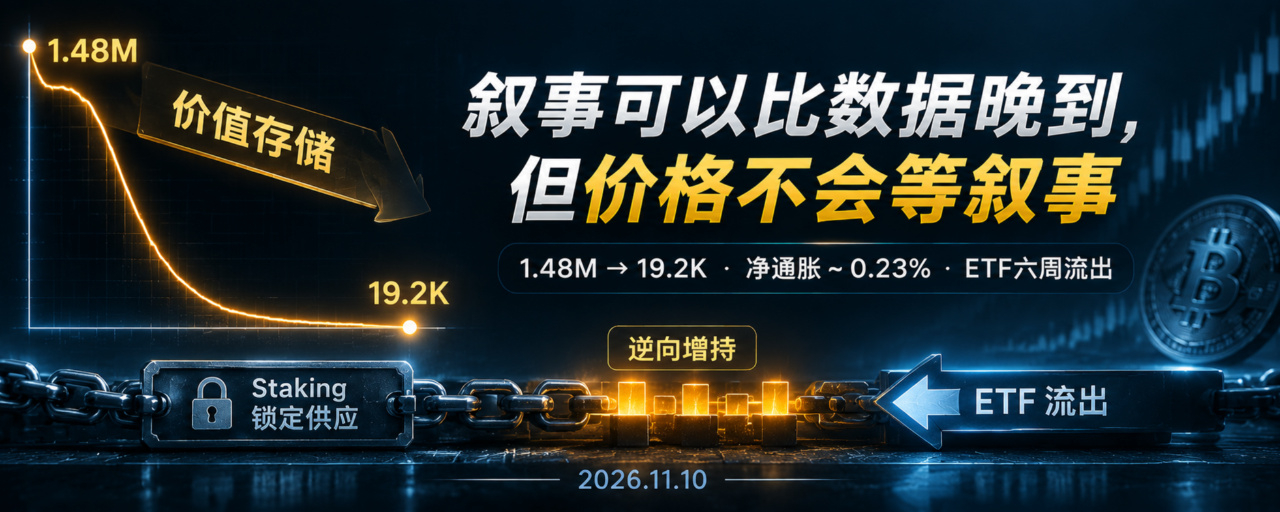
In 2022, Ethereum burned a total of about 1.48 million ETH, worth approximately $3.6 billion. By early November 2026, the amount burned was only about 19,200 ETH, worth around $43 million. By token count, that’s a drop of more than 98.7%—a difference approaching two orders of magnitude.
The start of the collapse can be traced to March 2024. The Dencun upgrade introduced EIP-4844, giving Layer 2 networks a dedicated, ultra-low-cost data channel (blobs). Activity continued migrating to rollups, and the amount of base-layer fees burned fell sharply as a result. On-chain records show that daily burns once peaked at 8,844 ETH in 2021; by 2026, they had fallen to around 57 ETH a day, far below the current issuance rate.
Scaling succeeded; burning failed. Both happened in the same upgrade, but the market celebrated only the former.
Net inflation didn’t start this year, nor did it suddenly spike in any single month. ETH supply grew by about 0.18% in 2025, and the inflation rate was about 0.23% in 2026. Since the Dencun upgrade, ETH has remained in a state of mild net inflation. Vitalik’s narrative correction came nearly two years after the supply curve had already been trending upward.
The questions “store of value” must answer are harder than those facing the burn model
Vitalik’s case for “store of value” rests on decentralization, censorship resistance, privacy, and stability. He wrote: “In an era of disruptive change brought by AI, stability will become a highly valued trait.”
But the burn model and the store-of-value narrative face the same question: where does net demand for ETH come from?
The burn model’s logic is: “Network usage generates fees, and burning those fees reduces supply.” The store-of-value narrative’s logic is: “The network is trustworthy, so ETH is worth holding for the long term.” The former can be disproven by data—and it has been. The latter is harder to disprove, but also harder to verify. In his post, Vitalik broke down the valuation model for burn-based tokens: market cap equals annual burns divided by the discount rate. If $1 billion is burned each year and the discount rate is 4%, the theoretical valuation floor is $25 billion. But he noted that much of the ETH burned between 2021 and 2023 came from demand within the crypto ecosystem. “This valuation-floor logic only holds if the demand generating fee revenue comes from the real world.”
Infrastructure being used doesn’t mean ETH is being bought on a net basis. Stablecoin transfers and RWA activity on Ethereum mainnet are still growing, but the gas fees these activities require represent a different kind of demand from “holding ETH as an asset.”
Staking locks up supply, ETFs are draining demand, but whales are buying against the trend
As of November 10, about 36.32% of the total ETH supply was staked, up around 4.32% since May. A large amount of the circulating supply is locked in validator nodes, which does reduce the freely circulating supply. But staking doesn’t create external demand denominated in ETH: stakers earn rewards denominated in ETH, and those rewards are themselves part of new issuance. A rising staking ratio locks up the liquidity of existing tokens; it doesn’t bring in external capital.
Institutional data points in the opposite direction. U.S. spot Ethereum ETFs have seen net outflows for six consecutive weeks, including $365.3 million in net outflows last week alone. On November 4, daily outflows reached $85.3 million, with $74.4 million coming from BlackRock’s ETHA alone. Glassnode had previously recorded net outflows for 23 consecutive trading days, the longest streak since the products launched.
But the same data source added a detail worth noting: during the ETF outflows, some large addresses were buying or withdrawing ETH. This isn’t a one-way story of “institutions fleeing across the board.” ETFs are regulated investment vehicles, and their outflows reflect a decline in funds allocating to ETH through this particular channel. The actions of large on-chain holders may point to a different rationale. Both can be true at once, but they aren’t the same thing.
Staking is locking up supply, ETFs are draining some demand, but large on-chain holders are stepping in from another angle. The narrative correction happened to land right in the window when these three forces were moving in different directions.
The timing of the narrative correction is itself informative
Vitalik publicly changed course nearly two years after the collapse in burn data, and that timing is worth noting. If the valuation logic behind “ultrasound money” had effectively failed after the Dencun upgrade in 2024, the narrative correction came about two years late.
The reason for the delay isn’t hard to guess: admitting that the burn mechanism had failed would mean admitting that one of ETH’s strongest valuation anchors over the past five years no longer held. But the collapse in the data didn’t stop just because the narrative correction was delayed. By the time the narrative changed, annual burns had already fallen from 1.48 million tokens to fewer than 20,000, and net inflation was already reflected in the supply curve.
Whether “store of value” is a better narrative than “fee burning” depends on a question that remains unanswered: can ETH become indispensable capital for on-chain financial activity, rather than merely fuel bought on demand when using the network? The staking ratio and infrastructure usage offer some supporting evidence. The coexistence of ETF outflows and whale accumulation suggests that, at least for now, different types of capital have yet to reach the same conclusion.
Disclaimer: This content is for informational purposes only. Please do your own research.