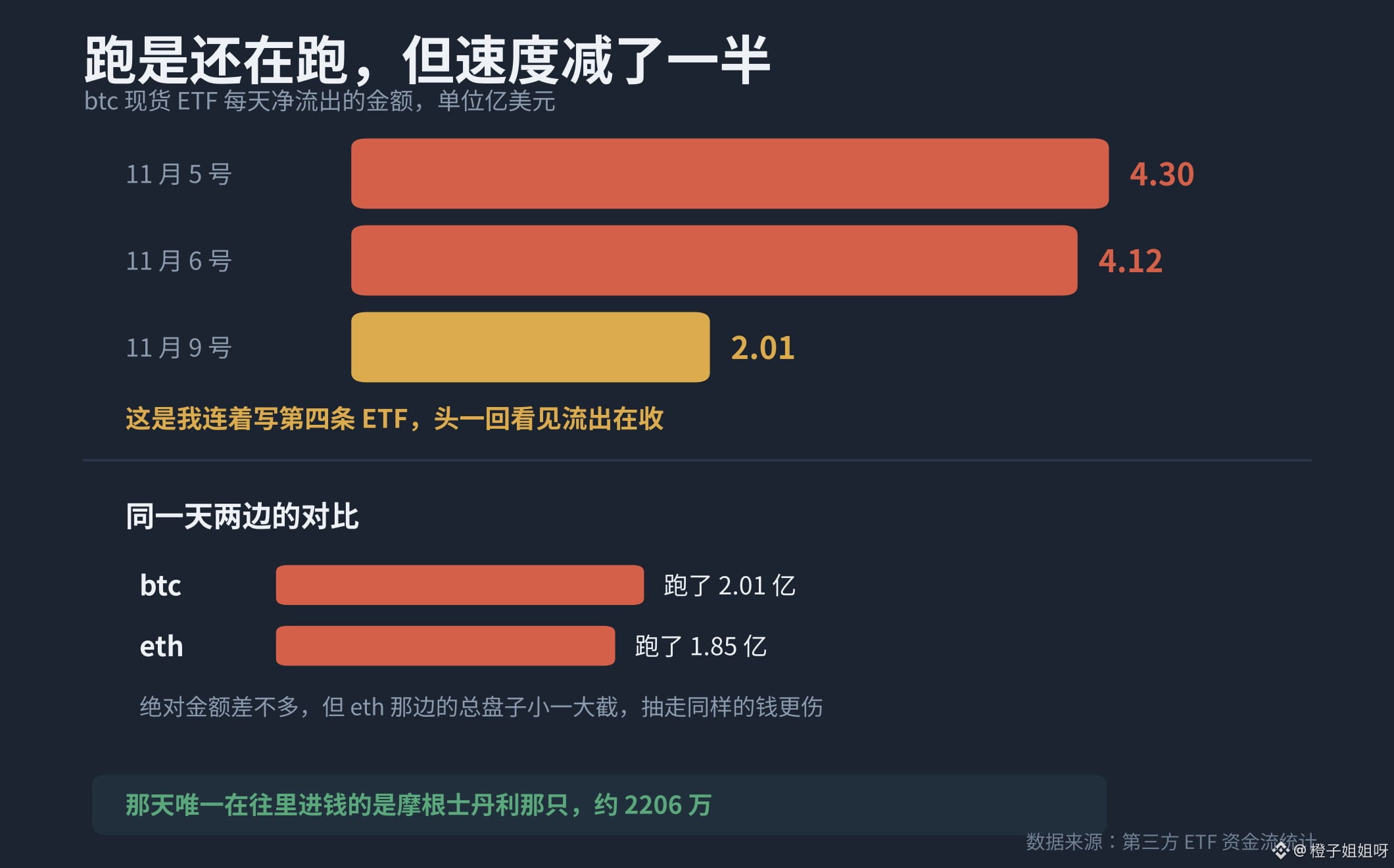
First, let’s get the figures straight. The $201 million flowed out on November 9 alone—it’s not $200 million over three days combined. “The third consecutive day” refers to the number of days, not the amount.
But there’s one change here worth calling out separately: the outflow is slowing down. $430 million flowed out on November 5, $412 million on the 6th, and just $201 million on the 9th. The daily amount was cut in half.
This is my fourth post in a row about ETFs, and this is the first time I’ve seen outflows ease.
Don’t rush to call it a reversal, though. Outflows cut in half are still outflows. It only means the selling pressure is easing—not that anyone is buying the dip.
ETH saw $185 million flow out the same day, about the same as BTC’s $201 million. But ETH’s overall market is much smaller than BTC’s, so pulling out the same amount of money hurts it more. Yesterday, I wrote that ETH was continuing to lose ground to Bitcoin, and these figures add another data point.
There’s another small detail I found interesting. The only one to see money flow in that day was Morgan Stanley’s fund, at around $22.06 million. While everyone else was heading for the exits, someone was buying against the trend. The amount wasn’t big, but the direction was different.
Here’s what I’d count as a bottom: either outflows keep shrinking over the next few days, or they turn into net inflows. A one-day halving doesn’t count. We saw a rebound like that last Friday, only for it to get wiped out the next day.
BTC is at 74,774 now, and the 50-week moving average is 75,535. Yesterday, I calculated that the break-even price for the company with the largest BTC holdings was 75,451—almost right on top of the moving average. Both levels are hanging overhead now.
CPI comes out tonight at 9:30.
The supermarket downstairs is running a promotion, and the loudspeaker has been playing on a loop all afternoon. #比特币现货ETF连续三日净流出2点01亿美元