

Author: rektdiomedes
Translated by: Foresight News TechFlow
Foresight News introduction: Since the Fed began raising interest rates in 2022 and Luna and FTX collapsed one after another, the crypto industry has turned toward cash flow and “real yield” amid concerns about survival, even valuing Ethereum using traditional price-to-earnings ratios. With Vitalik recently reiterating that $ETH should stand by its core narratives of decentralization and “store of value,” the market is beginning to reassess the potential that pessimism had obscured.
In practical terms, the author examines $fxUSD, a decentralized stablecoin built by Aladdin DAO, and evaluates its censorship resistance, zero-cost private transfers, and zero-interest leverage architecture against the five CROPS principles. Looking ahead to an era of high-frequency trading by AI agents, the article explores what kind of market-cap scale Ethereum and decentralized stablecoins may ultimately represent.

Two posts over the past few days really struck me and left me deep in thought.
The first was a post from Vitalik about $ETH, explaining why the market should further embrace and strengthen Ethereum’s “Store of Value” narrative.
Quoting @VitalikButerin (view original post): “To expand on why I think ‘$ETH as a store-of-value asset (SoV)’ makes much more sense than positioning it as a ‘fee-burning token.’”
“There are three main reasons: First, the logic behind $ETH as a fee-burning token has never been as robust as it seems. Second, relentlessly pursuing fee burns would inevitably force Ethereum to make compromises that conflict with decentralization and capture resistance.”
“Third, optimizing around SoV is fully aligned with Ethereum playing to its most distinctive strengths: decentralization and CROPS.”
“EIP-1559 and its burn mechanism are good and should be kept, but there’s no need to be discouraged if fee burns remain below 10% of breakeven over the long term. Ethereum’s real moat is the certainty created by decentralization and CROPS. In an era of disruptive change driven by AI, that stability will be highly valued.”
I was thrilled to see Vitalik’s post—not only because I strongly agree with its reasoning, but also because it prompted me to take a broader look at the crypto industry as a whole.
My core framework is this: essentially, we have been living through a prolonged crypto “Dark Age” since 2022.
That was the year Fed Chair Jerome Powell began an aggressive rate-hiking cycle (in my view, interest rates remain elevated and are still the biggest variable in today’s markets). It was also the year Luna and FTX collapsed one after the other.
The mainstream once declared the entire crypto industry dead. It became a laughingstock, constantly labeled “vaporware” and “proven worthless.”
That’s why, amid the ruins of an industry that seemed so chaotic and discredited, we were desperate to grab hold of anything that looked “real.”

Image: A black-and-white movie meme edited by internet users, showing Fed Chair Jerome Powell riding a nuclear bomb in 2022.
The rise of the “real yield” narrative
The industry’s struggles and anxieties about survival led us directly to embrace the “Real Yield” narrative.
We began enthusiastically backing tokens like $GMX and $GNS, which generated genuine organic protocol revenue and shared the cash flow with token holders. (I should add that I was once very proud to hold both of these high-quality assets.)
Suddenly, the market became obsessed with seeing $ETH as a “yield-maximizing machine,” elevating this new narrative into Ethereum’s primary bullish thesis.
To be fair, the industry-wide shift toward focusing on “real yield” was, on balance, a good thing—and an important step in the crypto market’s maturation.
But crypto’s value goes far beyond that. As the “Dark Age” dragged on, we forgot a higher-dimensional value proposition. Today’s debate over how to value $ETH is the clearest reflection of that collective amnesia.

Image: A community meme from late 2022 to early 2023 showing three girls praying devoutly to a blue GMX-style avatar in a framed picture. It reflects how the market worshipped “real yield”—much like it worships Hyperliquid today—and even valued $ETH like a traditional railroad stock.
Think much bigger
It’s understandable that people once used the “real yield” framework to make sense of $ETH, but the fundamental problem is this:
Ethereum is not a chain laundromat, a pest control company, or a competitor to Walmart or Home Depot.
The traditional price-to-earnings (P/E) ratio is simply not a valid valuation model for Ethereum.
On the contrary, $ETH is the permissionless, decentralized economic ether behind the internet—the emerging “telepathic hive mind” of humanity.
Our species has evolved a whole new level of consciousness. That is the world being shaped by the internet and AI.
In this new architecture, Ethereum is taking center stage as the core of the foundational economic infrastructure. In the future, it will serve billions of people and billions of AI agents as they transact, exchange, create, and store value.
$ETH represents both the “fuel” that powers this wondrous universe at high speed and “partial ownership” of the vast network ecosystem itself.
This is the bedrock of Ethereum’s value, and the essence of the “Store of Value” narrative that Vitalik so vigorously defended in his earlier post.

Image: A meme of Pepe the Frog, wearing a blue wizard’s robe in a library, waving his hand to conjure a glowing spellbook. It represents crypto natives wielding the “magic” to change the financial landscape.
All we really need to do is broaden our perspective and break out of the “crypto Dark Ages” mindset we’re stuck in.
From this perspective, $ETH absolutely deserves a market cap on par with gold—and should rightfully be worth far more than any single tech giant, whether Apple ($AAPL) or Microsoft ($MSFT).
This might seem overly ambitious today. But when people first imagined the internet 30 years ago—or discussed general-purpose AI just 10 years ago—didn’t those ideas seem just as far-fetched?
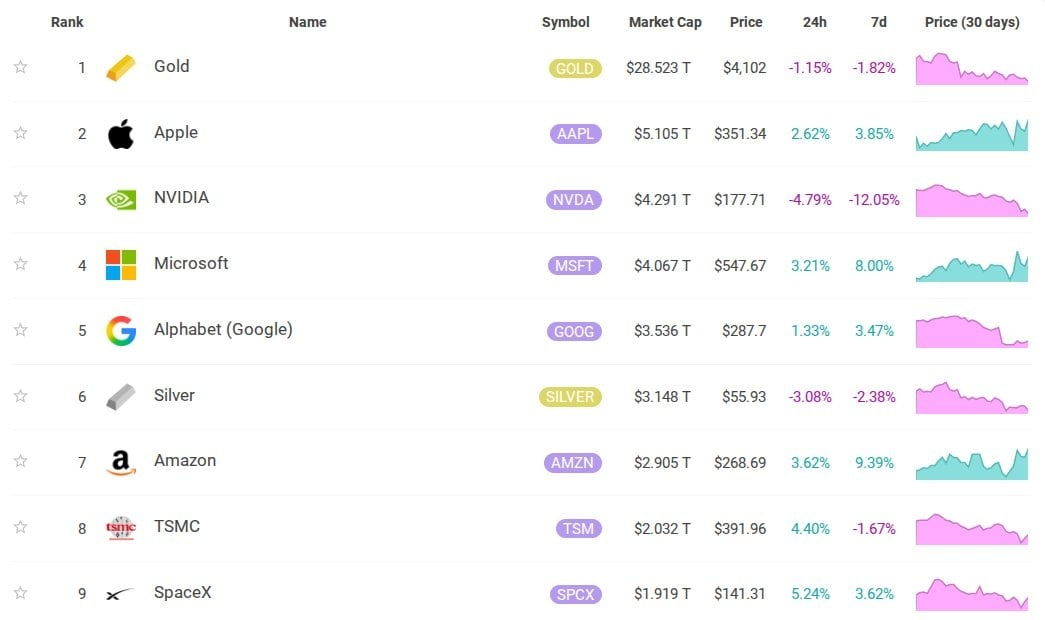
Image: A screenshot of the global assets ranked by market cap (gold leads at $28.52 trillion, followed by giants such as Apple, Nvidia, and Microsoft). The author argues that $ETH’s eventual market cap should rank at the top, alongside gold.
The rise and evolution of stablecoins
The second post that really resonated with me came from my friend @cyrille_briere (who works at @protocol_fx). It focused on the decentralized stablecoin $fxUSD, built by his team.
This post fits perfectly with Vitalik’s argument, because the evolution of stablecoins is closely intertwined with $ETH and the “economic ether” discussed earlier.
In this sense, stablecoins are the culmination of centuries of economic history and countless currents of thought on free money.
As Austrian School economist Friedrich Hayek once wrote: “I believe that we shall never have good money again before we take the thing out of the hands of government, that is, we can’t take it violently out of the hands of government, all we can do is by some sly roundabout way introduce something that they can’t stop.”
“We can’t take it violently out of the hands of government. All we can do is, by some sly roundabout way, introduce something that they can’t stop.”
This idea—building “permissionless, decentralized alternatives to escape government control over fiat currency”—was the spark that gave rise to Bitcoin.
Yet Bitcoin alone still cannot provide all the financial conditions crypto needs to realize its full potential.
As an early industry participant noted in an early discussion of decentralized stablecoins: “Many businesses operate on very thin margins and simply can’t afford BTC’s extreme price volatility; people with low incomes often can’t save and rely heavily on cash to maintain stable purchasing power between paydays.”
“So censorship-resistant stablecoins will be extremely valuable financial tools. They can replace physical cash and bank accounts, and serve as medium- to short-term savings assets that complement BTC as a long-term savings asset. Perhaps one day BTC will become stable enough that stablecoins are no longer needed, but until then, decentralized stablecoins backed by BTC have a perfectly legitimate and important role to play.”
Clearly, that argument was primarily about $BTC at the time.
Since then, however, I believe $ETH has taken over the role $BTC once played in many practical respects.
Today, Ethereum is the primary economic settlement network for holding and transferring stablecoins, as well as the most important on-chain store-of-value (SoV) collateral backing decentralized stablecoins.
As I joked beneath the “Ethereum chef” meme below: Bitcoin may have a mythic “immaculate conception” origin that makes it hard to abandon completely, but let’s face reality: the vast majority of real “crypto activity” now happens on Ethereum, which is quickly becoming the superior store of value.
It would have been nice if “EVM” had worked on Bitcoin, but it never did. Ethereum has clearly established itself as the “world computer.”

Image: A meme featuring a black-and-white tough-guy figure wearing a chef’s hat emblazoned with the Ethereum logo. It suggests that Ethereum has taken over as the “world computer” for on-chain economic activity and stablecoin settlement.
Meanwhile, the evolution of decentralized stablecoins has delivered many painful lessons. The most unforgettable was the catastrophic collapse of Luna and its $UST.
That disaster prompted Vitalik to write an article in May 2022 examining the principles behind decentralized stablecoins. He wrote:
“There are plenty of automated stablecoin designs whose basic mechanisms simply cannot work and are doomed to collapse, as well as many high-risk models that are theoretically viable but extremely fragile. But there are also stablecoins that are theoretically very robust and have weathered real-world extreme market conditions. What we need is neither blind, uncritical hype nor blanket pessimism, but rigorous design grounded in first principles.”
Almost as soon as Vitalik wrote those words, I plunged into an obsessive study of stablecoins myself. I was convinced that stablecoins were the most important and bullish catalyst in the entire crypto industry.
Author’s throwback post from 2022 (@rektdiomedes): As early as August 2022, I published a long thread, (Ten Reasons Stablecoin Market Cap Will Eventually Surpass $10 Trillion), laying out the economic and social forces that would drive stablecoins to expand exponentially over the next 5 to 10 years.
The landscape today: $fxUSD, born out of crisis
In the years since Vitalik wrote those words, the broader crypto market has continued to languish through the so-called “Dark Ages.” But the stablecoin sector has never stopped evolving, with increasingly sophisticated technology and risk controls. As of 2026, most of the mechanism-related challenges that once troubled the industry have been overcome.
The industry naturally faces new concerns now—North Korean hackers, the threat of quantum computing, and the recent spy rumors that have caused a stir, for example. But when it comes to stablecoin design, we already have mature, industrial-grade solutions and a range of excellent products.
At one end of the product spectrum are enormous but more centralized giants like $USDT and $USDC, whose growth is limited almost entirely by the amount of U.S. Treasuries they hold as backing. At the other are highly decentralized, permissionless protocols that are fully collateralized directly by native crypto store-of-value assets such as $ETH.
Among the latter, decentralized camp, I believe the best all-around example is $fxUSD from @protocol_fx.
Built by the top engineering team at AladdinDAO, $fxUSD set out from day one to be the ultimate choice for users seeking true decentralization, permissionlessness, and censorship resistance.
As the team put it in its official manifesto: “f(x) Protocol was born at the height of the USDC depeg crisis, with a simple but radical goal: to build a ‘last line of defense’ stablecoin that keeps working under any extreme conditions.”
“fxUSD relies on no commercial bank, is tied to no sovereign government, and requires no human intervention to operate. It is fully backed by ETH and BTC collateral, and every line of the protocol’s operating logic can be publicly verified on-chain. Even if the entire centralized financial system shuts down, it can keep running indefinitely.”

Image: A Gothic stained-glass illustration centered on the spinning @protocol_fx logo. $fxUSD was built by the AladdinDAO team.
Why $fxUSD is DeFi’s best stablecoin today
I firmly believe that $fxUSD has become the best stablecoin in DeFi today and is poised for explosive growth in the years ahead.
That is also the central point of the post mentioned earlier, from @cyrille_briere, a core member of @protocol_fx.
Click here to read the full post. Below is a quick screenshot highlighting its key data points:
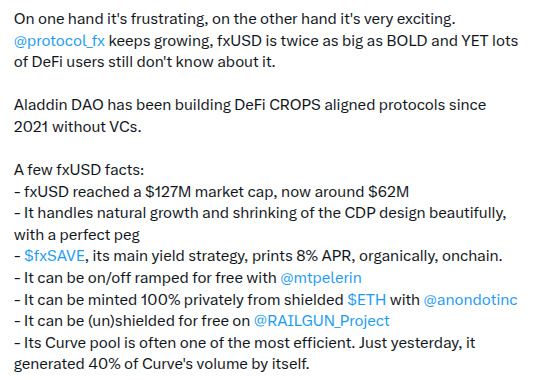
Image: Screenshot of a post by @cyrille_briere describing AladdinDAO’s work from the ground up since 2021, without venture capital; $fxUSD’s peak of $127 million (then worth around $62 million at market cap); roughly 8% organic APY on $fxSAVE; and fee-free fiat on- and off-ramps.
As he emphasized in his post, AladdinDAO has always been a long-term builder at the heart of Ethereum’s “CROPS” values. Applying this framework to $fxUSD, it scores top marks across the board.
As a quick reminder, the five letters in “CROPS” stand for the five principles Ethereum values most:
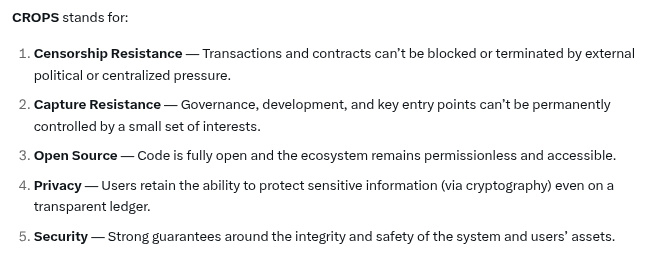
Image: Screenshot listing the five core CROPS values: censorship resistance, capture resistance, open source, privacy, and security.
Censorship resistance and capture resistance: Unlike $USDT or $USDC, $fxUSD has no centralized issuer that can freeze accounts or blacklist addresses.
Minting and redemption rely entirely on $ETH and $WBTC collateral and operate permissionlessly. No single entity can unilaterally seize funds or shut down the system.
Open source: It is a thoroughly open-source project. The smart contract code running on Ethereum mainnet and Base is fully public, the technical documentation is transparent and detailed, and the entire balance sheet is verifiable on-chain in real time.
Privacy: In addition to inheriting DeFi’s permissionless nature, $fxUSD is at the forefront of the new “stablecoins × private payments” narrative through its close collaboration with @RAILGUN_Project (see the two posts below).
Quoting @cyrille_briere (original post): In May 2026, the first-ever private decentralized stablecoin mint in DeFi history took place on Ethereum, completing the entire collateralized lending process on-chain without leaving any traceable links (view the on-chain transaction hash).
Quoting @protocol_fx (original post): Many people give up on Ethereum’s privacy features because of the cost. With $fxUSD on @RAILGUN_Project, the protocol fully subsidizes the fees for entering and exiting the shielded pool in $FXN every month, making it Ethereum’s lowest-cost trustless private transfer tool.
Security: This may be $fxUSD’s strongest line of defense. The protocol uses f(x)’s constant formula to achieve endogenous overcollateralization, and pioneered soft liquidation/rebalancing and a “liquidation brake” to prevent cascading liquidations. It also has a hard redemption path as a clear solvency backstop.
Even more impressively, thanks to AladdinDAO’s extremely rigorous engineering security standards, the team has built and maintained several complex protocols over the past five years without a single security exploit to date (knock on wood, as always).
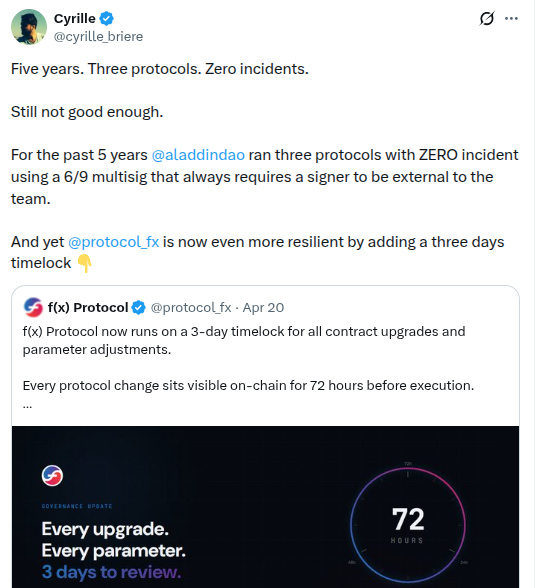
Image: Screenshot of @cyrille_briere reposting @protocol_fx, highlighting a five-year, three-protocol record with zero incidents and noting that contract upgrades and parameter changes are now protected by a 72-hour timelock and multisig.
And on the most fundamental measure for any stablecoin, $fxUSD is dominant when it comes to maintaining its peg.
While many stablecoins marketed as decentralized swing wildly with market volatility, $fxUSD’s peg has remained rock-solid even through the recent nail-biting turbulence. See the live trading screenshot shared below by my good friend @PhilMrlo—and don’t forget to give him a follow.
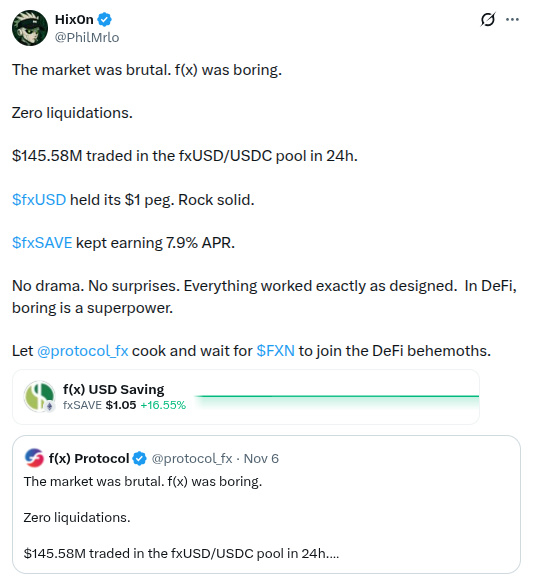
Image: Screenshot of a live post by user @PhilMrlo, praising $fxUSD for holding its $1 peg with zero liquidations amid extreme volatility, while the fxUSD/USDC pool on Curve recorded over $145 million in 24-hour volume.
Not only is its resilience impressive, but, as his post shows, $fxUSD’s trading volume on Curve has recently surged. The fxUSD/USDC liquidity pool has repeatedly topped the daily volume rankings on the veteran decentralized exchange:
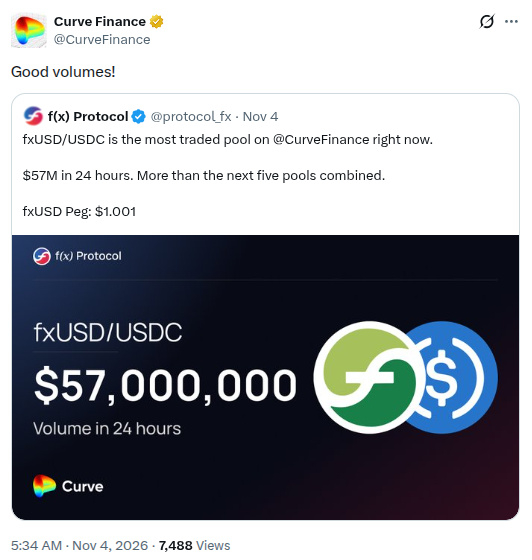
Image: Screenshot of a Curve post reposting @protocol_fx’s data graphic, showing $57 million in 24-hour volume for the fxUSD/USDC pool, ranking first across the platform, with the peg at $1.001 at the time.
Even more exciting, @protocol_fx’s elegant protocol architecture and solid utility are continually creating fertile ground for some of the crypto market’s most lucrative yield strategies today.
It all starts with fxSAVE’s stable 6% to 9% organic base APY. Leveraging this through looping strategies can significantly amplify the yield. And if you take it a step further by splitting yields with Pendle (Pendle-maxxing), the upside is staggering.
The post below from early October clearly breaks down the strategy. In the weeks since—and right up to today—this highly capital-efficient, high-yield strategy has continued to work reliably:
Quoting @protocol_fx (original post): How to break down a stablecoin strategy yielding over 43% APY.
Supply fxSAVE as collateral on Morpho, borrow USDC at 4.13%, and deposit it back into fxSAVE (base yield: 6.59%). Looping this 10 times can deliver 28%+, and switching to PT-fxSAVE on Pendle can take returns above 43% APY.
On top of that, as more people discover @protocol_fx, DeFi traders are noticing an incredibly attractive feature: they can directly collateralize $ETH or $WBTC and borrow at 0% interest (with only minimal opening and closing fees). This is also driving $fxUSD’s market cap steadily higher over the long term.
Quoting @protocol_fx (original post): A straightforward comparison of the cost of capital for holding leveraged long positions in $ETH or $BTC.
Borrowing USDC on Aave costs as much as 10.4% APY—borrowing $1 million means paying about $104,000 in annual interest. With f(x) xPOSITION, the funding rate is 0%, so the annual interest expense drops to zero.
More bullish catalysts for the f(x) ecosystem
Beyond the fundamentals discussed above, @protocol_fx is also building in several promising new directions.
First, the team is focused on the emerging agentic economy, aiming to make $fxUSD the preferred settlement stablecoin for autonomous transactions between AI agents.
In fact, earlier this year the team wrote an exceptionally forward-looking deep dive on this sector. It’s well worth reading:
Quoting @protocol_fx’s long post on X (click to view the original): (The Great Decoupling: Why AI Agents Won’t Use “Human” Money). It makes a compelling case for how the traditional human financial system will be utterly transformed when AI agents, operating autonomously at high speed, replace humans as the primary actors in commerce and payments.
Second, the team is bringing its proprietary liquidation-protection technology—already battle-tested by @protocol_fx, supporting up to 7x low-friction leverage in its CDP architecture—to its new sister project, @FX100Perp.
@FX100Perp has just wrapped up a highly praised testnet trial and is now pushing hard toward its upcoming mainnet launch.
It will continue to rely on this liquidation-protection core, offering users a 15-minute golden window of liquidation protection while allowing leverage of up to 100x. This fundamentally addresses the painful problem of wick-triggered liquidations in traditional perpetual futures models.
This design is incredibly cool. If you’re interested, explore it further through the post below or at fx100.club:
Quoting @FX100Perp (original post): Just as a perfectly timed pit stop can save an entire F1 race, FX100’s unique 15-minute liquidation buffer gives traders time to save their positions. The team has launched a six-week pre-mainnet points campaign with live missions on Guild.
Taking all these developments together, I believe the $FXN ecosystem has firmly established itself as one of the most exciting DeFi projects in crypto today—and perfectly illustrates just how far ahead we should be looking when assessing the industry’s future.
The vast growth ahead of us
Let me say it again: in my view, we have been stuck in a crypto Dark Age for the past four full years.
I can’t say exactly when this bleak period will truly end (though I suspect it ultimately comes down to the Fed’s rate cycle, with a turning point likely once the cost of capital falls). But my long-term conviction about crypto’s ultimate future is completely at odds with the gloomy mood of today’s markets.
I sincerely believe that in the real world of the future, AI and robots will handle most physical and everyday “practical work,” structurally transforming the focus of human economic activity.
Some economic activity based on real, face-to-face human interaction will of course remain offline. But most value creation and circulation will irreversibly move onto the internet, a global “telepathic hive mind” connecting all humanity.
This migration has already begun: 15 years ago, only a tiny minority could earn all their income purely online. Today, these digital natives have become a force to be reckoned with.
Looking 15 years ahead, I believe most of humanity will earn their income primarily online, alongside billions upon billions of AI agents transacting every second.
When that era arrives, Ethereum will naturally serve as the foundational economic settlement layer and source of power for that vast online world.
It will become the wondrous “ether” flowing through the global hive-mind economy and keeping it running smoothly. The market cap corresponding to the value it supports could rise 100-fold or more—and may even surpass gold outright.
Along the same historical timeline, stablecoins will also fulfill their destiny of “devouring the traditional financial world.”
By then, most of the world’s sovereign fiat currencies will either have disappeared or be on the verge of accelerating decline, replaced by a variety of efficient, free-flowing stablecoins.
This new monetary landscape will still include giants backed by U.S. Treasuries, such as $USDC and $USDT. But native stablecoins that are fully collateralized by high-quality crypto assets such as $ETH, fully aligned with CROPS, decentralized, and permissionless will command an equally significant share.
Looking across the entire DeFi sector, I don’t think there’s another decentralized stablecoin better positioned than $fxUSD to carry this torch.
Following this vision of the future, $fxUSD’s market cap could grow 100x, 1,000x, or even more from where it is today. If that happens, the governance token $FXN powering the @protocol_fx ecosystem, along with many of the high-quality crypto assets you and I believe in, could also undergo an unimaginable revaluation.
At the end of the day, all of us are thinking far too small and too conservatively right now.

Image: An illustration of a golden sailboat beneath a sea of rainbow-colored neon clouds, with the message “Think bigger.”
Disclosure and disclaimer: I hold a large position in both $ETH and $FXN and continue to actively accumulate both assets. I’m also deeply involved in the work of the @protocol_fx team! So my outlook in this article is 100% biased, and this piece is me going all-in to champion the projects I believe in.
That said, every word I’ve written comes straight from the heart: I really am a complete, unabashed permabull.

Image: A meme poking fun at the author as a “long-term permabull,” with Pepe pointing to “I am here” at the far-left tail of an IQ bell curve.

Image: A meme poking fun at the author as a “long-term permabull,” showing a cartoon bull in a straitjacket locked in a padded room.

Image: A photo of an extraordinarily muscular Belgian Blue bull, illustrating the author’s “long-term permabull” self-deprecation.
Conclusion
The crypto “Dark Ages” of the past several years have quietly conditioned us all, locking our imaginations inside an incredibly narrow cage.
We’ve learned to meekly hope for only a small uptick in the market each day. We’ve learned to keep lowering our big dreams and ambitions for the industry. We’ve even subconsciously come to equate “idealism” with “niche scale” and “never going mainstream.”
But that’s got it completely backwards from the ground up.
It is precisely crypto’s inherent idealism and its bold, big-picture vision for reshaping the old order that made it so captivating in the first place.
Deep down, people have always wanted to believe in something that can truly change the world. That is crypto’s most fundamental mission.
AI has unquestionably dominated the world’s attention over the past few years, but it is really just one facet of a much bigger truth: technological progress is racing forward at the speed of light, and the entire world is being reshaped on an unprecedented scale.
We simply forgot for a while, during a brief period of confusion, that crypto is just as dazzling a part of this technological upheaval. Before long, it will all become self-evident again, and we’ll laugh at ourselves for ever having doubted it.