Beginner Lesson 38: The rise is slowing and each new high is harder to reach—is it running out of steam? How to read and trade wedges
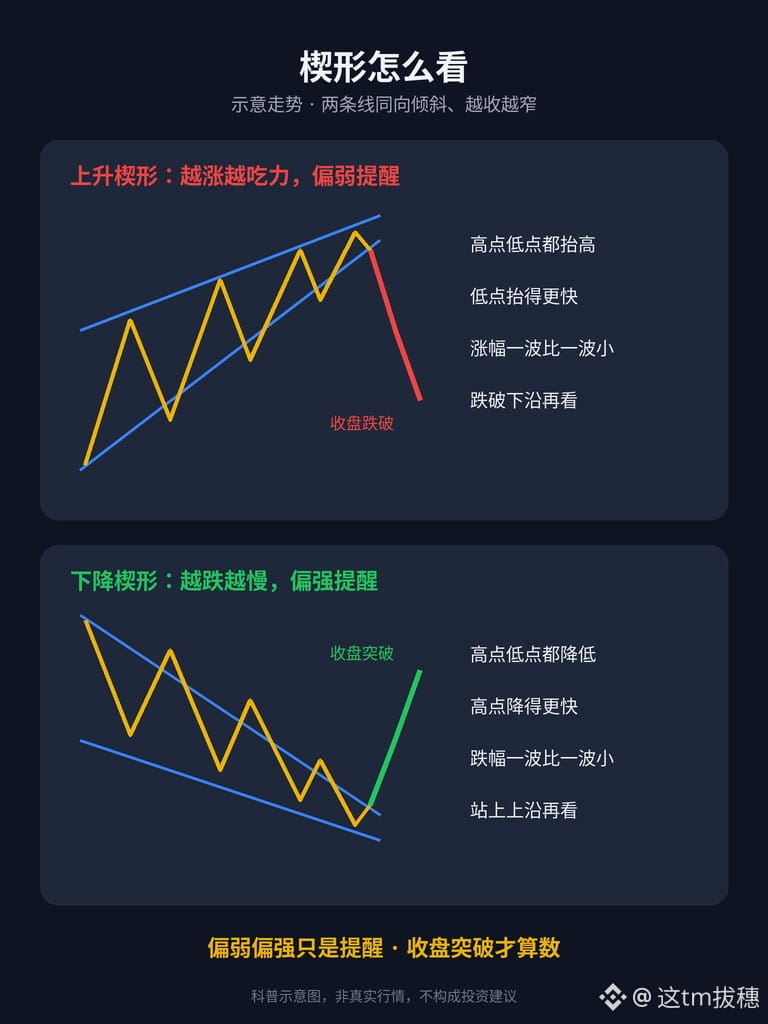
The previous lesson covered flags. This lesson covers a pattern that looks a little similar but often means the opposite: the wedge. In short, a wedge consists of two lines sloping in the same direction and converging. A rising wedge slopes upward but gradually loses momentum, so it is often seen as a bearish signal. A falling wedge slopes downward but declines more slowly, so it is often seen as a bullish signal. But as with all chart patterns, until there is a closing-price breakout, it’s only a guess.
I. What a wedge looks like
1) Both lines slope in the same direction: either both upward or both downward;
2) The lines converge, forming a slanted point. This is what distinguishes a wedge from a parallel channel or flag;
3) Rising wedge: both highs and lows rise, but the lows rise faster, and each upward move is smaller than the last;
4) Falling wedge: both highs and lows fall, but the highs fall faster, and each downward move is smaller than the last;
5) Volume: it often declines during consolidation. A breakout accompanied by higher volume is more reliable.
II. How to distinguish wedges from triangles and flags
1) Triangle: one line slopes upward and the other downward, or one line is horizontal—the lines move in different directions;
2) Flag: the flag itself is a small parallel channel, and it should be preceded by a steep flagpole;
3) Wedge: both lines slope in the same direction and converge, and it usually lasts longer than a flag.
Draw the lines the same way as trend lines in Lesson 34: connect at least two highs along the upper boundary and two lows along the lower boundary. Watch closing prices, and don’t let wicks mislead you.
III. How beginners can use them (for illustration, not a trade call)
1) Rising wedge: don’t chase prices higher inside the wedge. Consider a bearish position only after the closing price breaks below the lower boundary, or reduce existing long positions;
2) Falling wedge: don’t try to pick a bottom and predict a reversal inside the wedge. Consider a bullish position only after the closing price moves above the upper boundary;
3) Place a stop-loss just inside the wedge, on the opposite side of the breakout point. If price returns to the wedge after breaking out, accept the loss according to your plan;
4) Many guides use the “height of the wedge’s opening” to estimate a target. Treat this only as a rough reference and take profits in stages as price approaches it;
5) Check the higher time frame first: if the $ETH -day chart is still in a strong uptrend, a rising wedge on a lower time frame may simply be a pause, and an upside breakout is also possible. So always wait for the direction to become clear.
IV. Common pitfalls
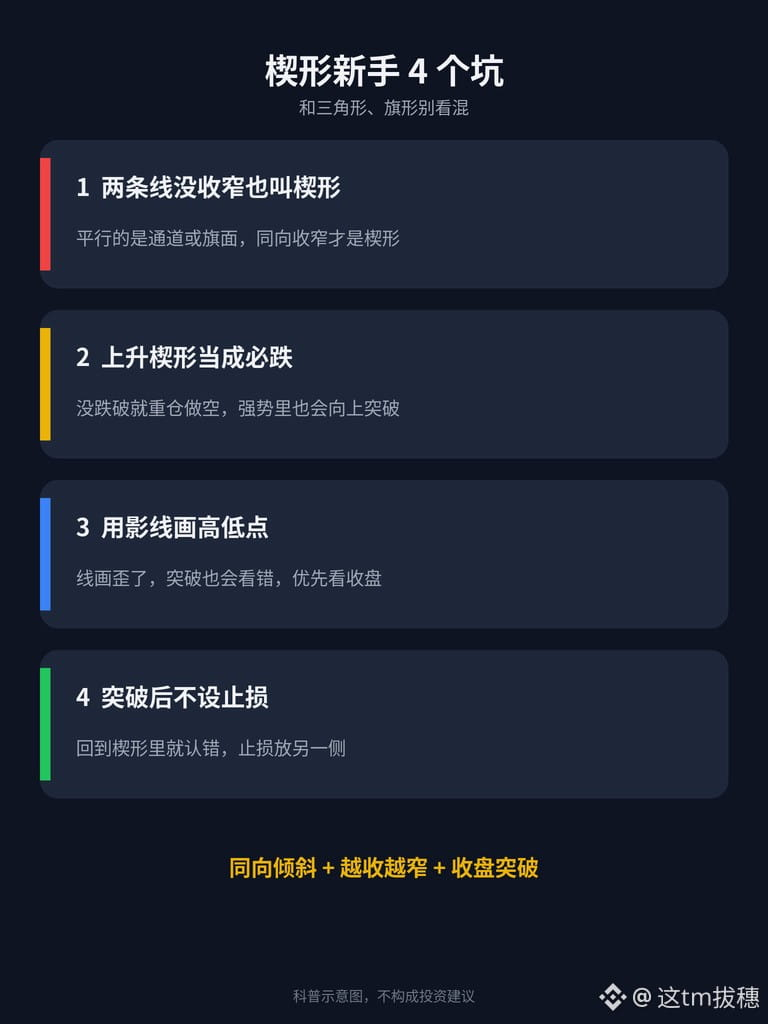
1) Calling any two lines a wedge without checking whether they are converging;
2) Treating “rising wedges are bearish” as a guarantee of a decline and taking a large short position before the price has broken down;
3) Using wicks as highs and lows, drawing the lines incorrectly, and misreading the breakout;
4) Failing to set a stop-loss after the breakout and getting stuck when a false breakout reverses.
In a nutshell: a wedge is defined by “sloping in the same direction and converging.” A rising wedge warns that momentum is weakening; a falling wedge suggests that selling pressure is easing. But wait for a closing-price breakout to confirm the direction, place your stop-loss on the other side, and treat the target as a reference only. Look through historical candlestick charts of major coins paired with $USDT and find a few wedges to compare where price eventually went. Practicing your eye is better than rushing into a trade.
Which coin have you seen a wedge on recently? Share in the comments.
The content above is for educational purposes only and does not constitute investment advice. Crypto assets are extremely volatile, and futures trading carries even greater risk. Only trade with money you can afford to lose.
#新手入门 #技术分析 #BinanceSquare