


Author: Chainalysis
Translation: Luffy, Foresight News
Chainalysis, a research firm specializing in crypto data, has released its 2026 Global Crypto Adoption Report. The Western Europe chapter notes that even as the global crypto market slumps, Western Europe's $2.08 trillion crypto economy remains resilient, posting modest positive growth.
The region's markets are sharply divided: the UK market is contracting; amid fiscal pressures, users in France are turning to self-custodial stablecoins; and exchanges in Spain are attracting substantial cross-border capital from across Europe. Stablecoin holdings in Western Europe have surged, and the euro's share of crypto trading has increased, as the industry shifts from speculation toward institutional adoption. Below is the Chinese translation of the report's Western Europe chapter:
As the global crypto market entered a downturn, Western Europe showed strong resilience. During the period studied (July 2025 to June 2026), Western Europe’s crypto economy totaled $2.08 trillion, ranking second globally, and grew modestly by 1.2%. Worldwide, only Sub-Saharan Africa, Latin America, and Western Europe recorded positive growth.
New regulations, the continued entry of institutional capital, and increasingly deep ties with traditional finance are reshaping crypto markets in the region. But national development paths vary considerably. The growing adoption of stablecoins, the rising role of the euro in crypto trading, and the cross-border expansion of exchanges are shared trends.
Christopher Beck, co-CEO of BS Digital, a leading crypto infrastructure provider in Europe, described this wave of change: “Institutional adoption is accelerating. Crypto assets are gradually moving from an emerging speculative asset class to mainstream financial products.”
But all of this is happening against a backdrop of an uncertain economic outlook across Europe and steadily changing user preferences, both of which directly shape crypto fund flows and the market’s center of gravity.
Six markets account for two-thirds of Western Europe’s crypto economy
The UK remains Western Europe’s largest crypto market, valued at $424.5 billion, or 20% of the region’s total. As a long-established global financial center with mature capital markets and banking, the UK’s crypto market is more like a natural extension of its domestic financial services industry. However, its market size fell by 8% during the period studied, mainly because trading volume on decentralized exchanges (DEXs) contracted.
Germany ranked second at $288.8 billion, followed by France in third place at $215.8 billion. Germany’s market contracted slightly, also due to a decline in DEX trading, while France’s market was broadly flat. Spain ($156.1 billion) and Switzerland ($132.8 billion) grew, primarily due to increased activity on centralized exchanges (CEXs).
Together with the Netherlands ($207.8 billion), these six countries account for around two-thirds of Western Europe’s total crypto economy, which is heavily concentrated in the region’s largest markets.
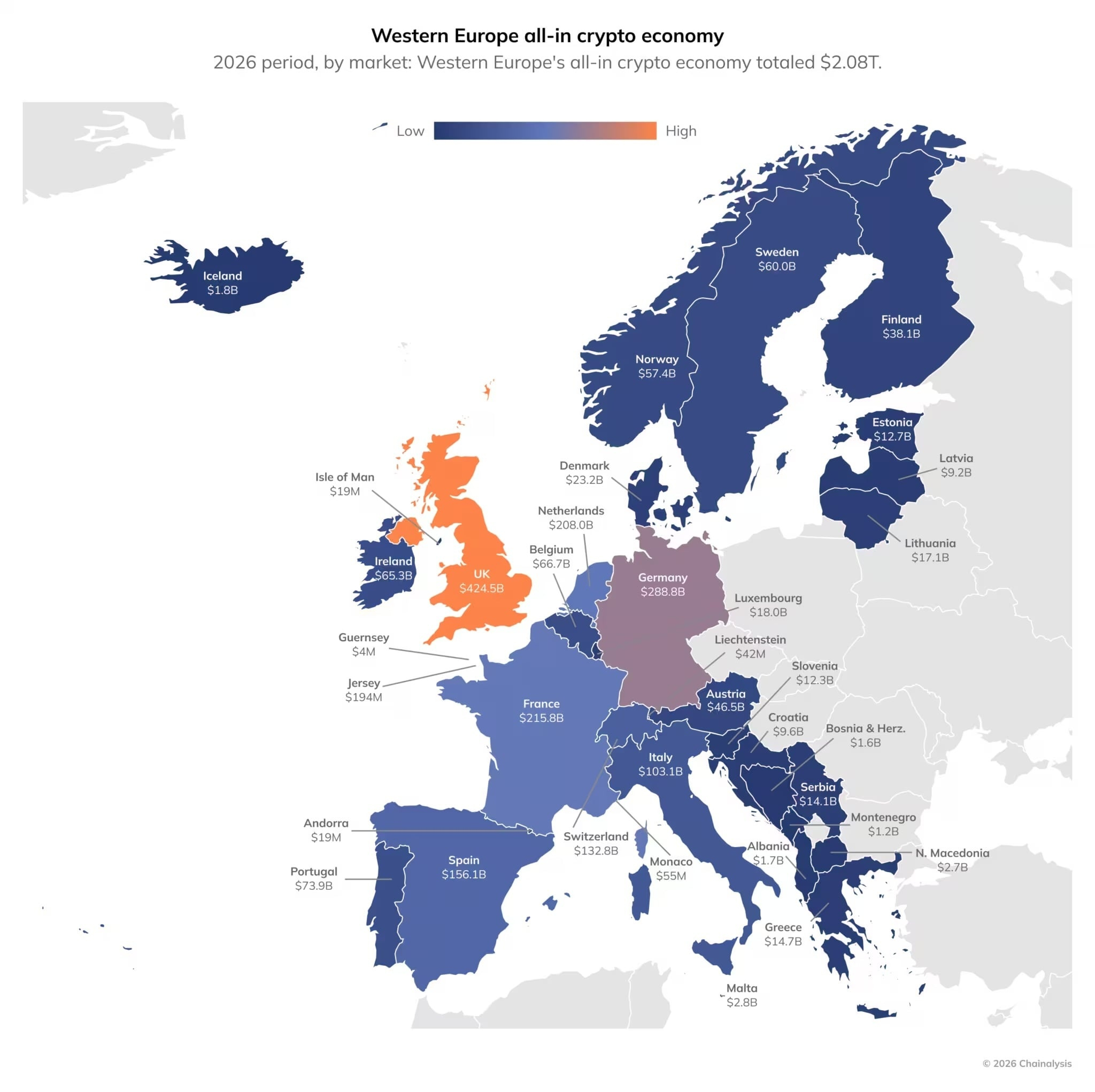
Chart: Map of Western Europe’s crypto economy
Industry experts interviewed generally believe that Europe’s crypto sector has left behind its period of unrestrained growth and entered a new stage of maturity. Faustine Fleuret, Global Head of Public Affairs at decentralized credit infrastructure Morpho, pointed to this shift:
“We can clearly see a shift: people are no longer just experimenting with cryptocurrencies; they are embedding blockchain in mainstream financial operations. Banks, asset managers, and fintech companies are gradually realizing that on-chain finance is not a parallel system competing with traditional finance for business, but a new foundational technology on which they can build.”
The euro is gaining a stronger voice in crypto markets
The euro’s growing role is one sign of the maturity of Western Europe’s crypto market, and it reflects the currency’s standing in traditional foreign exchange markets.
According to the Bank for International Settlements (BIS), the euro was involved in 28.9% of global foreign exchange trades in April 2025. Crypto order book data counts one side of a trading pair (euros exchanged for tokens), unlike the two-sided measure used for foreign exchange. This article therefore uses half that figure, or 14.5%, as a benchmark.
Chainalysis data shows that the euro is increasingly becoming an exchange route for ordinary people entering the crypto market. By the end of the period studied, euro-denominated trades accounted for 11.8% of crypto trading across 33 major fiat currencies worldwide, a marked increase from the past and bringing the euro closer to its benchmark share in foreign exchange markets.
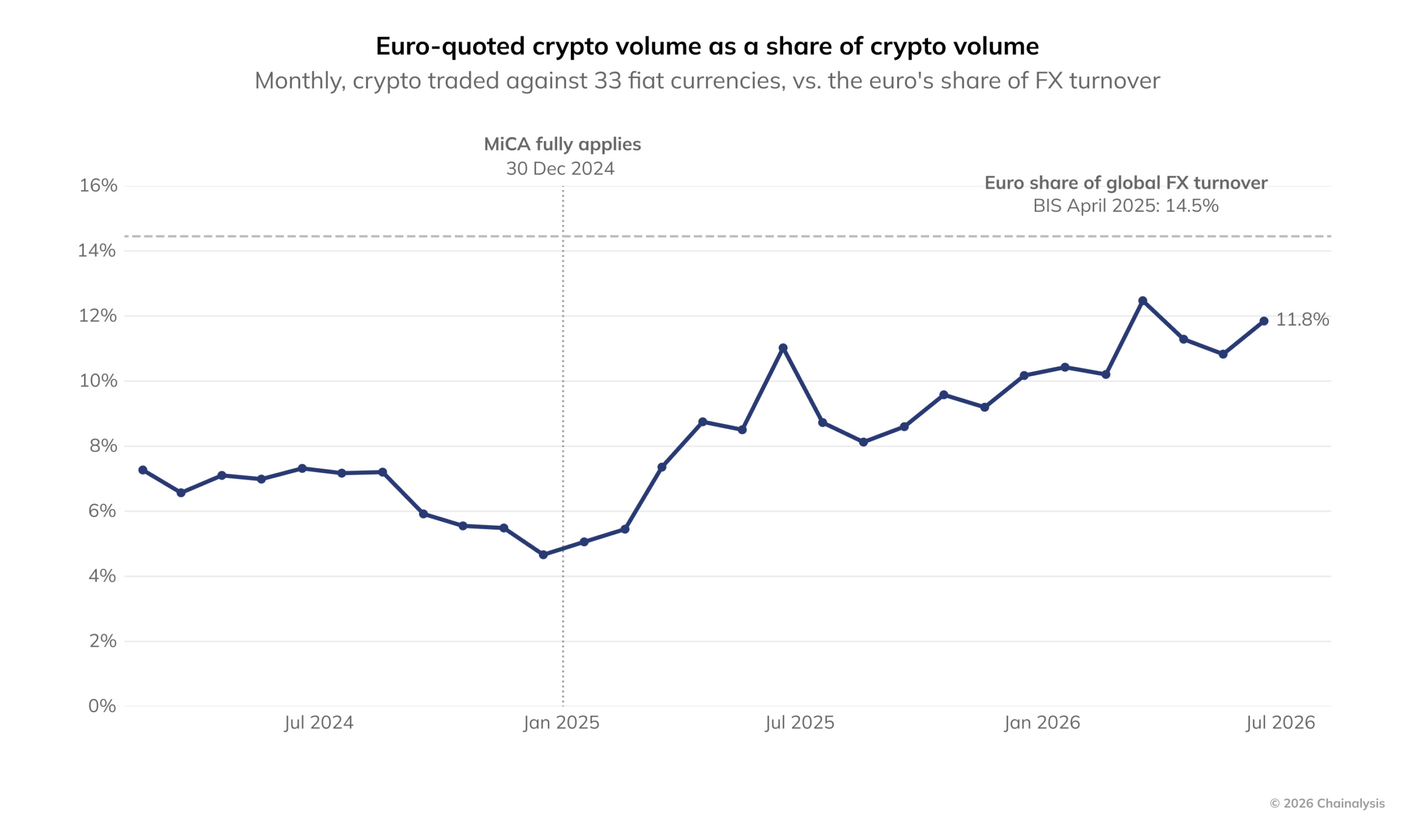
Chart: Euro-denominated crypto trading volume as a share of total crypto trading volume
This upward trend coincided with the implementation of the EU’s MiCA regulation. MiCA establishes a unified regulatory framework for all crypto-asset issuers and service providers in the EU, reducing uncertainty for investors. Once licensed, service providers can operate in every EU country.
Although the data cannot directly prove a causal relationship, the rise in the euro’s share of trading likely benefited from the market stability brought by unified regulation, as well as the overall expansion of the EU crypto market.
Laurynas Spangevičius, General Manager of Robinhood Europe, described MiCA’s impact: “The regulatory change with the greatest impact on Europe’s crypto industry is the full implementation of MiCA. Clear rules have replaced regulatory uncertainty, giving mainstream investors the confidence to enter the market over the long term.”
Stablecoin holdings in Western Europe are growing far faster than in other regions
The research found that stablecoins are taking on a growing share of Western Europeans’ digital asset holdings, with stablecoin balances in personal wallets increasing in every country studied.
This shift is significant. As stablecoins become more widespread, Europe must answer a central question: how should these digital dollars and digital euros be incorporated into the existing financial system?
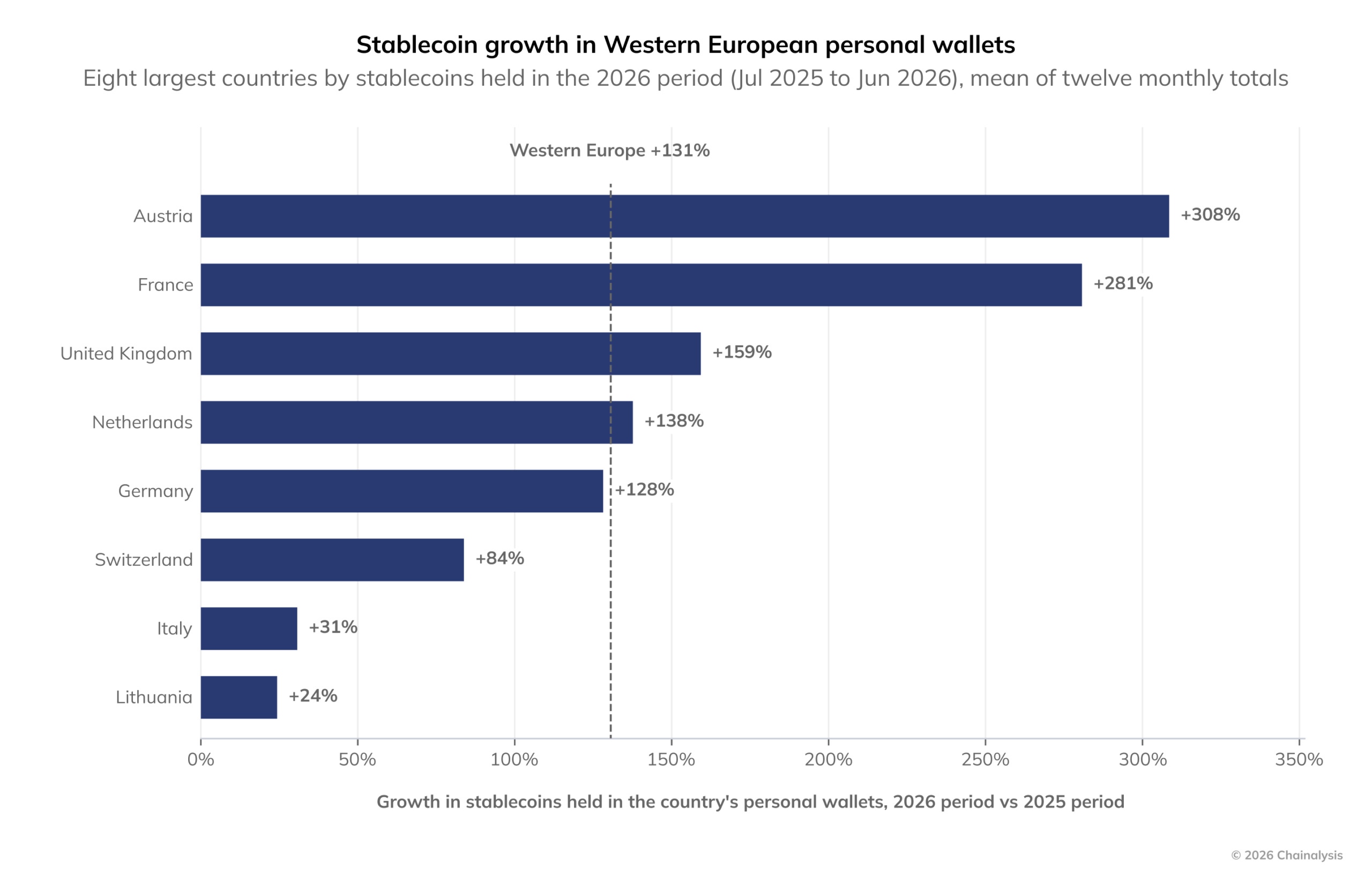
Chart: Growth in stablecoin holdings in personal wallets in Western Europe
Total stablecoin holdings in personal wallets across Western Europe surged by 131%, far outpacing global growth of 52%. Austria and France recorded the largest increases. This growth lifted Western Europe’s share of global stablecoin holdings from 3.4% to 5.1%.
Several factors are driving this trend: Europeans want more options for storing and transferring value, while MiCA has established clear entry requirements for euro stablecoin issuers, encouraging the development of the euro stablecoin sector. Stablecoins are spreading rapidly in Europe, and their potential impact on the financial system can no longer be ignored.
The debate has already begun. In September 2026, the European Central Bank and EU national central banks publicly opposed a stablecoin reserve rule in MiCA: under the current rules, ordinary stablecoin issuers must hold at least 30% of their reserves in European bank deposits, while large, significant stablecoins must hold 60%. Central banks are concerned that a large-scale redemption run could cause a sudden outflow of bank deposits and trigger financial risks.
Traditional financial institutions are also moving into the space. Qivalis CEO Jan-Oliver Sell, whose stablecoin project is backed by a consortium and complies with MiCA regulations, noted that compliant euro stablecoins already have clear real-world use cases: as on-chain cash settlement tools for tokenized assets, and to support programmable conditional payments between businesses, such as cash on delivery.
A spokesperson for Spanish multinational bank CaixaBank said that developing this kind of business is also part of Europe’s effort to avoid becoming entirely dependent on dollar stablecoins in the stablecoin market.
Overall, euro stablecoins could become an important part of Europe’s digital financial infrastructure, but regulators and banks continue to weigh the risks they pose to financial stability and monetary sovereignty.
Euro bond yield shifts influence EU bitcoin and tokenized gold trading
The study also found a pattern: when eurozone government bond yields rise relative to U.S. Treasury yields, the share of bitcoin and tokenized gold trades denominated in euros rises in tandem.
This is unfolding against a backdrop of growing market concern about Europe’s public finances, with sovereign debt risks becoming a subject of debate. Years of high debt, repeated economic shocks, and weak growth have gradually exposed fiscal vulnerabilities.
France is in the market spotlight: high debt and political deadlock are unsettling bond markets. In October 2026, the yield on French 10-year government bonds topped 5.14%, a 20-year high, reflecting investors’ concerns about the country’s finances and political situation.
Using weekly data from July 2025 to June 2026, Chainalysis compared yields on highly rated eurozone government bonds and U.S. Treasuries with trading activity in bitcoin and tokenized gold, and found a clear pattern.
When euro yields rise relative to U.S. Treasury yields, the share of euro-denominated bitcoin and tokenized gold trades compared with dollar-denominated trades increases. When the yield spread narrows, interest in euro-denominated trading declines.
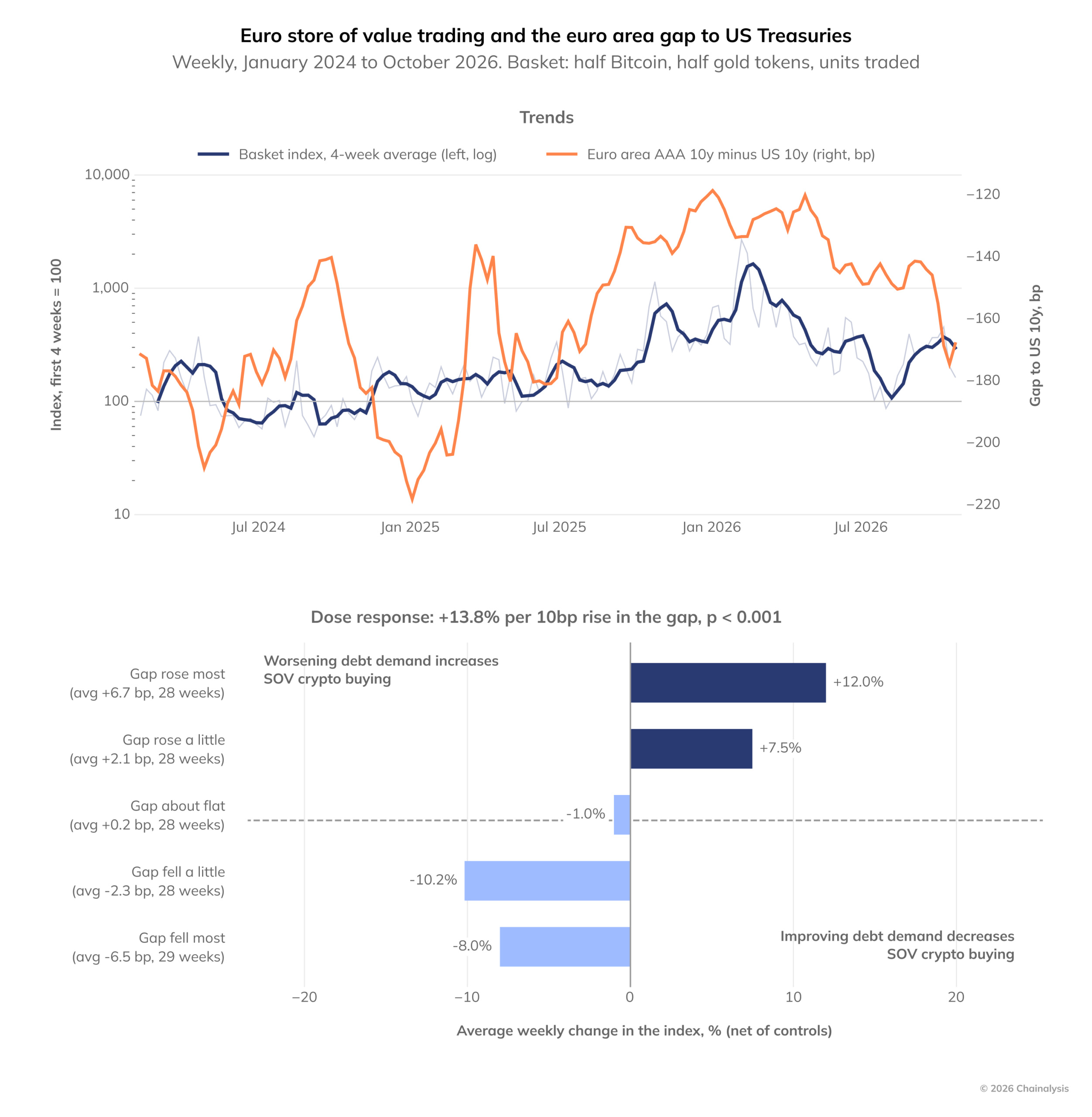
Chart: Relationship between eurozone value-storage crypto trading and the yield spread between highly rated eurozone government bonds and U.S. Treasuries
The size of the changes is also correlated. When euro yields rise by around 2 basis points relative to U.S. Treasury yields, euro-denominated trades are about 7.5% higher than dollar-denominated trades; when they rise by 7 basis points, they are about 12% higher. When euro yields fall relative to U.S. yields, euro-denominated trading volume is 8% to 10% lower.
One interpretation is that when the eurozone’s fiscal outlook is called into question, traders add bitcoin and tokenized gold to their portfolios as alternative safe-haven assets. Data from France later in the report also offers supporting evidence for this trend. Of course, the data show correlation only and cannot prove direct causation.
Prediction markets: European users bet on geopolitical events and favor negative outcomes
Prediction markets mean crypto assets are no longer used only for speculation: users can bet on geopolitical conflicts and economic outcomes. Chainalysis analyzed European wallets’ trading behavior in contracts tied to geopolitical events.
The data for this analysis was collected before the European Securities and Markets Authority (ESMA) introduced new rules in July 2026. The rules classify these event contracts as retail binary options, effectively banning prediction markets across the EU. The UK also has relevant bans in place, and the analysis takes the continually changing regulatory environment into account.
The data shows that during the period studied, 74% of funds from European wallets in U.S.-Iran-related binary prediction markets were wagered on negative outcomes, compared with a global average of 49%. On average, however, positions betting on negative outcomes earned lower returns than those betting on positive outcomes.
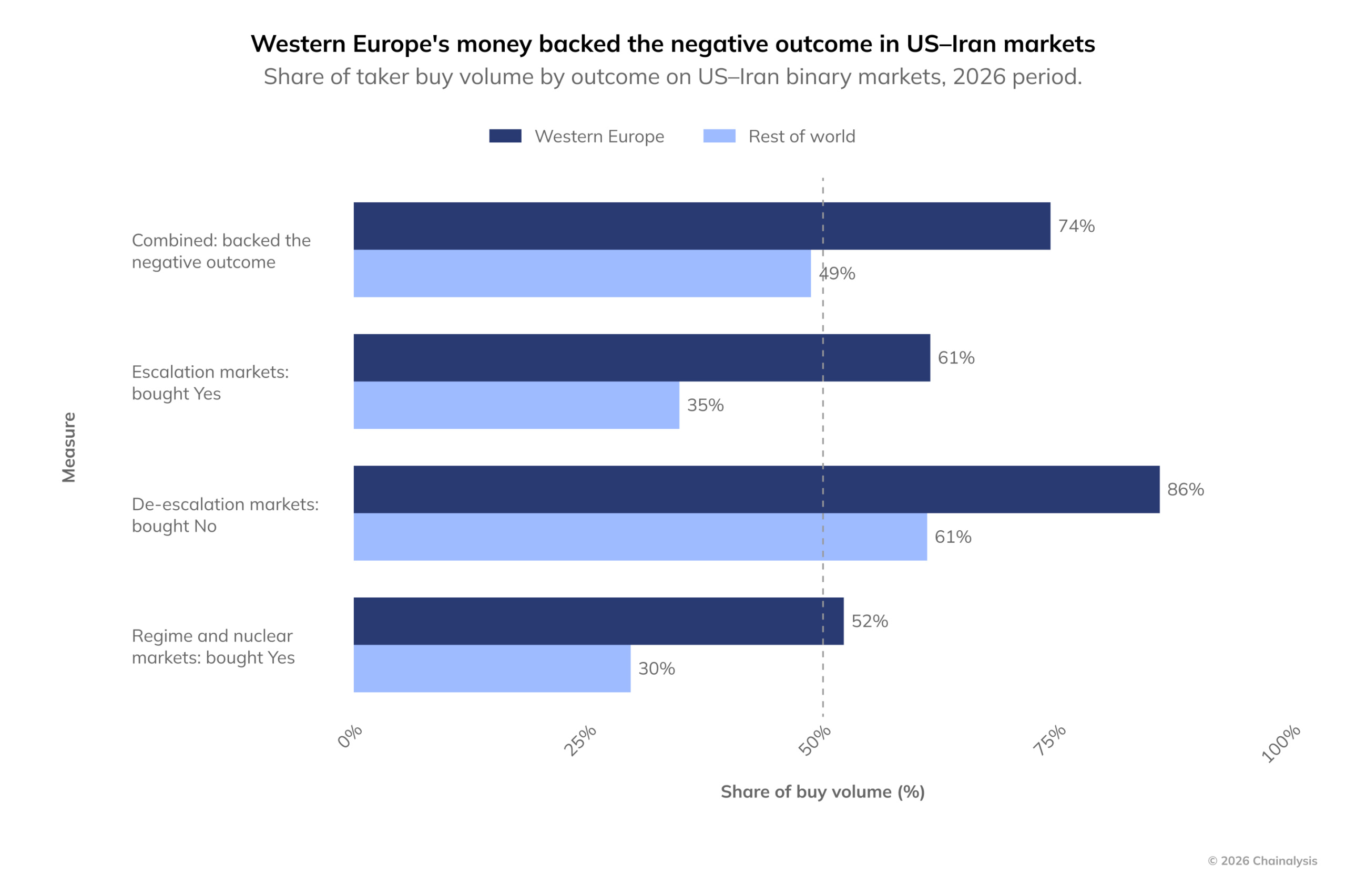
Chart: Western European funds broadly bet on a negative turn in U.S.-Iran relations
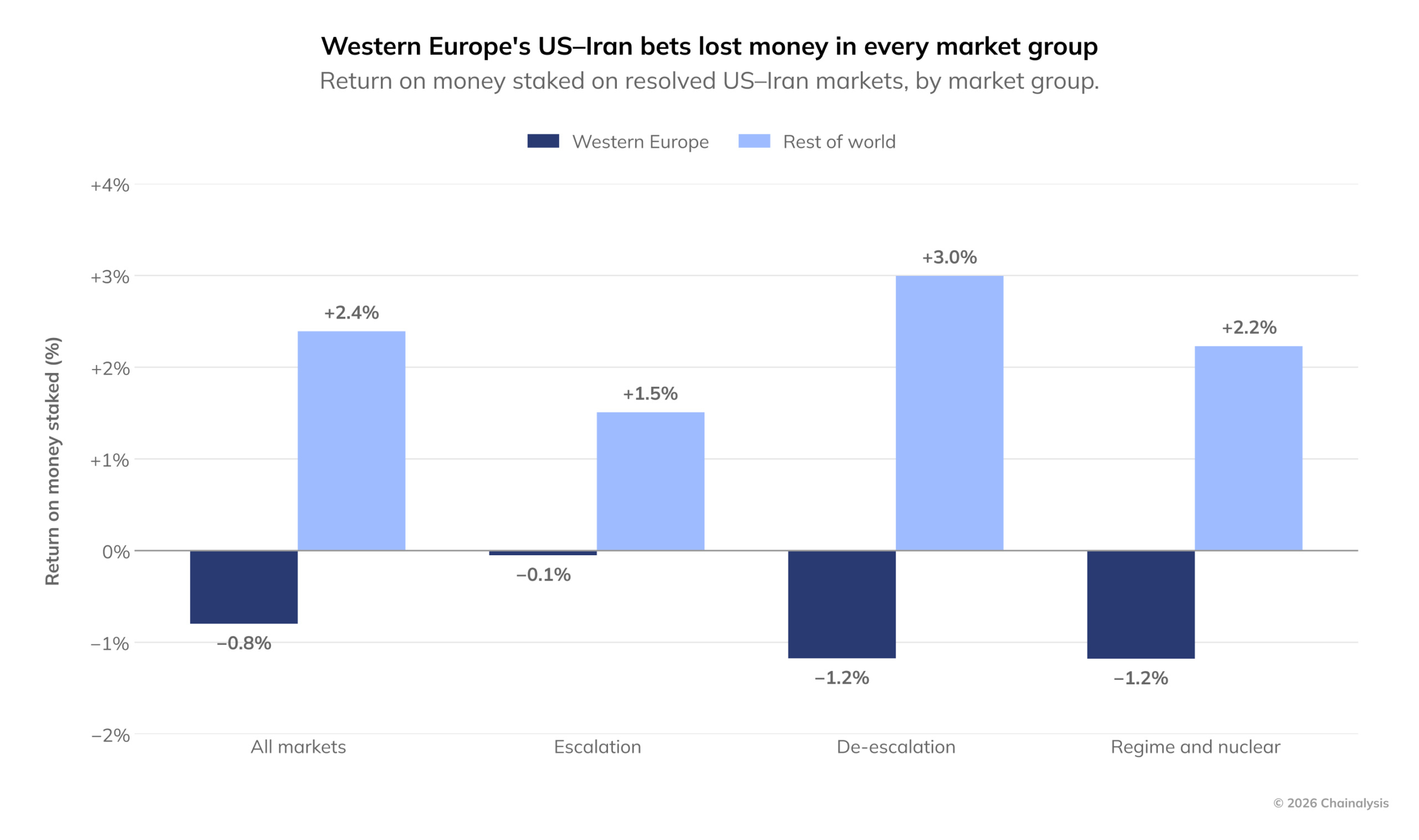
Chart: In U.S.-Iran-related prediction markets, Western European funds lost money across every category
This shows that prediction markets are not just used to forecast how events will unfold; they have also become a way for users to express geopolitical views. But fund flows and profits diverge: people expect something to go wrong, yet it is hard to make money from that prediction.
UK market shifts from growth to decline as the EU continues to expand
For several years, the UK’s crypto market grew faster than those of the rest of Western Europe, but the trend has reversed. The UK remains Western Europe’s largest market, but its size fell by 8%. The rest of Western Europe grew by 3.8%, while the EU, considered separately, grew by 2.2%.
This divergence raises two questions: Why did the UK grow so quickly before, and why is the EU proving more resilient now?
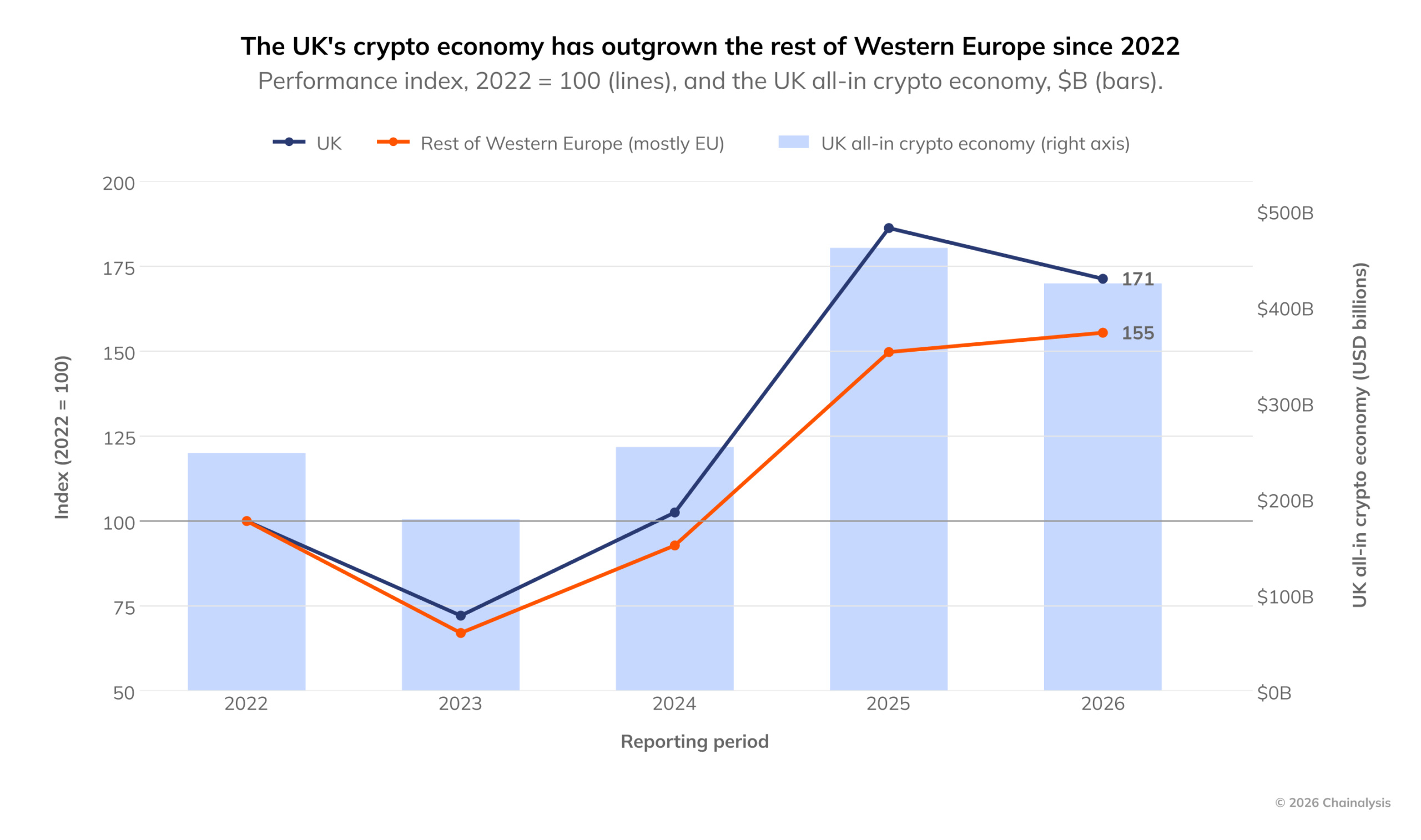
Chart: Since 2022, the UK’s crypto economy has grown faster than the rest of Western Europe
MiCA’s impact is an important clue. When MiCA entered its initial implementation phase in December 2024, higher compliance costs and regulatory uncertainty held back growth in the short term. Once service providers completed the transition and obtained licenses in July 2026, the benefits of MiCA began to materialize: licensed providers could operate directly in every EU country without applying for licenses one by one.
So MiCA first restrained, then supported, the expansion of the EU market. This latest expansion took place during a bear market in which global crypto market capitalization was cut in half.
The UK, meanwhile, had no equivalent unified regulatory framework to cushion it against the downturn. The market slowdown also coincided with the Financial Conduct Authority’s (FCA) introduction of a crypto regulatory access pathway in September, prompting many participants to take a wait-and-see approach.
Of course, the data cannot prove that regulation was entirely responsible. Market factors are also complex, and MiCA’s impact cannot be isolated on its own. The timing, however, closely aligns.
A new shift in UK stablecoins: from cross-border tool to mainstay of domestic transfers
The way stablecoins are used in the UK is changing: stablecoin transfers between domestic wallets have surged. Stablecoins are no longer used only for cross-border remittances; demand for domestic fund transfers is growing rapidly.
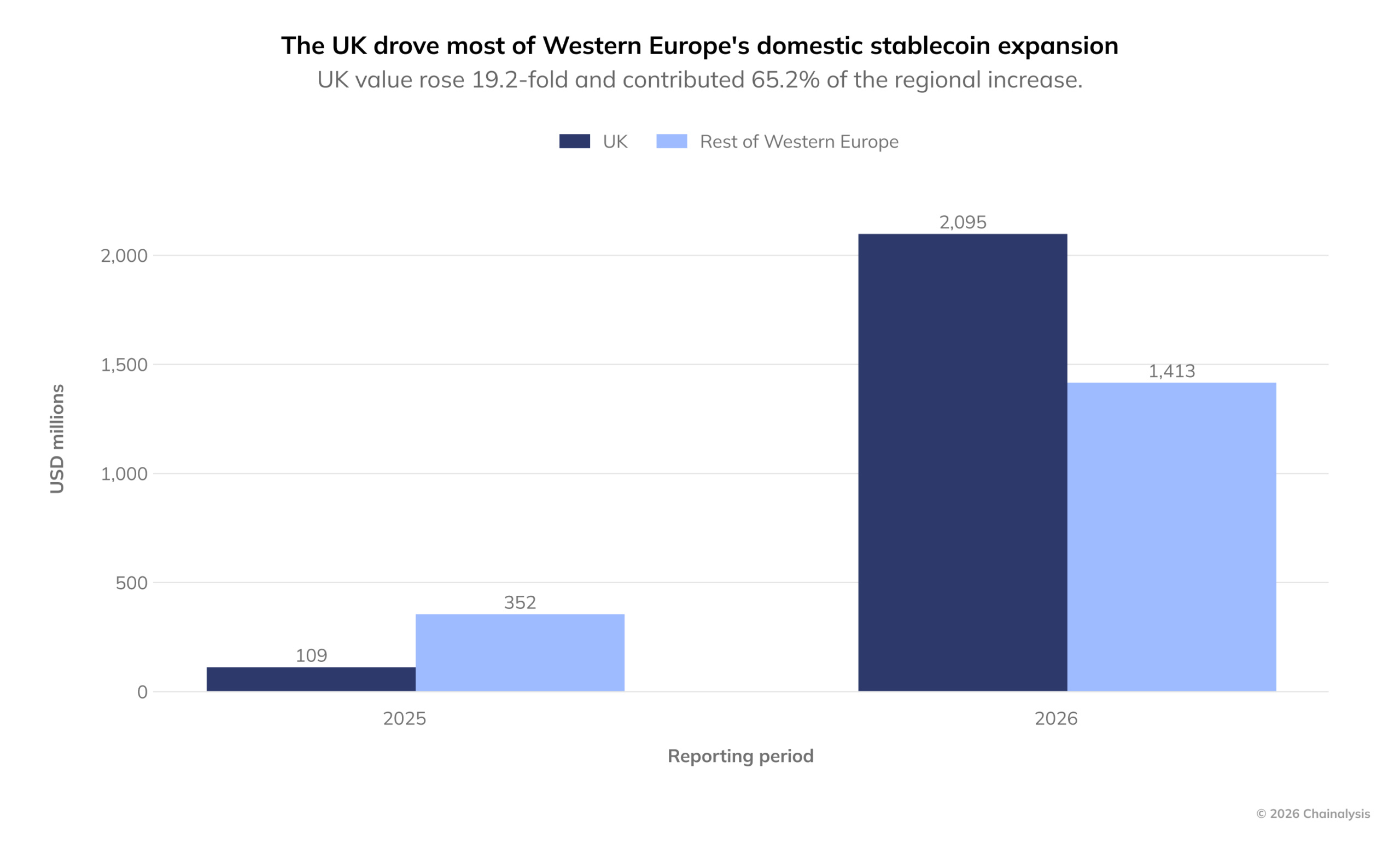
Chart: The UK leads the expansion of domestic stablecoins in Western Europe
During the period studied, peer-to-peer stablecoin transfers within the UK reached $2.09 billion, up from just $109 million in the same period a year earlier. The UK accounted for 65.2% of the total increase in domestic stablecoins across Western Europe, and its total transaction value made up 60% of domestic transfers in the region.
The contrast with the rest of Europe is striking. The value of domestic transfers in the UK is 1.32 times that of cross-border P2P and service-provider transfers. In the rest of Western Europe, cross-border transaction volume is 4.38 times domestic volume.
UK regulators have also made stablecoin payments a priority for 2026. In June 2026, the Bank of England published a draft regulatory framework for systemic stablecoins, setting out rules for large-scale stablecoin payments.
The Bank of England has also set a personal holding limit. Each person may hold no more than £20,000 in a single systemic pound stablecoin. This rule will shape the role stablecoins play in household finances. On-chain data already points to a trend: more and more ordinary UK users are treating stablecoins as a place to store funds, not just as tokens to move between trades.
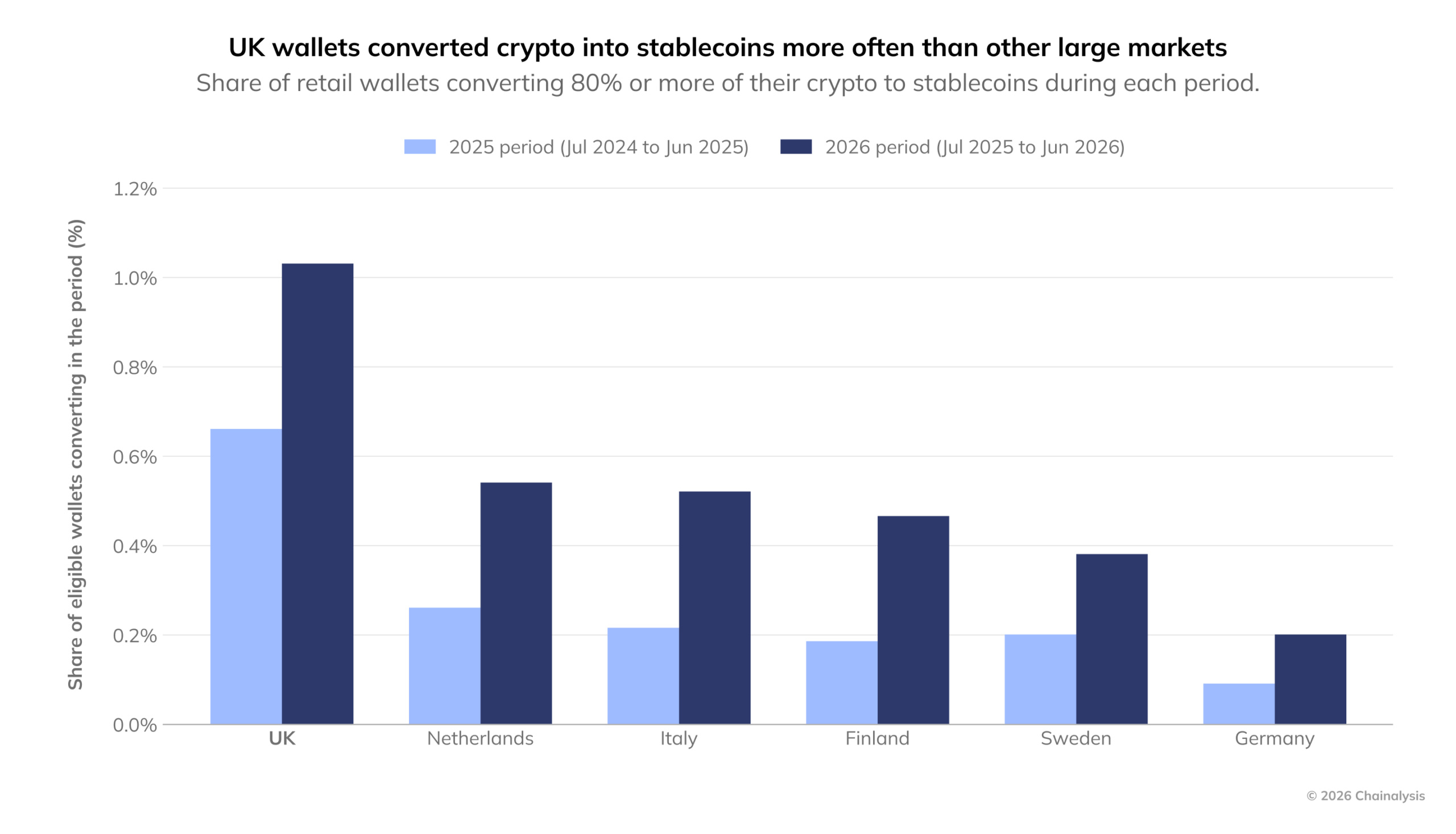
Chart: The share of retail wallets in the UK that have converted the vast majority of their crypto assets into stablecoins is higher than in other major Western European markets
During the period studied, 1.03% of eligible UK retail wallets had converted at least 80% of their crypto assets into stablecoins. The figure was 0.66% a year earlier, and the UK had the highest rate among Western Europe’s six major markets. The Netherlands stood at 0.54%, Italy at 0.52%, Finland at 0.46%, Sweden at 0.38%, and Germany at 0.20%.
The share rose in all six countries. Italy and Germany saw larger multiples of growth (2.5 times in Italy, 2.3 times in Germany, and 1.6 times in the UK), but the UK’s lead in absolute terms continued to widen.
There is another key point: the wave of conversions peaked between July and September 2025, before bitcoin’s October high. This suggests it was not simply a defensive move during a bear market, but a gradual, long-term shift in user habits. The team continued tracking these wallets and found that when the market subsequently fell, many users chose to keep holding stablecoins.
Amid fiscal pressure in France, users turn to self-custodied stablecoins
France is at the center of Europe’s fiscal tensions. High debt and a divided parliament have made it difficult to advance spending cuts and deficit controls. Austerity measures have sparked protests, budget bills have repeatedly faced hurdles, and confidence in France’s public finances has weakened.
Against a backdrop of growing economic and political uncertainty, on-chain data reveals three clear signals that French users are increasingly turning to self-custodied stablecoins to manage their assets: a rising share of withdrawals from centralized exchanges, more personal wallets holding stablecoins, and steadily growing wallet balances. Users want to control their own assets.
In three years, France climbed from 10th to 1st among Western Europe’s major markets for the share of exchange withdrawals involving stablecoins. During the period studied, stablecoin withdrawals accounted for 54.2% of the total withdrawn from exchanges by French users, surpassing Germany. The total value of funds transferred from exchanges to French wallets rose by 12%, compared with an average of 7% across the rest of Western Europe, indicating that more assets are being self-custodied on-chain.
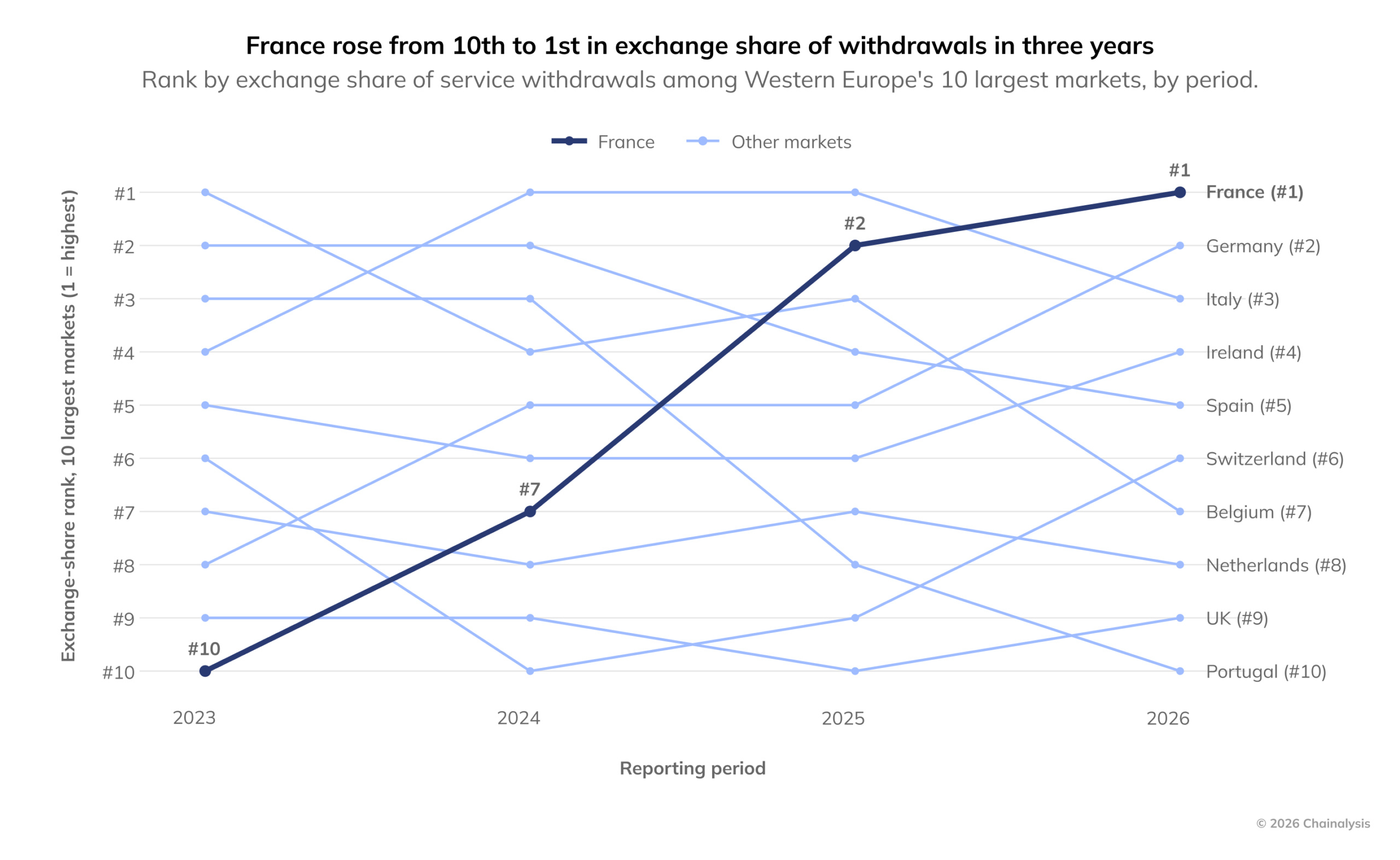
Chart: France’s share of exchange withdrawals climbed from 10th to first in Western Europe in three years
The number of personal French wallets holding stablecoins continued to rise: from 3,577 in June 2025 to 12,255 in June 2026, a 3.4-fold increase. The average for the rest of Western Europe was just 1.7 times.
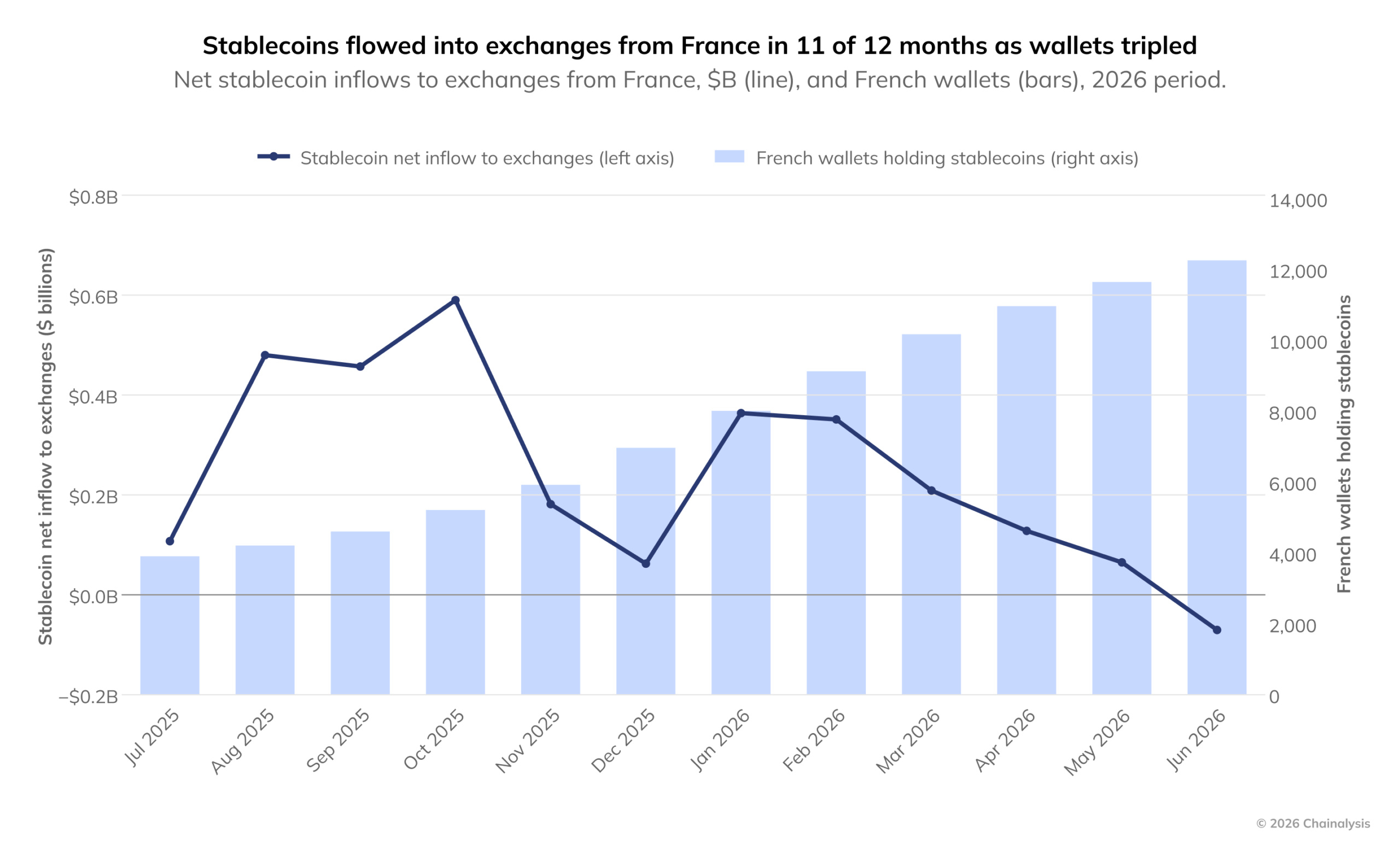
Chart: The number of stablecoin wallets in France tripled, with net stablecoin inflows to exchanges in 11 of 12 months
Wallet growth moved in step with pressure in the bond market. Monthly growth was around 6% in mid-2025, then surged to 18% in a single month at the end of the year, after turmoil in the bond market that autumn. As market sentiment calmed, growth fell back to 5% by June 2026. The report’s data ends in June, so the new wave of bond market turmoil in October is outside its scope, and any further effects cannot yet be observed.
During the period studied, French users’ self-custodied stablecoin balances surged by 192%, while French bank deposits grew by just 2%. Stablecoins remain small compared with traditional savings, but their growth rate is striking.
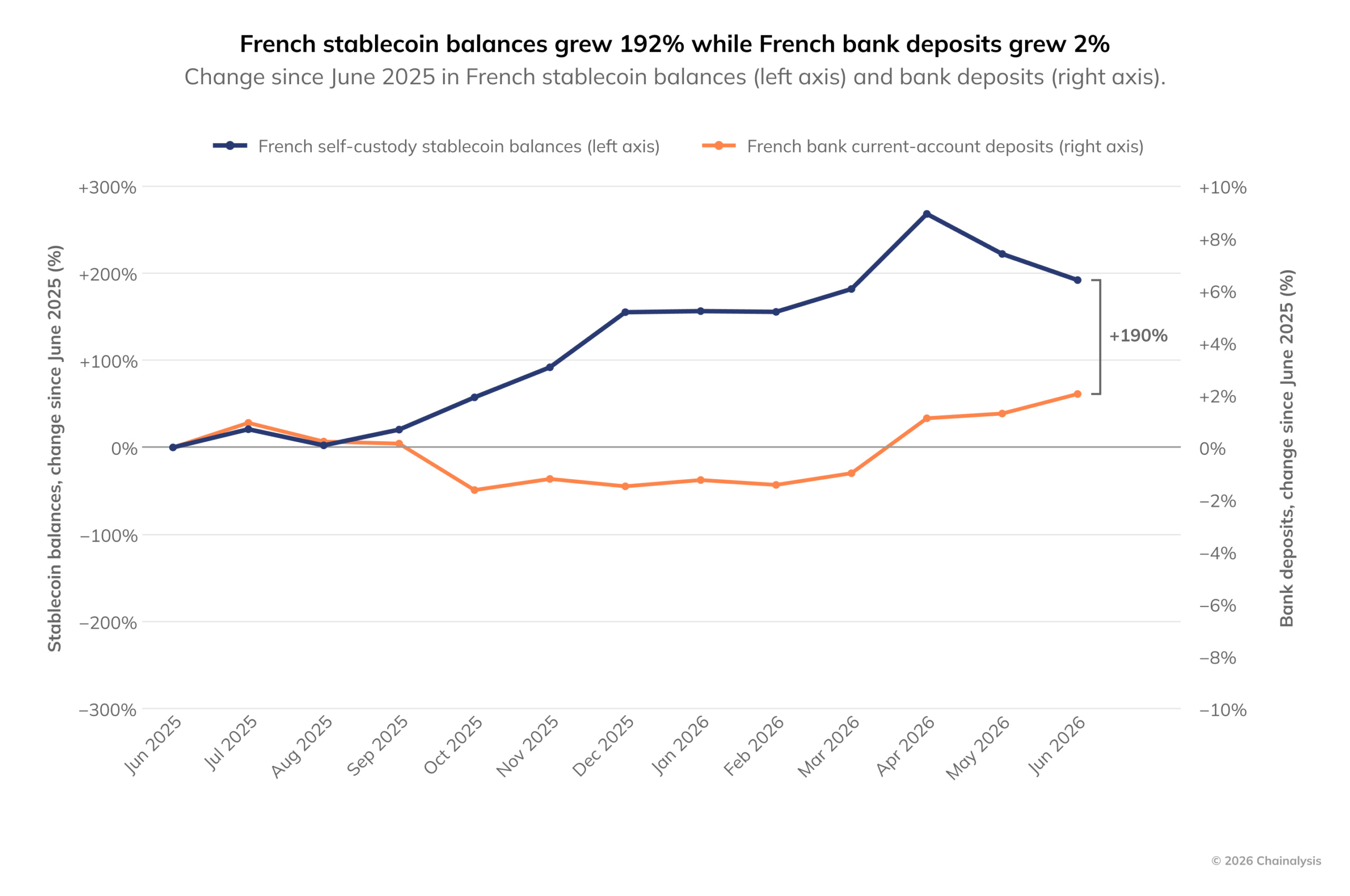
Chart: Self-custodied stablecoin balances in France rose 192%, while bank deposits grew by just 2% over the same period
Taken together, these trends suggest that French residents are seeking alternative ways to store assets amid uncertainty. They do not mean that people have lost faith in the euro; rather, they reflect a choice to diversify their portfolios.
Spanish exchanges attract users from across Europe
Inflows to Spanish crypto exchanges are no longer driven mainly by domestic users. Users from other European countries contribute more funds than local users, making Spain a hub for crypto trading across Europe.
Since 2024, both domestic and cross-border inflows to Spanish exchanges have grown, but cross-border funds have increased much faster. During the period studied, inflows from other European countries exceeded those from Spanish users.
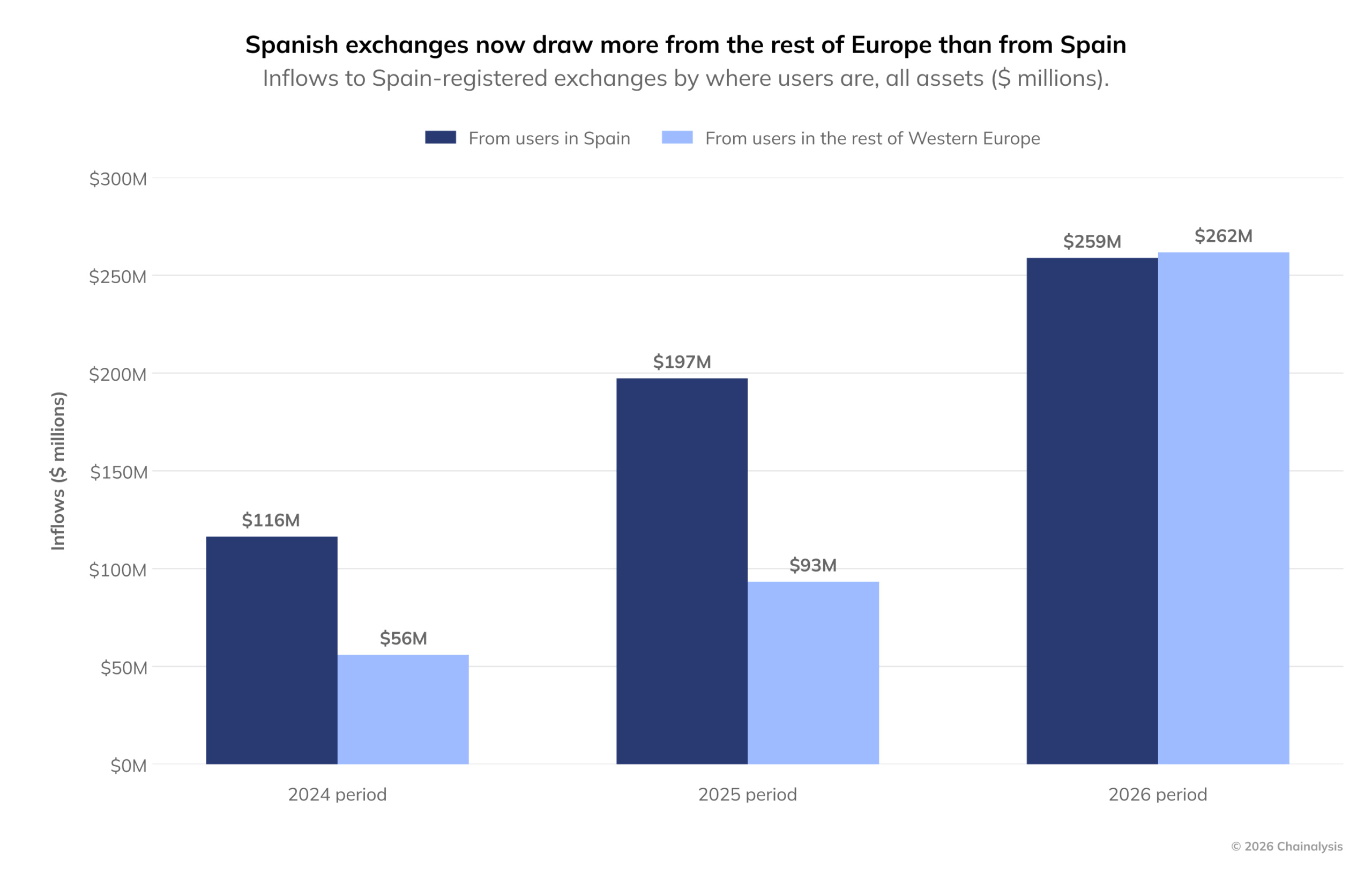
Chart: Sources of funds flowing into Spanish exchanges: Western European users from abroad now outnumber domestic Spanish users
Growth in cross-border inflows has been broad-based. Among the countries that transferred more than $100,000 to Spanish exchanges in the previous year, the average increase during the period studied was 198%, up from 100% the year before. Median growth rose from 82% to 162%. Italy and Portugal were the largest sources of funds: inflows from Italy surged from 22% growth to 329%, while those from Portugal jumped from 36% to 751%.
Inflows to Spanish exchanges from other European countries grew by 79.1%, while Spain’s domestic crypto economy grew by just 24.6%. From July 2023 to the present, Western European users transferred a total of $984 million to Spanish exchanges, of which $521 million flowed in during the current period studied.
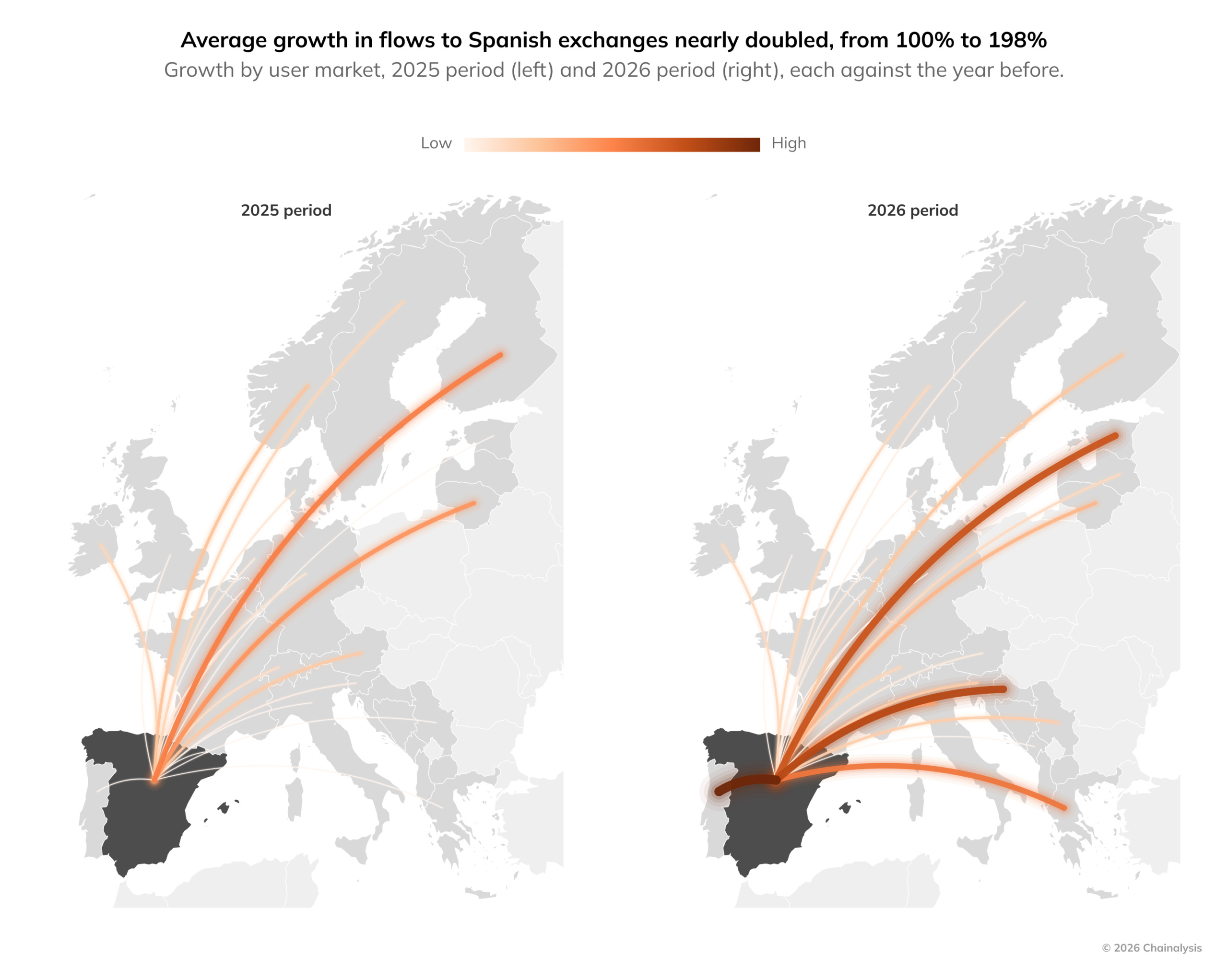
Chart: Growth in inflows to Spanish exchanges nearly doubled, rising from 100% to 198%
Gabriel Ayala, Director of API and Banking at leading Spanish exchange Bit2Me, explained the reasons behind this: some neighboring countries lack a leading domestic platform. “The size and language characteristics of the Portuguese market make it difficult for a large domestic platform to emerge; Italy’s complex regulation and fragmented market make it difficult to build a large local exchange.”
Spanish platforms seized the opportunity, using their compliance capabilities and scale to compete across Europe. MiCA’s unified regulatory framework has also lowered the barriers to operating across the EU. The rise of Spanish exchanges reflects the broader integration of markets across Europe.
Europe’s crypto industry turns a new page
The spread of stablecoins, cooling DEX trading in some markets, and exchanges attracting users across borders are reshaping Western Europe’s crypto market, alongside changing user habits, fund preferences, and external macroeconomic factors. Robinhood’s Spangevičius summed it up: Europe’s crypto industry has moved from scattered speculation to structural maturity.
Financial risks, geopolitical events, and regulatory changes are transforming digital asset trading worldwide, and Europe offers one of the clearest examples of these shifts. Whether the industry can continue to move forward depends not only on whether institutional capital keeps flowing in, but also on how industry participants adapt to an ever-changing financial environment and regulatory landscape.
As institutional involvement deepens, consumer protection, regulatory harmonization, and the links between crypto markets and the traditional banking system will become central issues shaping the industry’s long-term direction.