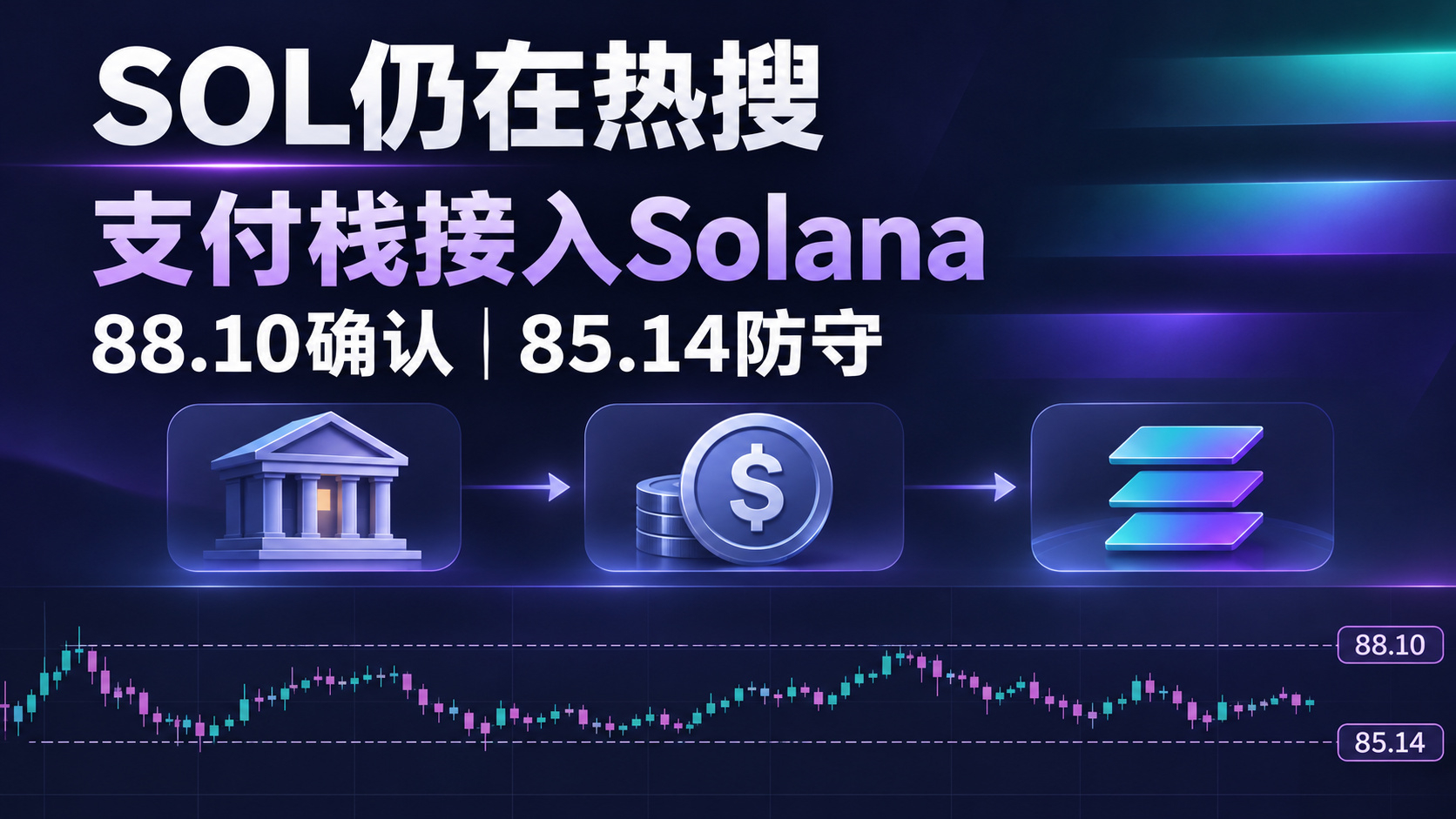
SOL remains a hot search|Polygon payment stack now supports Solana|Waiting for real demand near $86
My view is that expanding payment access has value, but I won’t treat a single integration announcement as direct buying demand for SOL. SOL is still among Binance Square’s Most Searched assets over the past six hours. The verifiable related development is that Polygon announced officially on October 29 that its Open Money Stack now supports Solana: businesses can use a single product workflow for bank deposits, fiat and stablecoin conversions, holding funds in Solana wallets, cross-chain routing, and withdrawals to banks or cards. The Solana Foundation’s October ecosystem roundup on November 6 also listed this integration. The two official sources corroborate that the functionality has been integrated, but neither provides figures for new merchants, settlement volume, or SOL purchases today.
I think the key issue is friction along the payment path. In the past, a business moving funds from a bank account into stablecoins, transferring them across multiple chains, and ultimately making a payment often had to connect to several service providers separately. If a unified interface operates reliably, it could shorten product launch times and increase the chances of Solana being used as a settlement network. However, cross-chain routing means the activity may not stay on Solana, and an increase in stablecoin transactions does not necessarily translate into proportional demand for SOL. On-chain transactions require a small amount of SOL for fees, but low fees are precisely one of Solana’s advantages; we should not imagine every dollar of payment volume as a dollar of net buying demand for SOL. What is genuinely worth tracking is the number of merchants actually brought online, sustained transaction volume, balances remaining on Solana, and network revenue.
The market has not responded as if an announcement alone were enough to trigger a breakout. When I checked Binance SOLUSDT spot, the price was around $86.14, down about 0.4% over 24 hours, with a range of $85.14 to $88.07. Solana’s official status page showed the mainnet and RPC operating normally, with no incident reports on November 9 or 10. This only tells us that the current pullback cannot simply be attributed to a network outage; it does not prove that ETF flows or macro factors are entirely responsible. Farside’s SOL fund table for November 9 provisionally shows net outflows of $7.7 million, while the TSOL line item is still blank, and the total may be revised. This is one clue about fund flows, not a real-time measure of selling pressure during today’s session.
The U.S. Bureau of Labor Statistics will release October CPI tonight, so I’m putting more emphasis on risk management ahead of the report. If inflation comes in above expectations, interest-rate and dollar expectations could weigh on risk assets, including SOL; if it comes in below expectations, any improvement in sentiment still needs price confirmation. I’m using around $88.10 as the short-term threshold for a bullish turn and $85.14 as the floor of the current range. Only if SOL moves above $88.10 after CPI and holds it on a retest will I reconsider my current wait-and-see stance. If it falls below $85.14 and fails to rebound convincingly, I’d prioritize the possibility of further downside rather than average down based on the payment narrative.
If I were trading this myself, I wouldn’t enter right now; I’d only consider a conditional spot long. The trigger would be SOL holding firmly above $88.10 on increased volume for at least an hour after the CPI release, with the level holding on a retest. I’d use 20% of my tradable capital for the initial position, add up to 30% only after a confirmed break above the range high, and avoid high leverage. The first target is $90, where I’d take half off; the second is $92, where I’d halve the remaining position. I’d place the stop below $85 and close the entire position if it is hit. Even if the stop is not hit, I’d exit if SOL falls back below $88.10 within a day of entry. If the trigger never occurs, I’d stay in cash and wait for payment adoption data and price action to validate the thesis together.
#CPITestsDecemberRateOutlook #SOL
This is only my personal market observation and does not constitute investment advice.