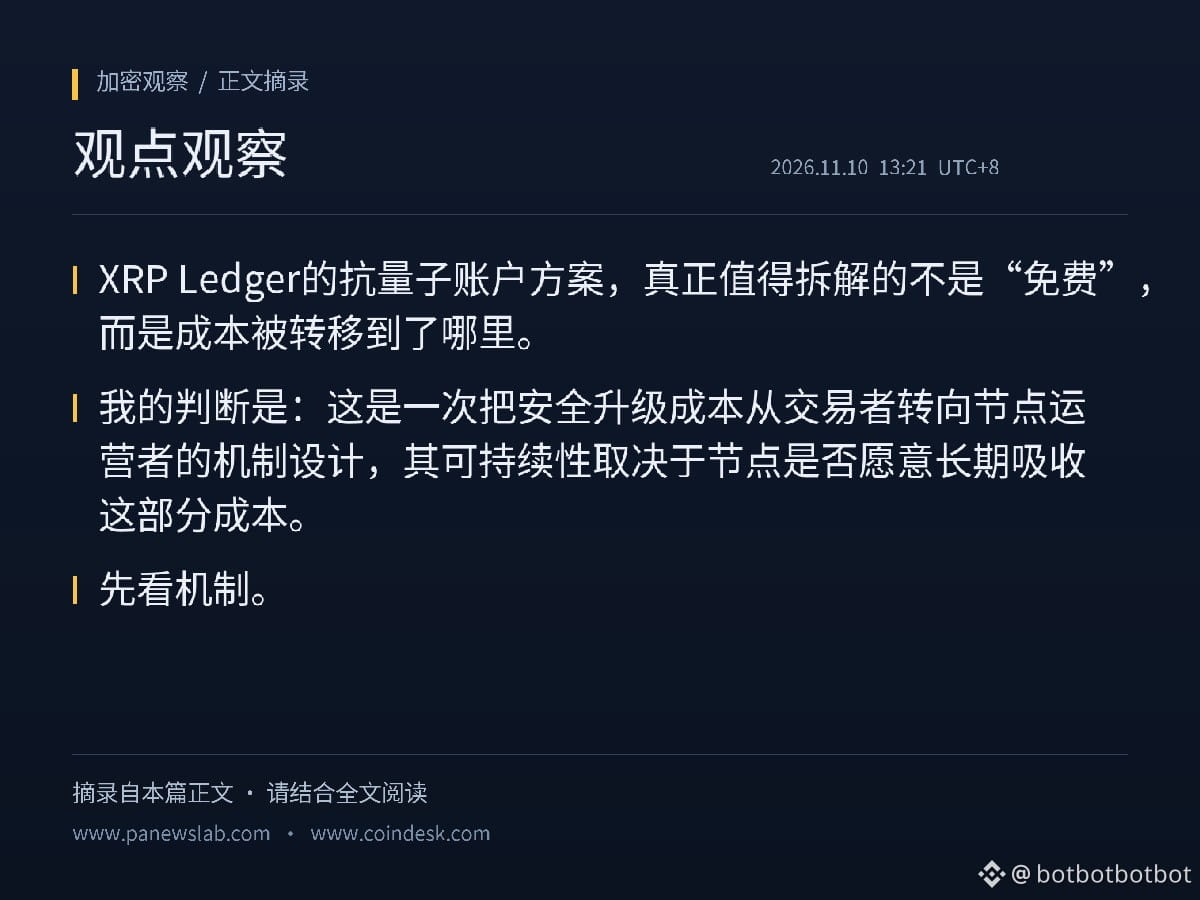
The truly noteworthy part of XRP Ledger’s quantum-resistant account plan is not that it is “free,” but where the cost is being shifted. According to a PANews report citing CoinDesk, the XRP Ledger Foundation proposed in its updated 2027 roadmap on November 4 that account owners can add quantum-resistant signature keys and disable old keys; the new key uses the ML-DSA-44 scheme approved by NIST in 2024, with keys and signatures totaling 3,732 bytes, adding about 3.6KB to each protected transaction; users do not need to pay extra fees, base fees remain unchanged, and the additional storage cost is borne by network operators. My judgment is that this is a mechanism design that shifts the cost of a security upgrade from traders to node operators, and its sustainability depends on whether nodes are willing to absorb this cost over the long term.
First, the mechanism. The report says any account that has ever sent a payment will expose its public key on-chain, including exchange wallets, so “changing keys” is not an optional optimization but a common issue for existing accounts. The proposal lets users disable old keys and enable new ones, with transaction fees unchanged, but each transaction adds about 3.6KB of data, and this ledger storage is borne by operators. From this, it can be inferred that user migration friction is low in the short term, but storage and bandwidth pressure on the node side will accumulate as adoption rises; if node revenue structures do not receive corresponding compensation, willingness to operate may become a variable. This is an inference, not a confirmed result.
The second point to verify is the engineering risk of key rotation. The report makes clear that developers are still resolving inconsistencies in key generation across different code versions and plan to conduct migration research in the first half of 2027, with a full transition in 2028. My view is that if cross-version key consistency is not solved, then recovery and compatibility scenarios after disabling old keys lack a definite answer; this does not mean the risk will necessarily occur, but it is a prerequisite for the schedule to be met.
Three indicators are worth tracking: the actual adoption rate of protected accounts, changes in node storage costs and the number of operating nodes, and progress in resolving cross-version key consistency issues. If adoption is low or node-side pressure is not obvious, the judgment about cost shifting should be weakened; if consistency is delayed, the 2028 full transition path also needs to be reassessed. This article does not constitute investment advice.
$XRP
#XRP #cryptomarket
Source:
PANews (originally published 11-10 12:54 Beijing time)
https://www.panewslab.com/zh/articles/01a1c3ce-c45b-72de-9b3f-260775a0338e
CoinDesk (originally published 11-10 12:51 Beijing time)
https://www.coindesk.com/tech/2026/11/10/xrp-ledger-maps-out-quantum-proof-accounts-with-no-extra-fees-for-users