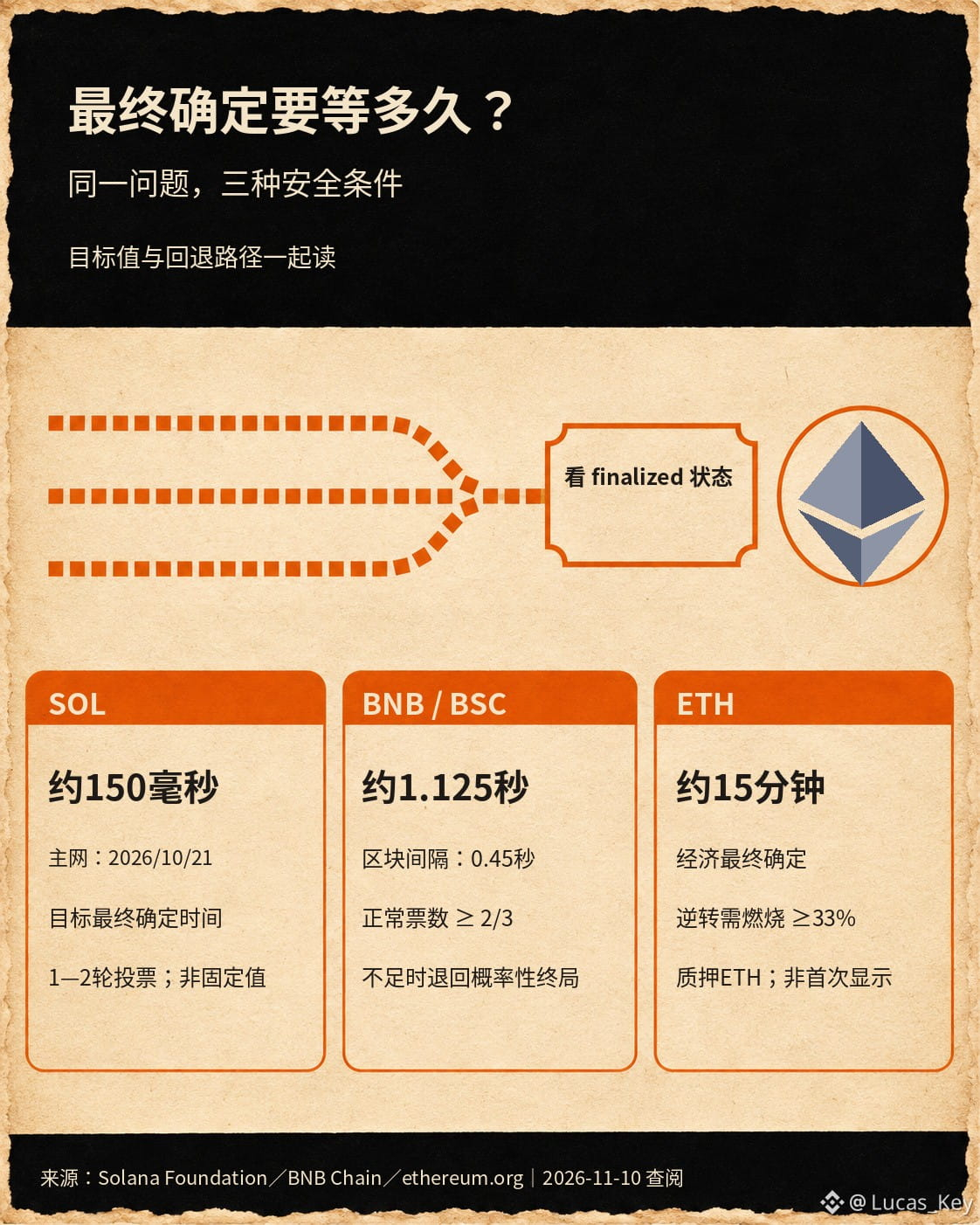
Alpenglow at $SOL went live on mainnet on October 21. The approximately 150 milliseconds cited in official materials is a target for finality, not a fixed promise for every transaction. Set alongside the approximately 1.125 seconds in BSC documentation at $BNB and the approximately 15 minutes on the $ETH mainnet, the speed difference is striking—but the security conditions of all three chains must also be considered.
There are practical reasons to favor faster finality: in situations such as cross-chain transfers, exchange deposits, and payment settlement, wait times directly affect the user experience. Solana changed voting to direct communication between validators, aggregated into certificates. Its official materials also explain that 150 milliseconds is a target that varies with stake distribution and voting rounds; block time is a separate matter. BSC’s approximately 1.125 seconds assumes that at least two-thirds of validators are voting normally; if there are too few votes, it falls back to probabilistic finality. Ethereum’s approximately 15 minutes refers to economic finality, where reversing a block would incur substantial staking penalties—not to the time it takes for a wallet to first show “success.”
So I would not rank these three figures directly as a “security ranking.” A more useful comparison is: which level of state does an application wait for before releasing assets? Solana’s finality certificate, BSC’s finalized block marker, and ETH’s finalized checkpoint are all signals that can be tracked. When discussing fast settlement, first clarify the waiting conditions and the fallback path in case of failure—that’s how we can tell who benefits from the speed improvement. Sources: official technical materials from Solana, BNB Chain, and ethereum.org; data reflects information checked on November 10, 2026. Risk notice: cross-chain and custodial platforms may set additional confirmation rules, and actual arrival times are not determined by on-chain finality alone.