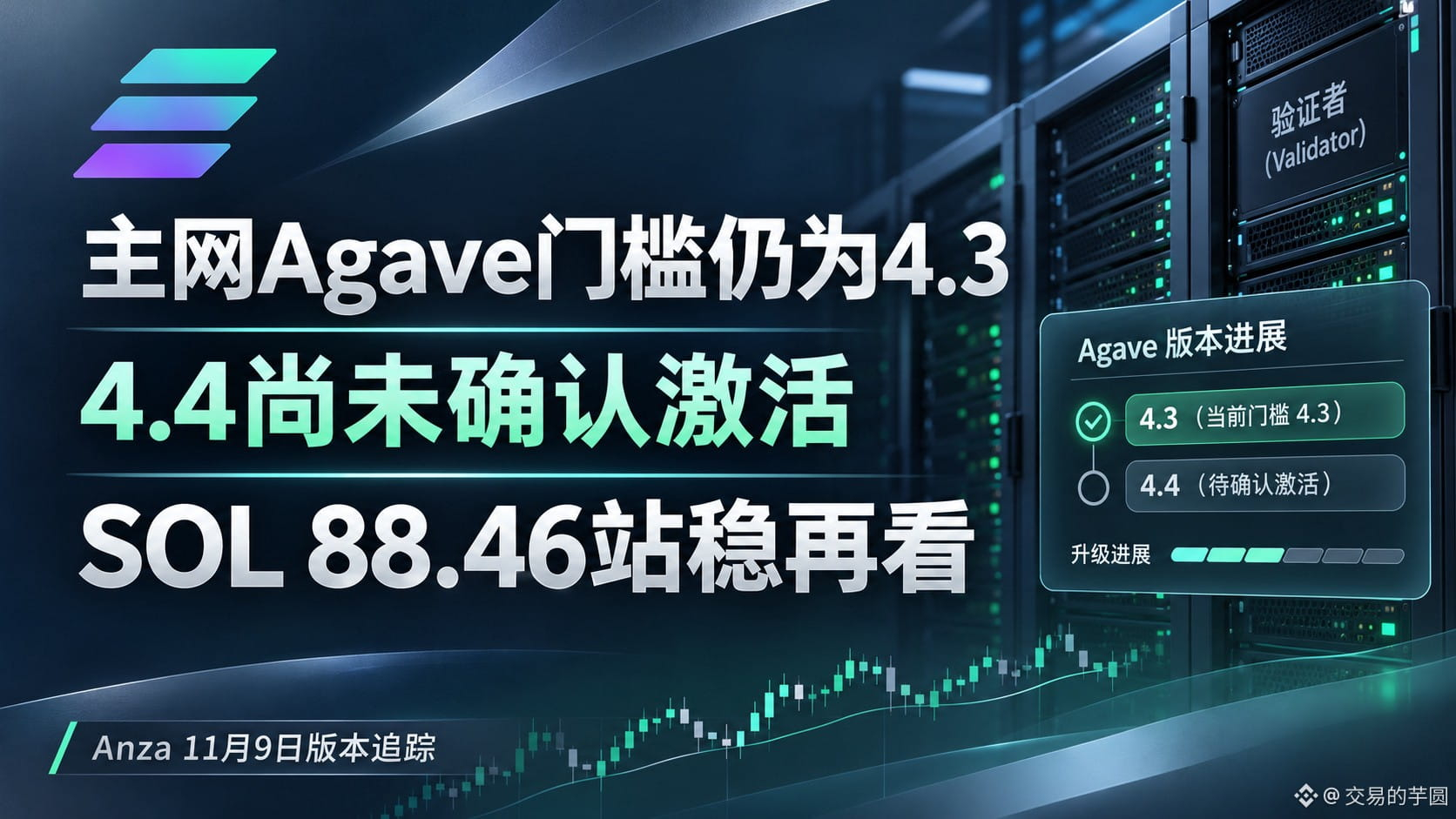
SOL client threshold remains at 4.3 | Agave 4.4 listed as a subsequent version, not activated on mainnet | I’ll wait before $88.46
My view is to treat upgrade progress as an operational fact, not to assume that a version number change is directly a catalyst for SOL to rise. Anza, Solana’s validator client, updated its official Feature Gate Tracker on November 9: the minimum Agave version currently supported on mainnet remains 4.3.0, while the testnet lists the 4.4.0 test version; the “next expected threshold” field for mainnet gives no confirmed date. The Solana Foundation’s upgrades page describes Agave 4.4 as expected in November, with features still in development. Neither source supports the claim that “4.4 is already fully active on mainnet.”
The threshold limits the minimum client version validators can run, affecting whether nodes can keep up during an upgrade. Anza explains that raising the mainnet minor-version threshold and activating related features requires the new version to be adopted by at least 95% of staked weight, followed by two full epochs. This is a condition in the published process, not a voting result that has already been completed, and it does not mean 95% of nodes. Stake weight and node count are different measures. Features passing on testnet or devnet does not mean they have gone live on mainnet. For long-term holders, the coordination costs of validator upgrades and network continuity matter more.
The market has not given this progress a clear, one-way reaction. SOLUSDT on Binance was around $86.61 when checked, up about 0.69% over 24 hours, with a high of $88.46 and a low of $85.14; the price remains within the day’s range. The official status page shows Solana mainnet and RPC operating normally, but normal status does not mean that all pending features have been deployed. Farside’s SOL fund breakdown for November 9 is still blank; the automated total should not be treated as confirmed zero flows. To discuss institutional demand, I would at least wait for complete fund subscription and redemption data and price action to confirm it together, rather than using client versions to fill in for flow evidence.
SOL is included in the Plaza’s six-hour trending searches, but this round’s trending topics have no accurate tag directly related to this version threshold, so I’m discussing only the project developments I actually found. If official sources later provide a mainnet activation epoch, stake adoption rate, and release notes, then the assessment can move from “planned progress” to “execution on the ground”; if the plan is delayed or nodes encounter compatibility issues, the risk premium may instead rise. For now, I view $88.46 as the upper confirmation level and $85.14 as the downside risk level. Both prices come from the current 24-hour market data and will change as new data comes in.
If I were trading this myself, I would not enter at present. I would only consider a small spot long if the conditions are met, with a planned position no larger than 6% of tradable funds. The entry trigger is a four-hour close above $88.50, followed by a pullback that holds above $87.80, while the official status page shows no new mainnet incident. After the trigger, the first target is $91, where I would close half; the second target is $94, where I would close half of the remaining position. I would exit the rest if a four-hour close falls back below $88.50. The initial stop-loss is $85.90; if hit, I would exit the entire position, without using high leverage or averaging down. If the price first breaks below $85.14, I would cancel the plan; if official sources confirm that the 4.4 launch comes with compatibility incidents, I would also immediately discard my view that the upgrade is progressing smoothly. Until the trigger is met, this is only a plan, not a record of a completed trade.
Sources: Anza’s official version-threshold tracker, the Solana Foundation’s upgrades and status pages, and Binance market data. #SOL
This is only my personal market observation and does not constitute investment advice.