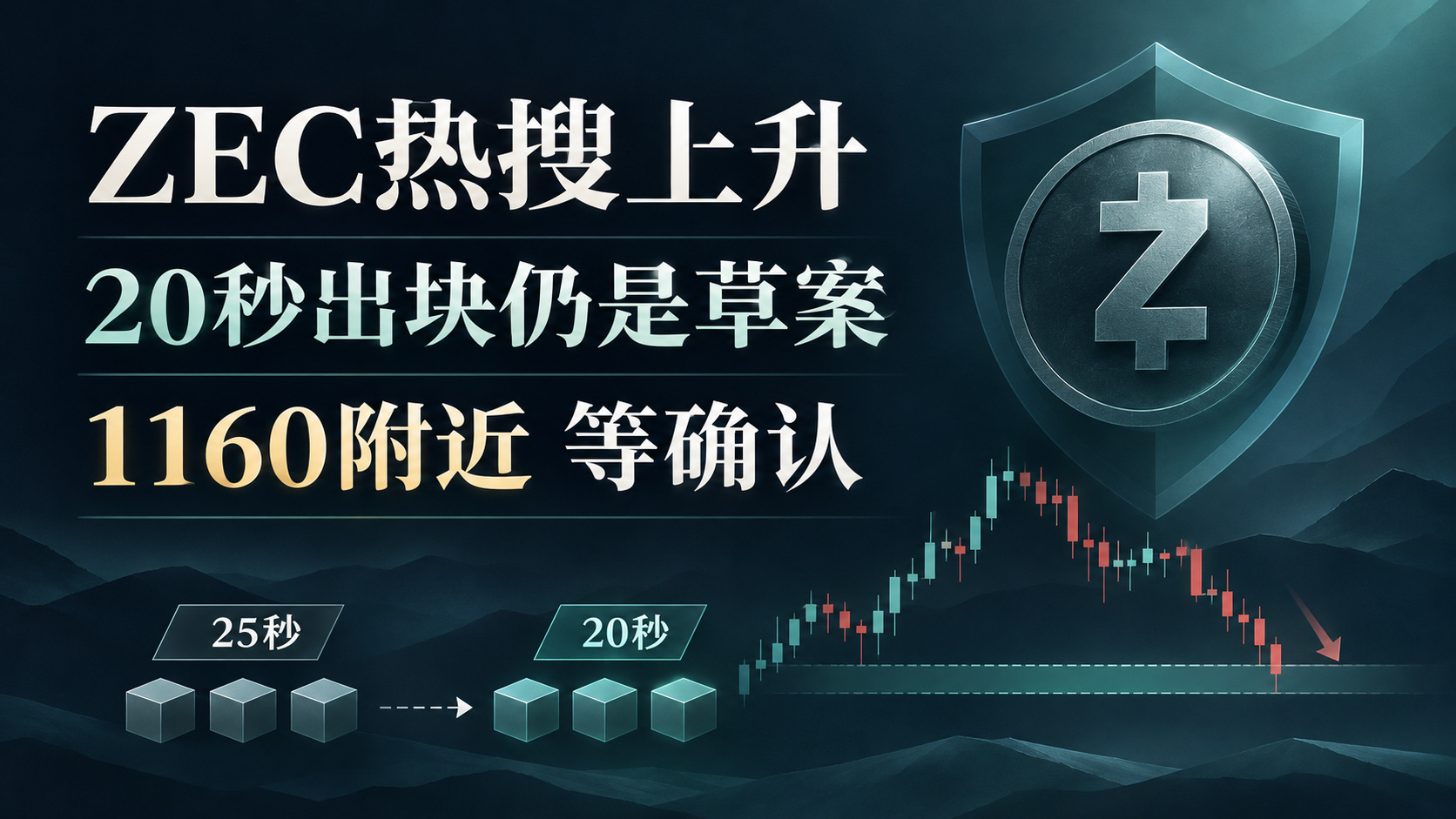
ZEC trending|20-second block time still just a draft|I’m waiting for confirmation around 1160
My stance is to watch cautiously and not treat a developer proposal as an upgrade already implemented on mainnet. In Binance Square’s six-hour Most Searched list, ZEC was labeled a Rapid Riser. That shows search interest is rising, but it doesn’t mean buying momentum has followed through. Binance News reported that developers are proposing to reduce Zcash’s target block interval from 25 seconds to 20 seconds. I checked the original post on the Zcash community forum: ValarDragon and Evan Forbes proposed the plan on November 8, hoping it would be put to the next vote and considered for inclusion in NU7.1. For now, it’s a discussion and a draft—not an approved upgrade date or a rule that has taken effect. The Zcash Foundation’s NU7 documentation confirms that the current target interval was reduced from 75 seconds to 25 seconds; the two changes should not be conflated.
The real point of interest in this draft is the trade-off. Cutting another five seconds from the block interval could theoretically reduce the wait for the first confirmation, exchange crediting, and payments. But the proposal also reduces the per-block limit on shielded transaction actions by one fifth, with the aim of keeping the daily wallet synchronization burden roughly unchanged. The authors explicitly state that this is a latency optimization, not an increase in daily private transaction throughput. Their stress tests estimate orphan rates of about 1.9% and 3.3% for different node configurations. Independent testing, a vote, client implementation, and actual mainnet performance still need to be assessed. Faster block times also don’t automatically improve security, and trading platforms may adjust their confirmation requirements based on their own risk controls.
First, the market facts: at the time of writing, ZEC/USDT on Binance was around 1169, with a rolling 24-hour high of 1252 and a low of 1159, down about 6.5%; ZEC/USD on Kraken was around 1168, with a low near 1157. The rise in search interest coincided with a price decline, so the draft shouldn’t be interpreted as a bullish catalyst, nor does it justify claiming that institutions have increased their holdings. The November 9 entries in Farside’s ZCSH table were still blank, so the displayed total of zero cannot be treated as a verified zero flow. The previous privacy development for wallet servers is also different from this consensus-layer draft: the former concerns protecting request information, while the latter concerns confirmation wait times.
If I were trading this myself, I wouldn’t enter now. I’d only consider a leveraged-free spot long, and wouldn’t chase a short during a decline. My total position would be capped at 1.5% of my capital: I’d first wait for ZEC to reclaim 1185, with two complete 15-minute candles closing above it, then enter only if a retest of 1175–1185 holds. I’d take half off at 1205, then half of the remainder at 1230. I’d close the remaining position if it failed to hold 1200. If the price fell below 1155 after entry, I’d stop out and close the entire position. If it broke below 1155 before an entry was triggered, I’d abandon the whole plan and reassess. This position is only for a controlled trial; whether the draft goes to a vote doesn’t replace a stop-loss. My view would be invalidated if the price continued to hold below 1155, or if official follow-up testing or governance clearly rejected the 20-second proposal. Conversely, I’d only become more confident if on-chain execution and trading volume both improved.
Sources: November 8 original post on the Zcash community forum, Zcash Foundation NU7 documentation, Binance News, live quotes from Binance and Kraken, Farside. #ZEC
This is only my personal market observation and does not constitute investment advice.