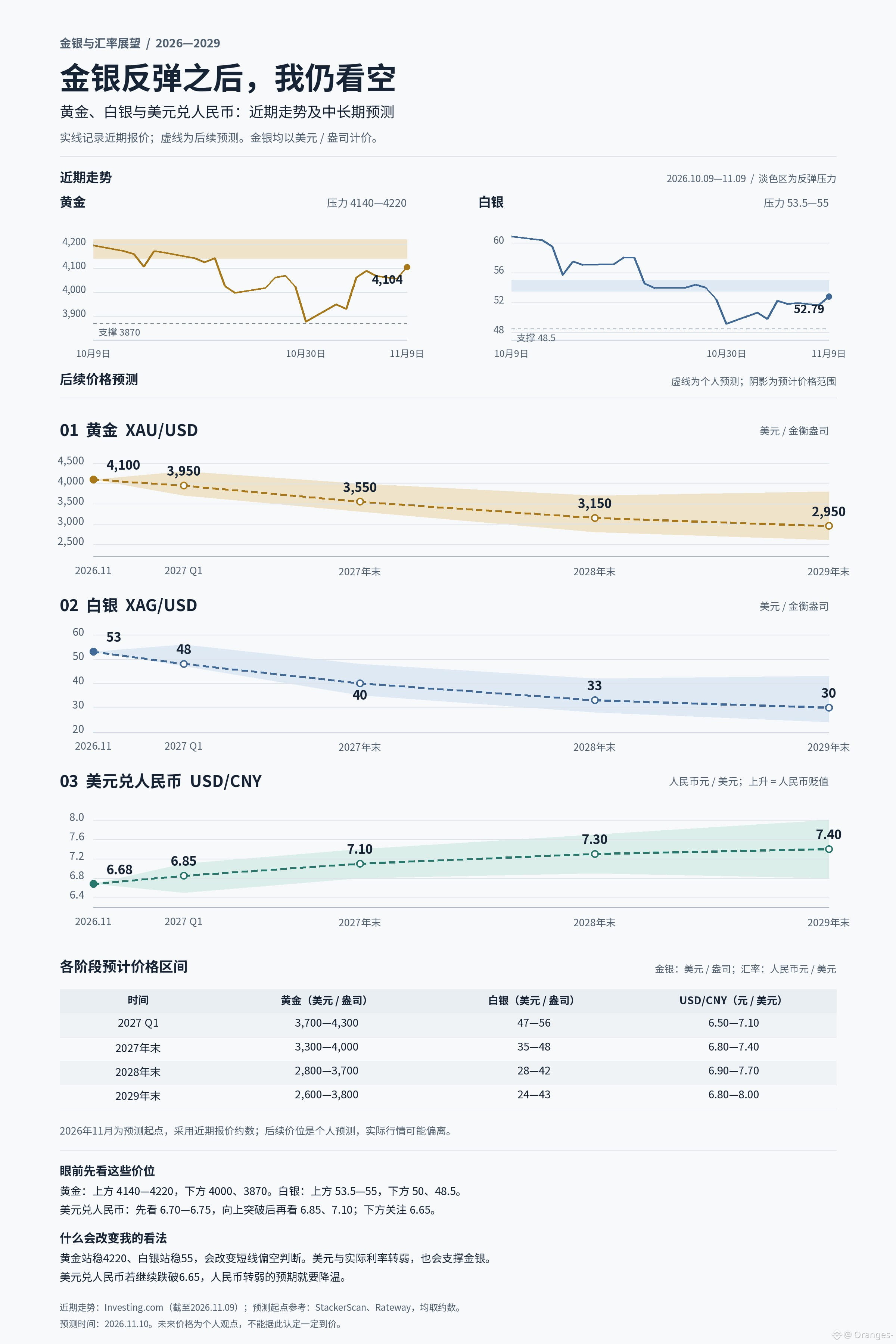
Silver has rebounded to $53, but I’m still bearish. The same goes for gold.
Silver was still at $60.83 on October 9, fell to around $49 at the end of October, and was quoted at $52.79 on November 9. This rebound has recovered some of the losses, but prices are still a long way from their October levels. I’m more inclined to see it as a recovery after the decline.
First, watch $53.5–55 on the upside. If prices can’t break through this area, they could return to around $50 and $48.5. If $48.5 gives way, the next level to watch is $47; if gold also continues to weaken, silver could return to around $40.
Gold’s rebound has been somewhat stronger than silver’s. Its mid-October high was close to $4,220, and it fell to a low of $3,870 at the end of October, before recovering to around $4,104 on November 9. Resistance lies at $4,140–4,220 for now. If gold can’t reclaim this range, I still lean toward $4,000 first, followed by $3,870. If the latter level is breached, the medium-term outlook points toward the $3,500 area.
The gold-silver ratio also rose from about 69 on October 9 to 78 on November 9. Silver has clearly underperformed gold. If gold’s current rebound comes to an end, silver could face greater downward pressure.
Looking back at the charts since 2010, I’m more concerned that the duration of this correction may be underestimated. From 2011 to 2015, gold went through a decline that lasted several years. The current rebound isn’t enough to make me change my view and call this the start of a new bull market.
Looking ahead, the U.S. dollar and real interest rates remain key factors. On October 28, the Fed kept its policy rate at 3.75%–4.00%, with two members still advocating a rate hike. If real returns on U.S. dollar assets remain attractive, the correction in gold and silver could drag on longer.
As for the yuan, I expect it to weaken in the next phase. The dollar is currently around 6.68 yuan. Over the past few months, it fell from around 6.74 to 6.65, meaning the yuan had been appreciating. Next, watch whether the dollar-yuan exchange rate can move back above 6.70–6.75, followed by 6.85 and 7.10. If it continues to fall below 6.65, I’ll temper my expectations for the yuan to weaken.
My current estimates are: for the first quarter of 2027, gold around $3,950, silver around $48, and the dollar-yuan exchange rate at 6.85; by the end of 2027, I expect 3,550, 40, and 7.10, respectively. If the correction continues into 2028–2029, gold could return to around $3,000, silver could fall to $30–35, and the dollar-yuan exchange rate could reach 7.3–7.4.
#黄金 #白银 #美元 #人民币