The most dangerous weapon in the Strait of Hormuz right now is not a missile. Nor a submarine. Nor an aircraft carrier.
It is something no crew ever sees coming.
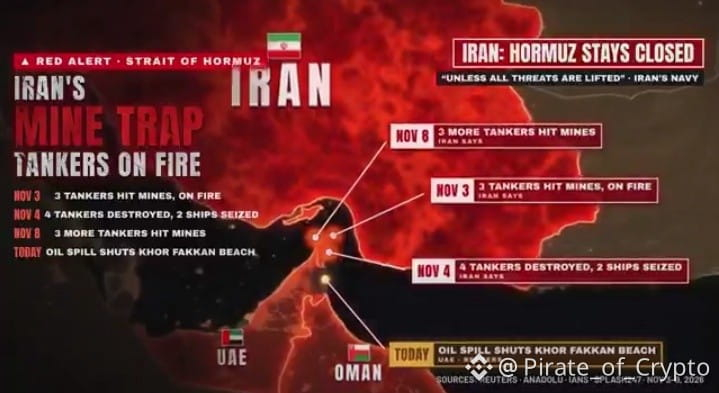
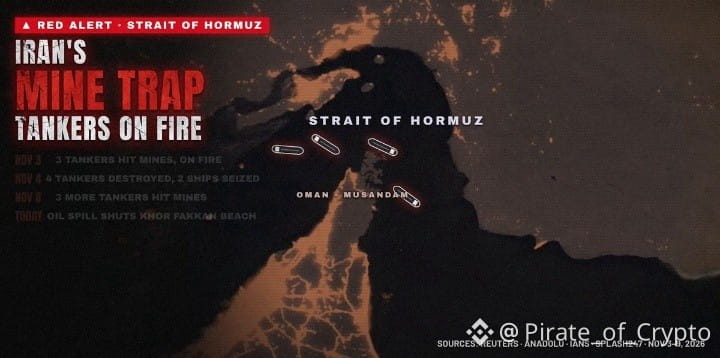
Look at the past 7 days:
→ November 3: Iran says 3 oil tankers hit naval mines and burned all night
→ November 4: Iran’s Revolutionary Guard says 4 tankers were destroyed by mines, and 2 other ships were detained
→ November 8: Iran says 3 more tankers hit mines in a single day and caught fire
→ Today: An oil spill closes a beach in Khor Fakkan, UAE
The Iranian navy says Hormuz will remain completely closed unless all threats are removed.
Washington wants Iran to reveal where the mines are.
Why mines? Because they are brutally effective. Cheap to lay. Hard to detect. Capable of stopping ships worth a billion dollars.
Each type is designed for a different trap:
▪️ Drifting mines are carried along by currents and explode on contact.
▪️ Floating contact mines sit just below the surface and explode when a ship’s hull touches their spikes.
▪️ Moored contact mines hang from a cable anchored to the seabed, like underwater tripwires.
▪️ Influence mines are smarter. They detect a ship’s magnetic field, engine noise, or pressure waves.
▪️ Bottom mines lie still on the seabed until a target passes over them.
▪️ Self-burying mines hide beneath sediment and are almost impossible to detect.
▪️ Rising torpedo mines are the most advanced. They detect the target, launch a torpedo upward, and chase the ship or submarine.
This is why mines are such a powerful geopolitical weapon. You don’t need to sink every ship.
You only need to make the waters too dangerous to cross.
We map every new report of mines in the strait as soon as it comes out. Follow us for the next report.
$GNS
$DCTH.US
$SOXL