


Imagine you're going to send bitcoins from your computer... The PC is connected to the Internet, prepares the transaction, and displays all the details....
But there's something it can't do on its own...
IT DOESN'T HAVE THE PRIVATE KEYS NEEDED TO AUTHORIZE THE SPENDING.
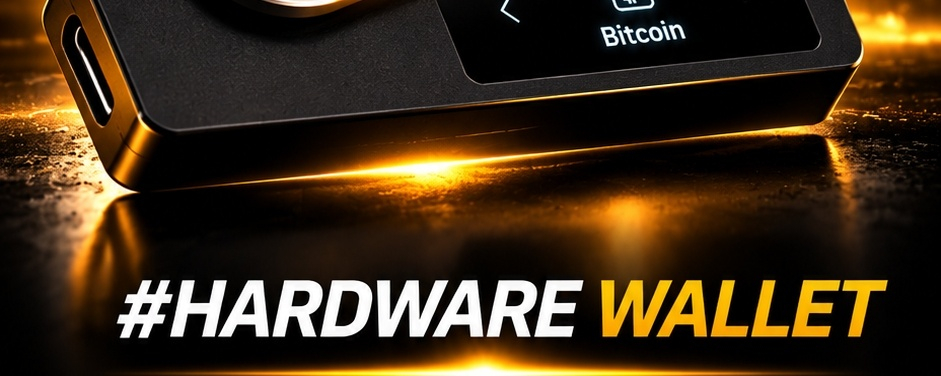
Those keys are protected on another device, designed specifically to perform cryptographic operations... That device is known as a HARDWARE WALLET.
And understanding how it works helps us understand one of the most widely used ways to protect Bitcoin keys.
WHAT EXACTLY IS A HARDWARE WALLET?
It is a specialized physical device that lets you manage cryptographic information and generate digital signatures while keeping private keys separate from the computer or phone we normally use.
But be careful...
IT IS NOT A USB DRIVE WHERE WE STORE BITCOINS.
BTC is not stored inside the device.....
What the device protects is the secret information needed to authorize certain expenditures.
Now comes the really interesting part.
HOW CAN A COMPUTER PREPARE A TRANSFER IF IT DOESN'T HAVE THE PRIVATE KEYS?
Because preparing a transaction and authorizing it are two different operations.
Let's follow an example...
Let's imagine that Ana has a hardware wallet and wants to send 2 BTC to Bruno.
Ana opens a compatible application on her computer.
She enters the destination address and the amount she wants to transfer.
The application uses the available information to prepare the transaction.
But something fundamental is still missing... CRYPTOGRAPHIC AUTHORIZATION.
To obtain it, the computer needs to communicate with the device that protects the private keys.
AND HOW DO THEY COMMUNICATE?
It depends on the model.
Some hardware wallets use USB.
Others allow information to be exchanged using QR codes or microSD cards...
The important thing is to understand what information is exchanged.
The computer sends the data needed to authorize the transaction.
One of the formats used for this procedure is called PSBT, short for Partially Signed Bitcoin Transaction.
It is a format that allows a transaction and the information needed to sign it to be transferred, even between devices that are not directly connected.
WHAT DOES THE HARDWARE WALLET DO WHEN IT RECEIVES THAT DATA?
The device interprets the operation and, on models that let you review it on their own screen, displays essential information.
For example, the amount being sent and the destination address.
It can also display the fee and other relevant details.
AND HERE WE COME TO ONE OF ITS MOST IMPORTANT SECURITY FEATURES.
Ana must check the details on the device's own screen before authorizing the signature.
Why?
Because a compromised computer could display one address while preparing a transaction intended for another.
IT'S NOT ENOUGH TO TRUST WHAT APPEARS ON THE COMPUTER. YOU HAVE TO VERIFY WHAT OPERATION THE DEVICE WILL ACTUALLY SIGN.
If Ana confirms that the details are correct, she approves the operation using the controls on her hardware wallet.
Then the cryptographic process begins.
WHAT HAPPENS INSIDE THE DEVICE?
The hardware wallet internally uses the corresponding private keys to generate the necessary digital signatures.
Those signatures are linked to the transaction data.
But there is a fundamental difference compared with using the keys directly on the computer.
THE DEVICE RETURNS THE SIGNED INFORMATION, NOT THE PRIVATE KEYS USED TO SIGN IT.
This way, a properly designed hardware wallet can authorize operations without handing its secrets over to the connected application.
AND WHAT DOES THE COMPUTER DO NEXT?
It receives the signed information.
When the transaction has all the necessary authorizations and is complete, it can be broadcast to the Bitcoin network.
Nodes perform their own checks to determine whether it complies with the protocol rules.
Therefore, the hardware wallet does not replace Bitcoin validation... Its role is to protect the keys and participate in the cryptographic authorization of operations.
BUT NOW COMES AN IMPORTANT QUESTION...
IF THE HARDWARE WALLET CONNECTS VIA USB, AREN'T ITS KEYS EXPOSED?
Not necessarily.... A USB connection allows devices to exchange data, but that doesn't mean the computer gets access to the private keys.
On devices designed to protect them, signing operations take place inside the device.
However, connecting a device to a potentially compromised computer is not without risk.
Security depends on the hardware design, its firmware, the isolation mechanisms, and properly verifying each operation.
SO IS A HARDWARE WALLET IMPOSSIBLE TO COMPROMISE? No...
A tampered device, compromised firmware, or approving an operation without checking the details can put funds at risk.
Nor is it enough to have a hardware wallet if you reveal the secret information that allows its keys to be recovered.
THE HARDWARE WALLET PROTECTS A FUNDAMENTAL ELEMENT: THE PRIVATE KEYS. BUT IT CANNOT REPLACE ALL THE CHECKS THE USER MUST PERFORM.
SO, WHAT HAVE WE JUST LEARNED?
A hardware wallet is a specialized device for managing and using cryptographic keys in an environment separate from the main computer.
The computer can prepare the operation.
The device can display its details for review and generate the corresponding signatures.
And the computer can then broadcast the signed transaction to Bitcoin.
Each component has a different role.
But there's still one question...
WHAT HAPPENS IF THAT HARDWARE WALLET BREAKS, GETS LOST, OR STOPS WORKING?
Do our bitcoins disappear? Can we regain control of the funds?
To answer that, we'll need to understand how cryptographic information is backed up and recovered....
BECAUSE TRUE SECURITY ISN'T JUST ABOUT PROTECTING A DEVICE...
IT'S ABOUT UNDERSTANDING WHAT INFORMATION IT PROTECTS....
AND WHAT HAPPENS IF WE NO LONGER HAVE ACCESS TO IT....