


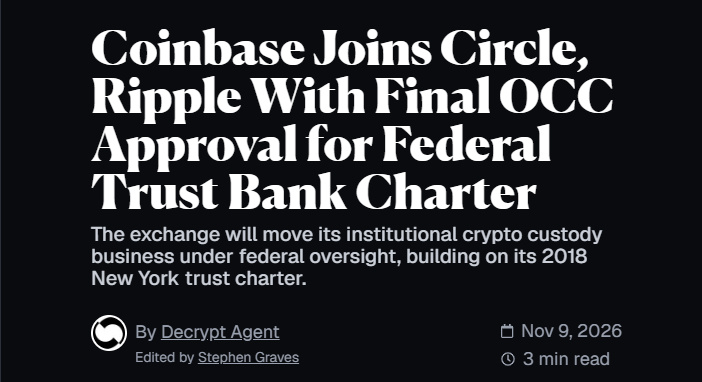
Coinbase Joins Circle, Ripple With Final OCC Approval for Federal Trust Bank Charter
The exchange will move its institutional crypto custody business under federal oversight, building on its 2018 New York trust charter.
🚨 Coinbase receives final OCC approval as a national trust bank!
📊 Official news:
• The OCC granted Coinbase National Trust Company final approval (November 6)
• Coinbase became the third crypto company after Circle and Ripple
• It will move its custody business from New York to federal oversight
━━━━━━━━━━━━━━━
🔍 What does the charter allow?
✅ Digital asset custody under federal oversight
✅ Fiduciary services for institutions
✅ Transitioning the custody business over three years
❌ But there’s an important caveat:
❌ It’s not a commercial bank (no deposits or loans)
❌ It won’t issue stablecoins
❌ It isn’t FDIC-insured
📊 Why does this matter?
✅ Coinbase has become part of the U.S. financial infrastructure
✅ Greater confidence for institutional investors
✅ A step toward integrating crypto into the traditional system
⚠️ But community banks have sued the OCC
💡 What does this mean for traders?
✅ Positive news for Coinbase and crypto as a whole
✅ Federal regulation boosts confidence
📊 Watch how the charter affects custody business and liquidity

📊 What exactly happened?
The agency: The U.S. Office of the Comptroller of the Currency (OCC) granted Coinbase National Trust Company (CNTC) final approval for a national trust bank charter on November 6, 2026.
The lineup: Coinbase became the third crypto company to receive final approval, after Circle (July 2026) and Ripple (October 2026).
Previous status: Coinbase had been licensed at the state level in New York (NYDFS) since 2018. The new federal charter adds OCC oversight of its custody business.
🎯 What does this charter allow (and not allow)?
✅ What’s allowed:
Digital asset custody: Coinbase will be able to offer digital asset custody services under federal oversight, expanding its institutional business.
Business transition: It will move its custody business from the New York-licensed entity to the federal entity over three years.
Trust services: Providing fiduciary services for digital assets.
❌ What’s not allowed:
It’s not a commercial bank: It won’t be able to accept regular retail deposits or offer loans like traditional banks.
It won’t issue stablecoins: This charter doesn’t allow Coinbase to issue stablecoins itself.
No federal insurance: The bank isn’t insured by the FDIC (like regular banks).
🔍 Why does this matter? (Analysis)
Bringing crypto into the financial system: Coinbase has become part of Wall Street’s infrastructure. A national trust bank charter puts the platform under federal oversight, giving greater confidence to institutions looking to entrust it with their funds.
Institutional custody: Coinbase is the world’s largest digital asset custodian (according to CEO Brian Armstrong). This charter will allow it to offer services under a federal framework, opening the door to institutional investors who were wary of state-level oversight.
Preparing for stablecoins: Although the charter doesn’t allow it to issue stablecoins, Coinbase partners with Circle (USDC) and Ripple (RLUSD). Analysts say this charter could eventually pave the way for expanding its stablecoin business, even if not right now.
Opposition from community banks: The Independent Community Bankers of America (ICBA) sued the OCC in October 2026, arguing that these trust bank charters give crypto companies an unfair advantage because they aren’t subject to the same strict rules as federally insured banks.
#Crypto #تداول_العملات_المشفرة #Coinbase #OCC #cryptouniverseofficial #TradingStrategies💼💰