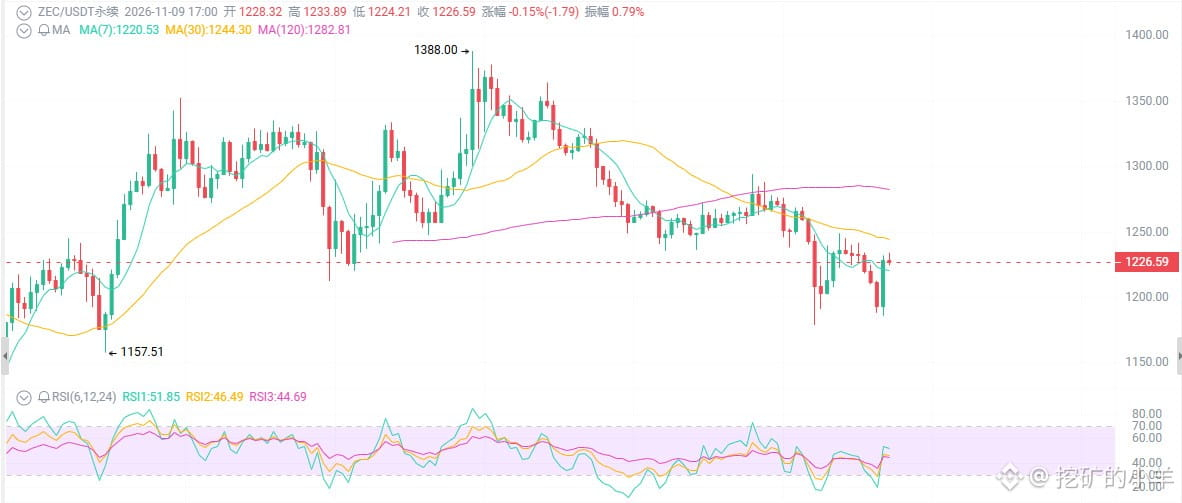
ZEC at $1,225—Did You Get Shaken Out?
Just 10 days after the upgrade went live, over 90% of long positions were liquidated, ETFs saw $13 million in outflows, and the price was slammed from $1,398 to $1,180. Everyone’s shouting “buy the rumor, sell the news,” but block times have already dropped from 75 seconds to 25. Is this a reason to run—or a chance to get in?
First, the surface story: a huge bullish catalyst went live, and the price fell instead.
On November 5–6, ZEC’s NU7 upgrade was activated on mainnet.
Before the upgrade, the price surged to $1,398. After it went live, it plunged to $1,180, down 1%–5% in 24 hours, with long liquidations accounting for more than 90% of the total. On the surface, this is a textbook case of “buy the rumor, sell the news.”
First thing to understand: NU7 isn’t a patch—it’s a new engine.
A lot of people are treating this upgrade as an ordinary technical update. They’re wrong.
Block times falling from 75 seconds to 25 means faster deposits and withdrawals at exchanges, and payment confirmations going from “wait a minute or two” to “there in a flash.”
The NSM mechanism is even more significant: 60% of transaction fees won’t go directly to miners, but will be locked in a reserve and released later, when the security budget comes under pressure after the 2031 halving. In the short term, miners earn less; in the long term, the network gets another layer of security. On top of that, retiring the Sprout pool freezes about 12,000 ZEC, tightening the circulating supply another notch.
The catalyst going live isn’t the end—it’s the start of the shakeout.
Second thing: 90% of longs were liquidated not because the fundamentals collapsed, but because leverage was too crowded.
Funding rates were +0.01% per 8 hours, meaning longs were paying shorts—about 11% annualized. Longs accounted for over 90% of liquidations in the past 24 hours.
Too many longs piled in before the upgrade, and leverage was too high. The big players used “sell the news” as an opportunity to flush out everyone chasing the rally, holding losing positions, or going all-in at 10x or 20x leverage.
What got liquidated wasn’t just positions—it was the mindset of chasing highs.
ETFs saw $13 million in outflows last week, and sentiment shifted from euphoric to neutral. But look closely: this is investors taking profits after the upgrade went live—not the privacy thesis falling apart. Shielded pools still account for around 30% of ZEC’s value, and real demand for privacy hasn’t disappeared.
Third thing: there’s no fuel in the macro environment, so high-beta assets are the first to buckle.
BTC is under pressure in the $73,000–$76,000 range, with several consecutive down weeks, while tech stocks are also pulling back and overall risk appetite is fading. ZEC’s correlation with BTC is around 0.5, but its beta is higher: if the broader market falls 1%, ZEC could fall 2%–3%.
In the short term, that’s a headwind. But think about it the other way: ZEC hasn’t gotten weaker—the market has run out of fuel. When the wind picks up, it could fly higher than anything else.