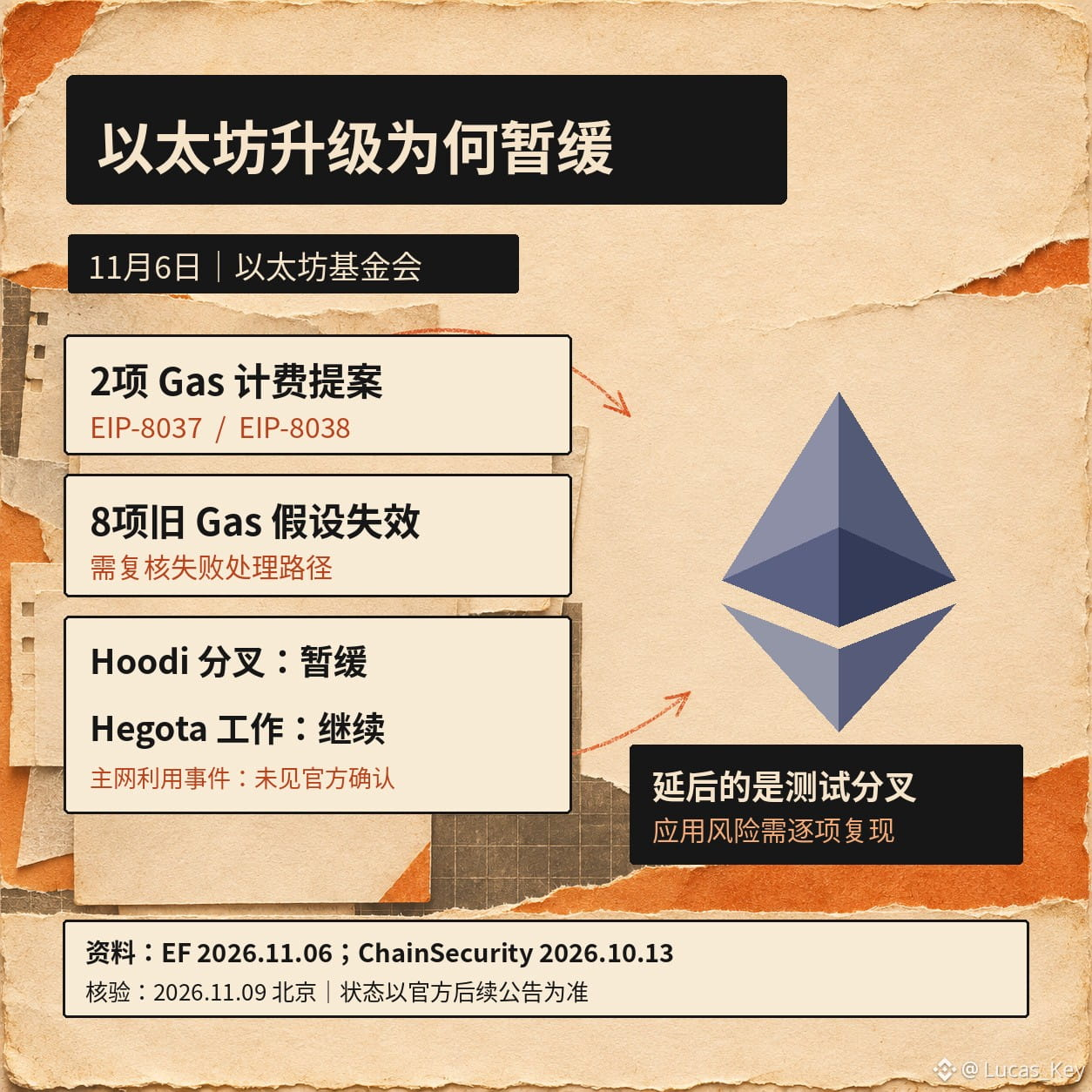
The Glamsterdam testnet progress for $ETH hit the brakes. On November 6, the Ethereum Foundation confirmed that two proposals, EIP-8037 and 8038, change the gas accounting for state creation and access, and ChainSecurity found in testing that some old assumptions relied on by projects would no longer hold. Core developers therefore postponed the Hoodi fork schedule, while noting that Hegota’s work continues to move forward.
There is solid basis for treating the delay as a risk signal. The Foundation listed 8 gas invariants that will be broken; one dangerous path is that after an external call runs out of gas, the caller’s originally expected failure handling, which would have rolled back together, may instead complete under the new accounting method and permanently record the “failure.” If an existing contract closes its retry entry point based on this assumption, the impact is more than just slightly higher fees.
But calling this a “mainnet exploit already found” goes beyond the evidence: as of November 9, what has been made public are pre-upgrade test and code review results, not an announcement that mainnet has been exploited. I am more concerned with whether the specification will be revised later, whether affected contracts will provide reproduction and fixes, and when Hoodi will resume progress. $ARB and $OP both rely on Ethereum for settlement, so their L1 contracts and cross-layer paths are worth checking; their L2 execution environments do not automatically synchronize these two EIPs, so not every L2 application can be counted as affected. Sources: Ethereum Foundation statement on November 6, ChainSecurity technical analysis on October 13. Upgrade details may still change, token price risk is borne by the reader, and this article does not constitute trading advice.
There is solid basis for treating the delay as a risk signal. The Foundation listed 8 gas invariants that will be broken; one dangerous path is that after an external call runs out of gas, the caller’s originally expected failure handling, which would have rolled back together, may instead complete under the new accounting method and permanently record the “failure.” If an existing contract closes its retry entry point based on this assumption, the impact is more than just slightly higher fees.
But calling this a “mainnet exploit already found” goes beyond the evidence: as of November 9, what has been made public are pre-upgrade test and code review results, not an announcement that mainnet has been exploited. I am more concerned with whether the specification will be revised later, whether affected contracts will provide reproduction and fixes, and when Hoodi will resume progress. $ARB and $OP both rely on Ethereum for settlement, so their L1 contracts and cross-layer paths are worth checking; their L2 execution environments do not automatically synchronize these two EIPs, so not every L2 application can be counted as affected. Sources: Ethereum Foundation statement on November 6, ChainSecurity technical analysis on October 13. Upgrade details may still change, token price risk is borne by the reader, and this article does not constitute trading advice.