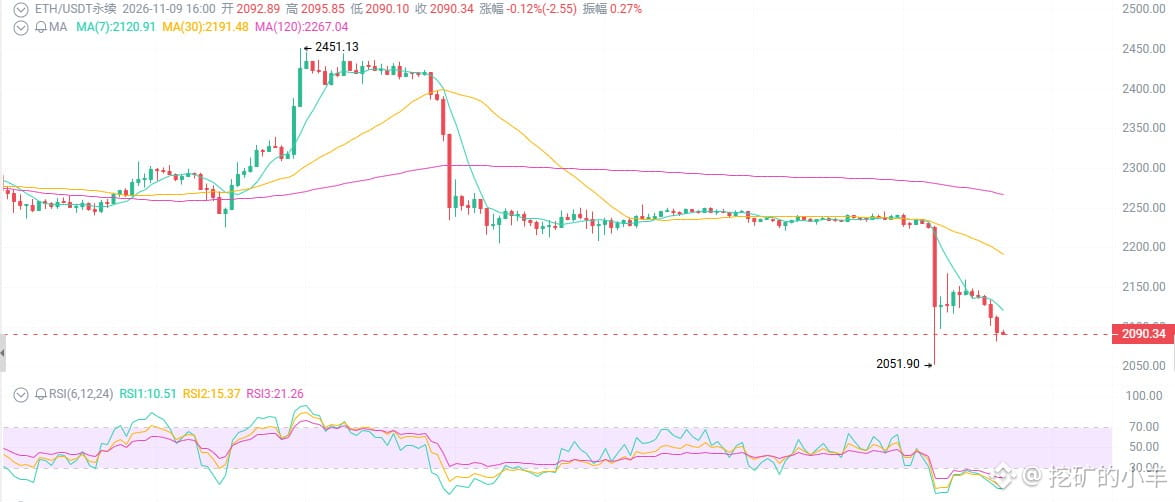
ETH at $2,090—did you cut your losses?
Spot ETH ETFs have seen consecutive days of net outflows, the Glamsterdam upgrade has been delayed, and liquidated bulls are crying out in pain. ETH is down 4% in 24 hours and 15% this month, and has fallen nearly 60% from its ATH. Is this the final leg down of the bear market, or one last shakeout by the whales around the $2,000 mark?
First, the surface picture: nothing but bad news, yet the price just won't budge lower.
ETH slid steadily from $2,400 to $2,090, with one lower high after another. The daily chart has broken down, moving averages are bearishly aligned, and the RSI is barely hanging on between 30 and 40. Everyone is shouting, “ETH is done—move your money elsewhere.”
But look at the chart: the $2,050–$2,100 zone has held firm for a full week. Every time you think it's about to break below $2,000, it bounces right back.
First: ETFs are seeing outflows, but do you know who's quietly buying?
Spot ETH ETFs have seen net outflows for several consecutive days, weakening institutional buying. Citi raised its 12-month target to $3,028, but that's for the “future.”
BitMine continues to accumulate millions of ETH, while Vitalik is still publishing lengthy posts emphasizing the “CROPS framework.”
We've seen this same script before: BTC went through it at the bottom of the 2022 bear market. When ETFs were nowhere in sight, smart money was already quietly building positions. What is a bottom? It's when everyone is criticizing the asset while someone quietly scoops it up.
Second: the Glamsterdam upgrade has been delayed, but the story isn't over.
The Glamsterdam upgrade, originally expected in Q4, has been postponed due to testnet delays and audit issues, and the mainnet launch date is still TBD. Changes to gas rules require contract adaptations, weakening near-term catalysts.
The upgrade's delayed, there's no short-term positive catalyst, and now you're panicking.
But think about it: average daily transactions on Ethereum mainnet are up 54%; L2s handle 25 million transactions a day; stablecoin transfer volumes have risen sharply; and ETH still leads the DeFi TVL and RWA ecosystems. More than 36% of the supply is staked, and its security remains unmatched.
The delay doesn't mean the fundamentals have collapsed. The narrative is shifting from “short-term hype” to “long-term development.”
Third: the technicals are telling you that $2,000 is the key level.
The daily RSI is weak, nearing oversold territory but showing no strong bullish divergence. Volume expands on down days and contracts on rebounds—a classic sign of continued bearish momentum.
Strong support: $2,050–$2,100, then $2,000 and $1,900–$1,950.
Near-term resistance: $2,150–$2,200, then $2,250–$2,300.
A sustained move above $2,200 would signal a structural recovery; a break below $2,000 would accelerate the final leg down.
And CPI data is due on November 10: soft data, and ETH rebounds sharply; hot data, and $2,000 is in jeopardy.