Following the gossip

Post


--

沐枫Btc
·
--
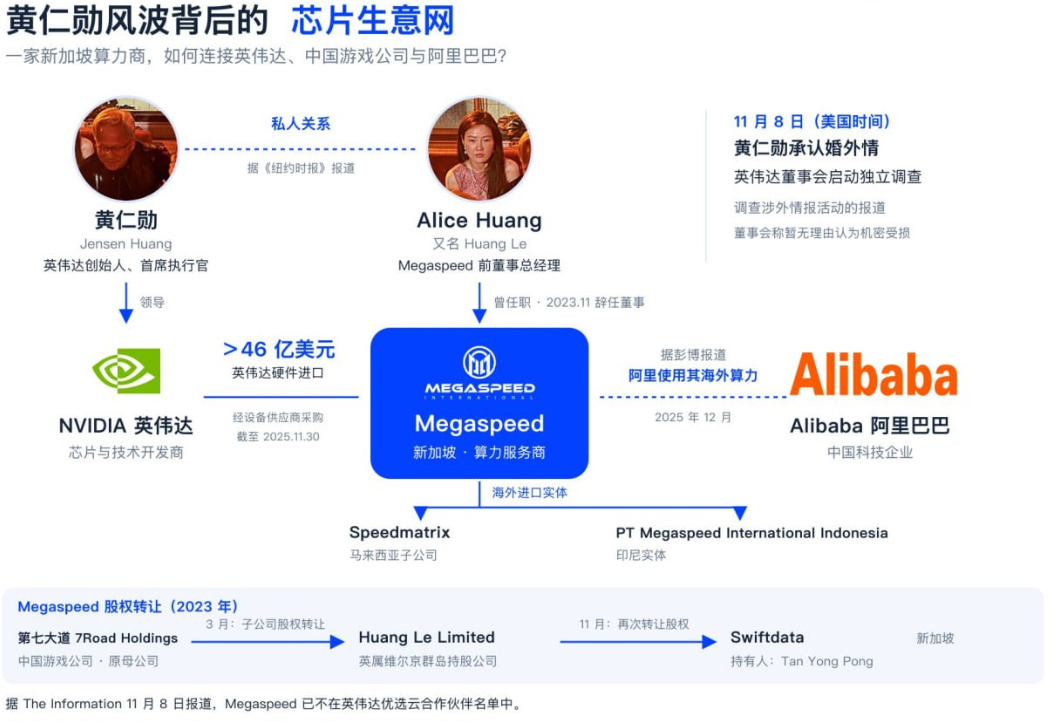
BullishBehind the huge scandal over Jensen Huang’s alleged affair lies a much bigger play: a nearly $5 billion cross-border computing-power rental scheme.
Today, everyone is discussing the possible impact of this juicy news about Jensen Huang on $NVDA ’s stock price. But Megaspeed, a Singaporean company where the woman involved, Alice Huang, once served as an executive, deserves closer scrutiny.
According to investigations by media outlets including The Straits Times, Megaspeed was originally the Singapore-based overseas entity of Chinese gaming company 7Road.
- In March 2023, the company changed its name and transferred its shares to a BVI company controlled by Alice Huang;
- In November 2023, the shares were transferred again, this time to a Singapore shell company, and Alice resigned as a director shortly afterward.
- Coincidentally, just days after this transfer was completed, Megaspeed was officially listed as an “NVIDIA Cloud Partner.”
After it became a partner, tracking by Bloomberg and trade data platform ImportGenius found that:
The company and its Malaysian affiliate spent $4.8 billion over two to three years to buy more than 100,000 of NVIDIA’s top-of-the-line GPUs, including H100s and H200s, and deployed them extensively in data centers in Malaysia and Indonesia.
Megaspeed then established one of the most central business models in today’s AI supply chain:
Remote computing-power rentals from a third country.
Physically, these graphics cards remain legally and compliantly in Southeast Asian data centers. But over the internet, the vast computing power they generate is remotely rented out to customers through cloud services.
According to The New York Times, Megaspeed has continued to provide cloud services to its main customer, Alibaba. Its Malaysian affiliate has also had related business and financial dealings with Alibaba.
The development has now prompted investigations by the U.S. Department of Commerce and Singaporean authorities. NVIDIA, however, insists that it had conducted checks earlier and found no evidence of equipment being illegally rerouted.
In this model, the chips never cross a border, but the computing power has already gone overseas. It brings to mind the earlier case of tokens going overseas from China—a subtle contrast.
Between increasingly stringent physical export bans and enormous demand for computing power, capital and technology are always seeking the most efficient routes to flow. $NVDA #AI芯片股重挫纳指周跌3.4% #黄仁勋因婚外情致歉,英伟达启动独立调查