
The overall crypto market remains cautious and tilted toward bearish sentiment. Political uncertainty following the U.S. midterm elections and rising expectations for macroeconomic interest rates are the main factors weighing on the market.
I. Market Overview
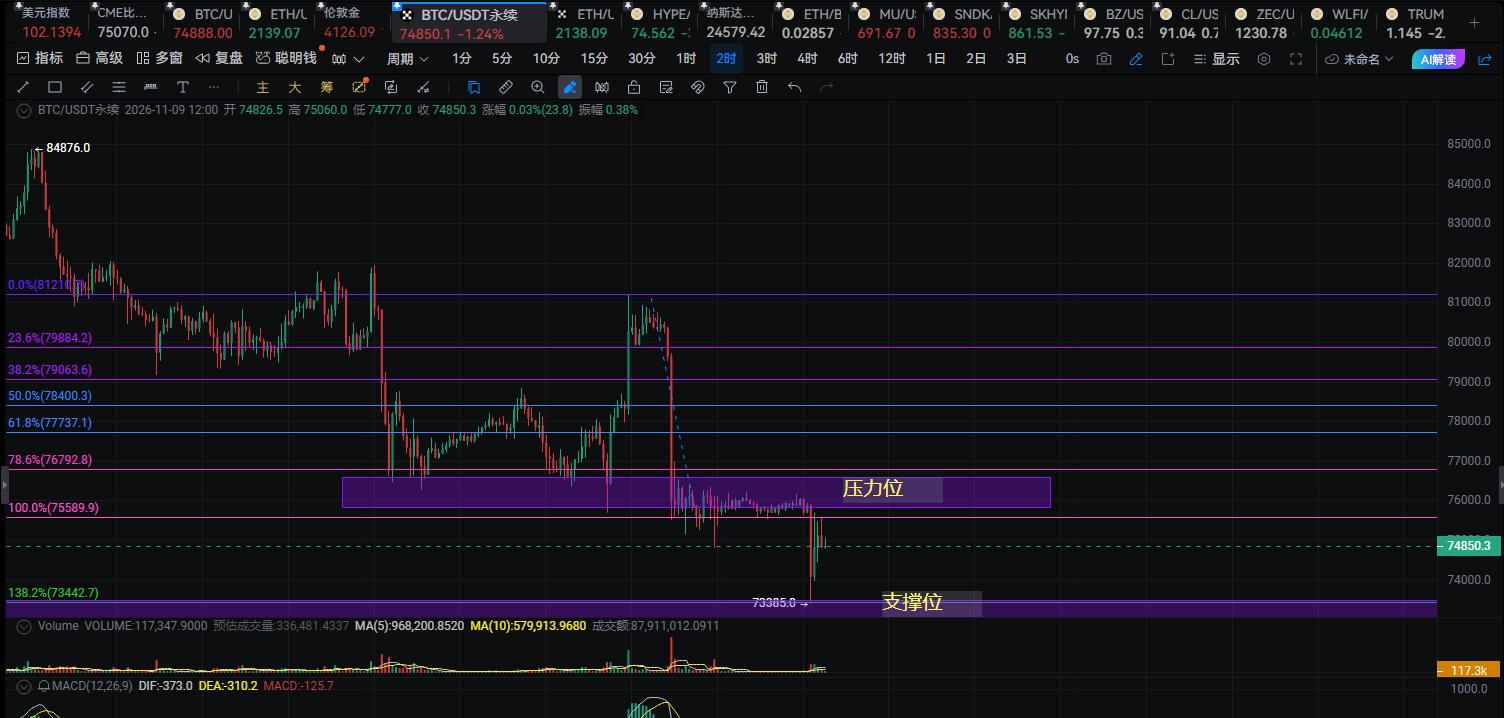
BTC: Currently trading around $75,000, after briefly dipping below $74,000 early this morning before recovering slightly. The 24-hour change is approximately -0.5% to -1.2%, down about 2–4% over the past 7 days and around 8% over the past 30 days. It is currently on its fifth consecutive week of bearish weekly closes.
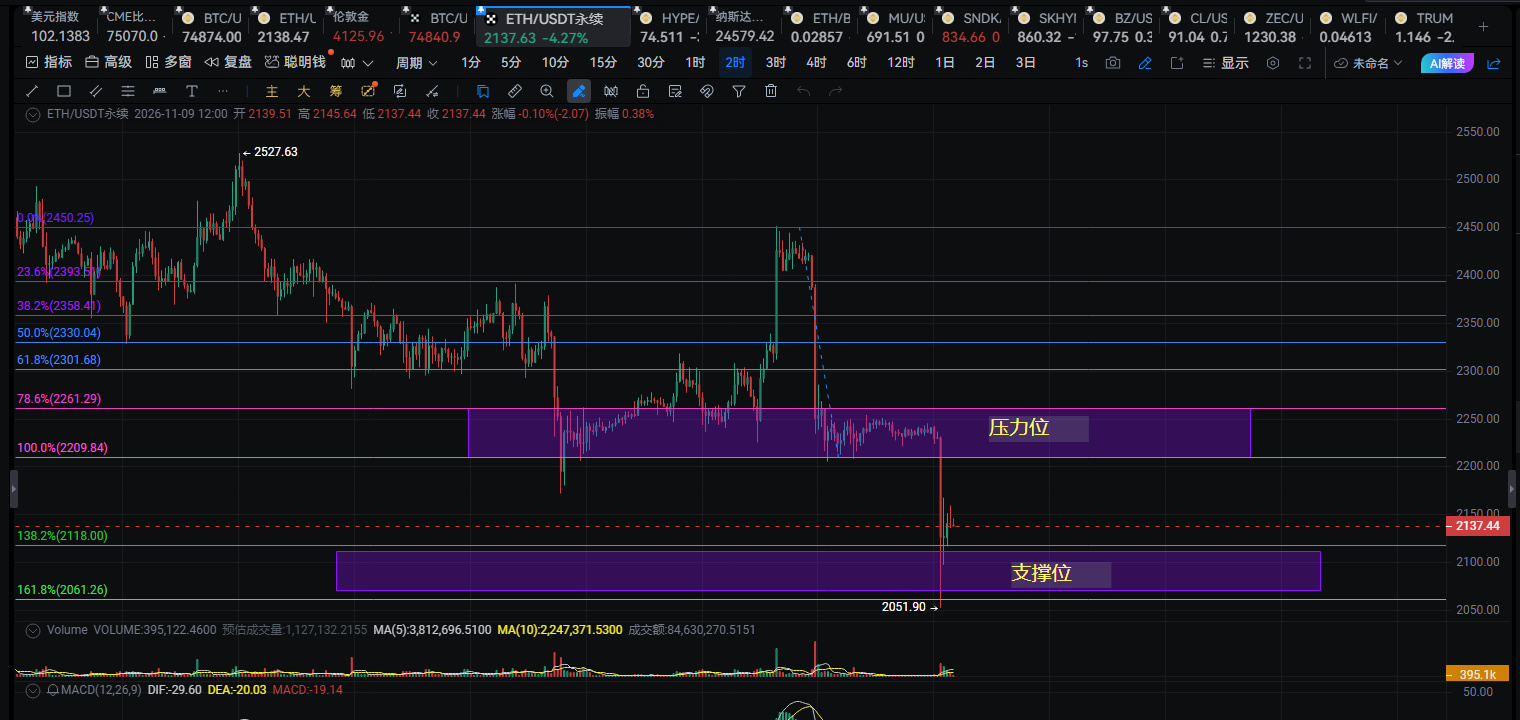
ETH: Around $2,140, down approximately 3–5% over the past 24 hours, underperforming BTC.
Total market capitalization: Approximately $2.49 trillion–$2.54 trillion, with a slight recent decline.
BTC dominance: Around 60%, relatively stable, indicating that capital remains defensively concentrated in Bitcoin.
Fear and Greed Index: 30, slightly up from 28 the previous day, but still in the fear zone. It touched 25 over the weekend, near the edge of extreme fear.
Other: There have been large-scale long liquidations in the past 24 hours, mostly flushing out leveraged longs. XRP is around $1.11, while major altcoins such as SOL are generally weakening.
Market breadth is weak, with most major coins down over the past week. Only a few, such as TRX and ZEC, have held up relatively well.
II. Key News
Persistent ETF outflows are the main bearish factor
U.S. spot Bitcoin ETFs recorded net outflows of about $1.28 billion in the week ending November 6, their worst weekly performance since June. BlackRock's IBIT accounted for most of Friday's outflows. This turned cumulative net inflows for 2026 negative (about -$914 million). Ethereum ETFs also recorded net outflows. The sharp short-term cooling in institutional demand is a direct reason for the price pressure.
Aftereffects of the U.S. midterm elections
The post-election rally has been fully erased. The market is concerned that Democrats gaining control of Congress could lead to tighter regulation of cryptocurrency, data centers, and AI-related sectors, increasing policy uncertainty.
Macro and tech stock correlation
The probability of a 25-basis-point Fed rate hike in December has risen to 77%. Strong employment data, including nonfarm payrolls, have reinforced expectations that interest rates will remain high.
Sharp volatility in the tech/AI sector (involving Nvidia-related news and geopolitical factors) has weighed on risk assets overall, with crypto markets declining in tandem.
Geopolitical developments, such as progress in Iran-related negotiations, have also added to volatility.
Other developments to watch
Security incidents: LNbits was affected by an attack, prompting its operators to urge users to shut down their servers; issues related to the Keplr wallet (Web3Auth is protecting funds during transfers).
Russia plans to allow retail investors to buy BTC, ETH, and USDT starting November 17.
Altcoin ETFs continue to expand under generic listing standards (products for SOL, XRP, ZEC, HYPE, and others are already available), but current demand remains concentrated in BTC/ETH.
News related to Strategy (formerly MicroStrategy) suggests it may continue accumulating Bitcoin.
Overall, the news backdrop is bearish. Capital outflows and macroeconomic uncertainty are combining, with no clear short-term catalysts.
III. Market Analysis
Technical analysis (near term)
BTC has fallen below a key moving average (the 200-day EMA is around $76,000), making the short-term structure more cautious. The main support is currently around $74,000; if it fails, the next levels to watch are $73,000 and then the $70,000–$72,000 range. Resistance levels above are around $76,000, $77,000–$78,000, and the psychological $80,000 mark.
ETH is weaker, having fallen below several moving averages, with psychological support at $2,000. For XRP, the area around $1 is key to watch.
Sentiment and capital flows
The Fear Index is at a low level. Historically, similar levels have often coincided with excessively pessimistic sentiment, but confirmation of a bottom requires waiting for funding conditions to turn positive.
Continued ETF outflows indicate a lack of institutional buying interest; some leveraged longs in the spot and futures markets have been flushed out, and open interest has declined.
BTC dominance remains around 60%. Altcoins are generally underperforming the broader market, indicating that the market is still in a defensive phase rather than seeing a broad-based recovery in risk appetite.
Short-term outlook
Prices have repeatedly tested a key support zone and stabilized somewhat after the sharp weekend decline, but sustained buying is lacking. If ETF outflows continue, macroeconomic data turn more hawkish, or tech stocks face another sell-off, the likelihood of a support breakdown will increase. Conversely, a return of ETF inflows or easing macroeconomic expectations could help form a near-term bottom in the $74,000–$76,000 range.
IV. Summary and Outlook
The market is currently under triple pressure from negative news, capital outflows, and fearful sentiment, making a short-term bearish trend or range-bound consolidation more likely. The $74,000 area is a key level to watch for BTC: a break below it could open the door to further downside, while holding it could lead to a longer period of consolidation.
Key points to watch:
Whether ETF flows reverse this week
Federal Reserve expectations and upcoming macroeconomic data
Further developments in U.S. politics and regulation
Whether key support levels hold.
The views expressed above are personal and for reference only; they do not constitute investment advice. DYOR