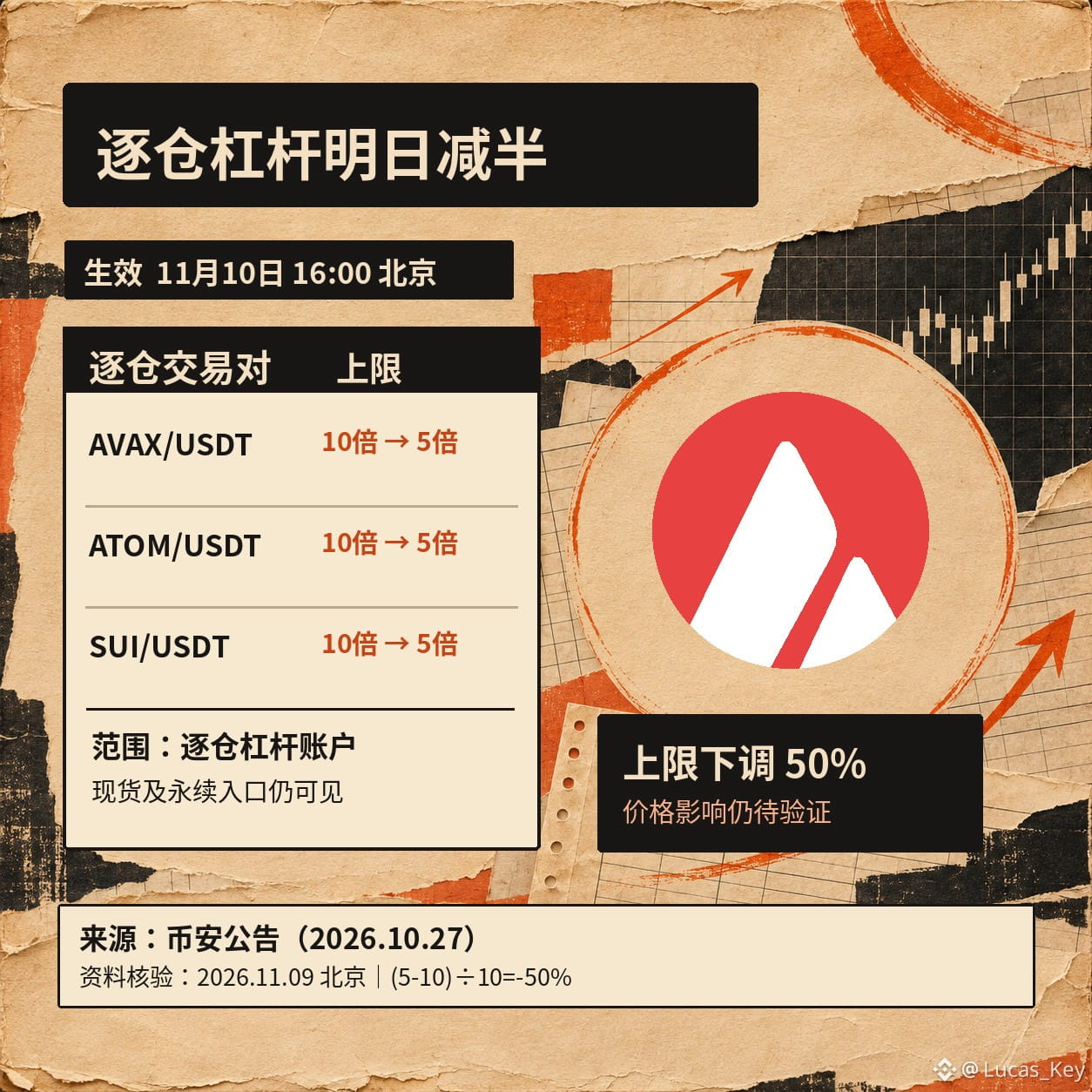
Don’t rush to label tomorrow’s leverage adjustment as “bearish” for $AVAX . Binance’s announcement is very specific: starting at 16:00 Beijing time on November 10, the maximum leverage for isolated-margin trading pairs including AVAX/USDT, ATOM/USDT, and SUI/USDT will be uniformly reduced from 10x to 5x, a 50% cut in the limit. This is a risk-parameter adjustment for isolated-margin accounts; spot and perpetual contract access for $ATOM , $SUI , and AVAX remains available. The announcement makes no mention of delisting.
The bearish side has valid reasons: positions that relied on high-leverage rolling loans will have less room to borrow, and the announcement explicitly warns that related liquidation risk ratios and other parameters will also change. If funds need to reduce liabilities, this could create short-term selling pressure in the spot market. But the other side’s argument should not be overlooked either: halving the limit only means the borrowing multiple is changing. It does not imply that every existing position will be liquidated immediately, nor should isolated-margin rules be mistaken for a broad reduction in leverage across perpetual contracts.
I’m more focused on two things before and after the change takes effect: how the isolated-margin tiers and liquidation parameters for these pairs are implemented, and whether spot trading volume and perpetual open interest show any simultaneous anomalies. If there is only price volatility, with no corresponding evidence of financing or trading activity, attributing it to this adjustment would be premature. The data scope and timing are based on Binance’s October 27 announcement; actual risk for each account depends on its positions, borrowings, and margin. Leverage can magnify losses. This article does not constitute trading advice.