
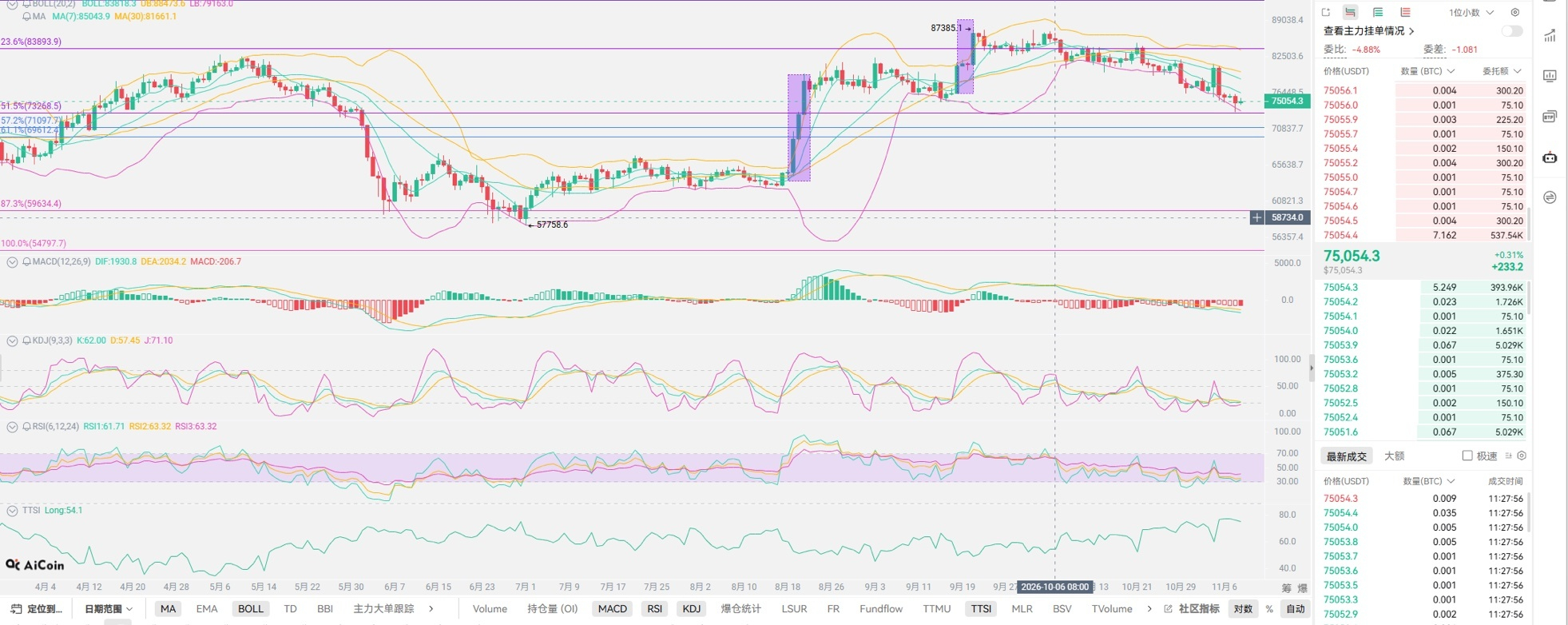

At 5 a.m., a wick pierced the key support level of 74,000, with the latest low at 73,333. The price action is in line with expectations. Among the recent hot news stories, one is particularly important: Nasdaq is introducing 23/5 trading—that is, continuous trading for 23 hours a day, five days a week, with just a one-hour maintenance window. A reminder: the official launch is scheduled for December 6. This has little to do with blockchain technology; it continues to rely on traditional technology. Why does Lao Cui think this news is so important? It looks a lot like a trial run for tokenization. Although there are no signs of crypto involvement in the short term, the idea of 23-hour trading must have come from earlier tokenization companies. You can also see the results: the total market capitalization of real-world assets (RWA) in the Solana ecosystem has reached $4.8 billion. Tokenized funds account for $3.7 billion, tokenized stocks for $1.1 billion, and tokenized commodities for $31.9 million. These are yesterday's figures as well.
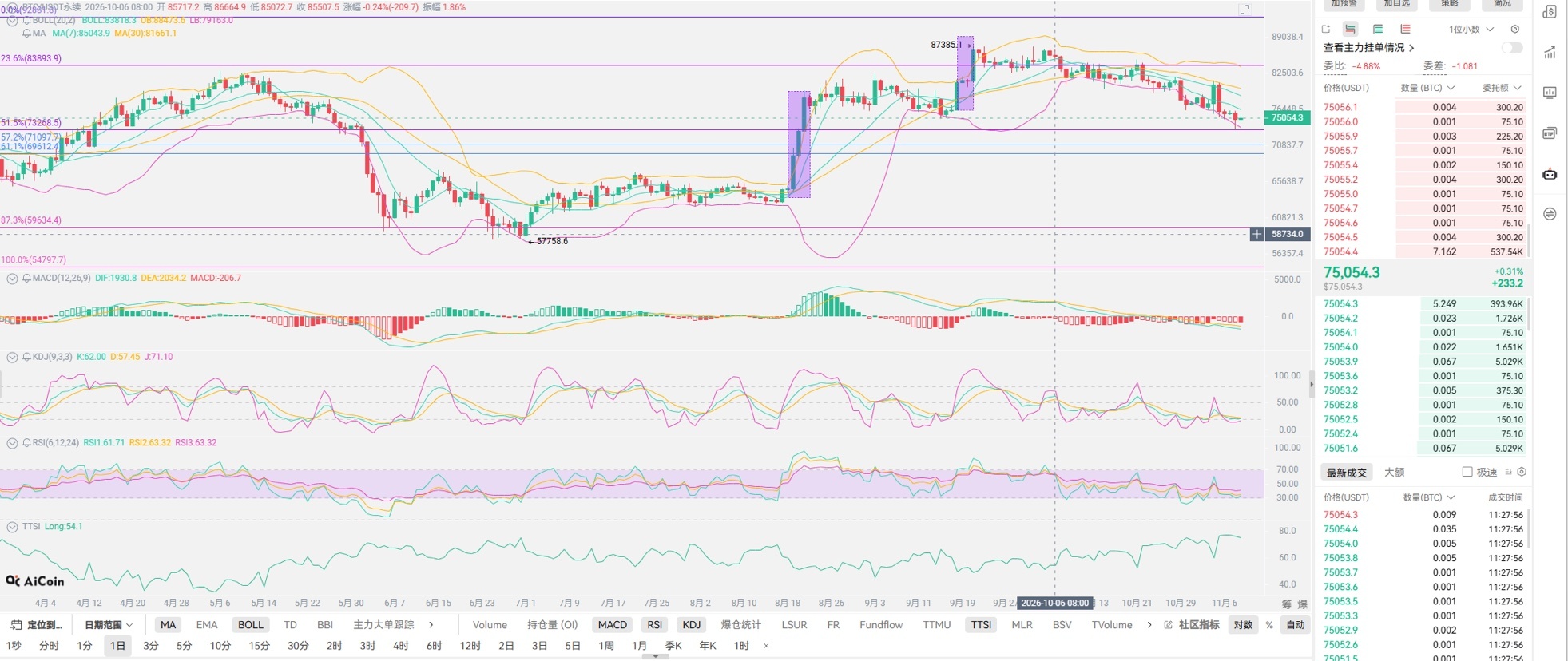
This kind of positive news can provide a floor for the crypto market during a bear-market cycle. In that respect, Lao Cui finds it hard to imagine Bitcoin’s price falling particularly low. Even though this bear-market cycle may already have begun, and the pressure from negative news is so intense, Lao Cui still doesn’t dare predict a new low as of now. Think back to history: Bitcoin’s darkest hour began with the crackdown in China. At the time, Bitcoin was under Grayscale’s control, and there was hardly any major institutional capital involved. A single market operation worth around a billion dollars could trigger a catastrophic sell-off across the crypto market. What about now? BlackRock, MicroStrategy, Musk, and even Vanguard, Goldman Sachs, VISA, Standard Chartered, and Citigroup—all of these major banks and investment institutions have gotten involved. The only thing that could alter the trend by controlling the market is a strategic move by the U.S. And Nasdaq is now operating on a 23-hour trading schedule to lay the groundwork for future RWA adoption. If it succeeds, the U.S. will have effectively bet on all dollar-denominated assets.
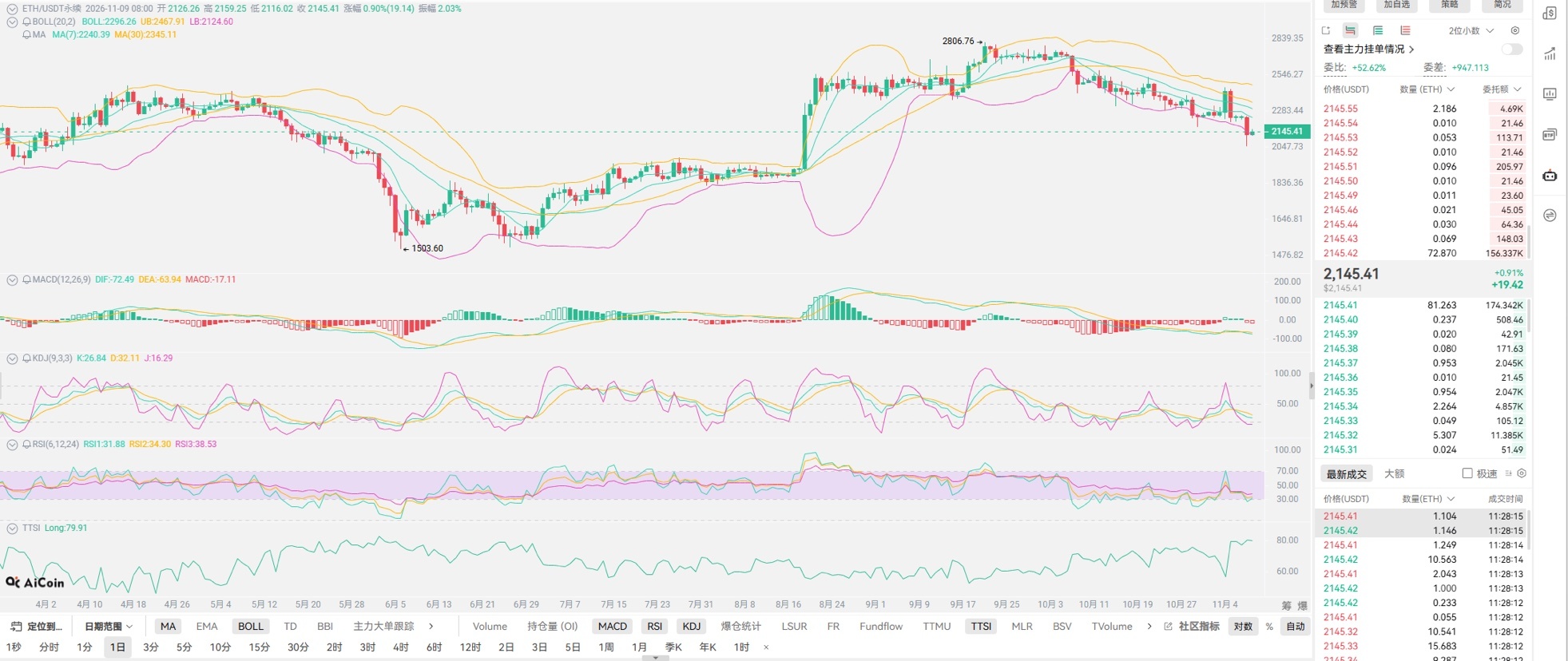
The main reason for explaining this view to everyone is the flood of opinions out there. Lao Cui knows very well that when prices rise, some people start clamoring that it’s a bull market; when they fall, others jump on the bear-market bandwagon. Quite a few people predict that Bitcoin will be cut in half from its current price, and some even forecast that the crypto market will fall below 2W. Lao Cui has carefully reviewed everyone’s opinions, but almost nobody has offered any concrete evidence. They’re all making their judgments based on cycle theory. In other words, they don’t consider the structure of the capital currently in the market, and naturally ignore inflow data. For example, Strive is adding to its Bitcoin holdings, with its position set to reach $3 billion; Hong Kong will submit a bill on Bitcoin and cryptocurrencies before the end of the year; Mr. 1,000 added 5,000 BTC over two days, bringing his total holdings to 6,000; and spot Bitcoin ETF holdings have surpassed 2.06 million BTC, or 10.24% of the supply. Faced with such positive news, they simply turn a blind eye.
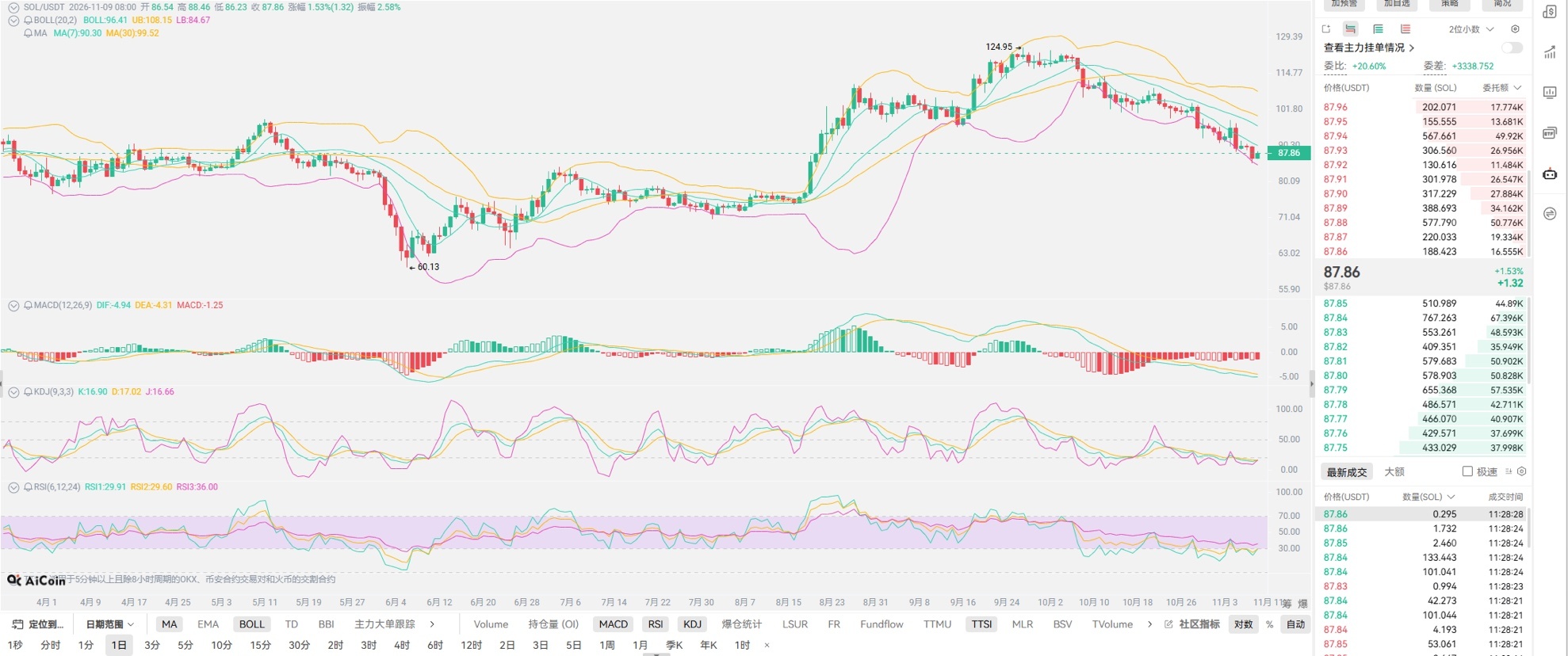
Lao Cui’s approach is usually very conservative. Whether making medium-term forecasts or estimating spot-market movements, he assesses how far the relevant developments have actually progressed and whether they can be achieved. He also considers their impact once achieved. All of this requires data to back it up; without data, it’s all just pie in the sky. This time, the first take-profit target of 74,000 has already been reached. Congratulations to everyone who was able to secure a solid return. Today’s price action should show some recovery, after which the downtrend will continue. Judging by the strength of this break below support, the subsequent bearish trend is unlikely to be interrupted. As for next year’s outlook, it needs to be assessed in conjunction with December’s price action. If Bitcoin falls into the 60,000–65,000 range in December, next year’s outlook will be very precarious. In particular, a new low could very well be reached before May. That would also put the entry window for spot investors somewhere between May and June. The specific approach will still need to take into account next year’s rate hikes and the progress of the legislation.
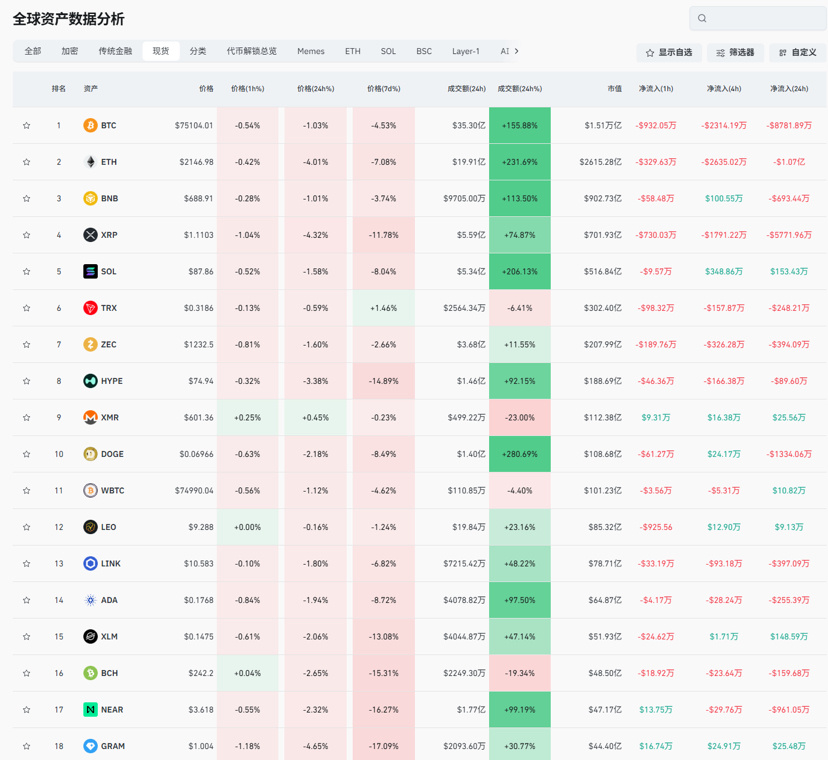
The key variable for this year’s market outlook is the Democrats’ assessment of their political power: will they investigate Trump and crypto assets? This is extremely important. If an RWA initiative gets underway, it will certainly be delayed, and progress on the legislation will also be pushed back. These are two separate things: the legislation must first pass before it can pave the way for RWA adoption. If both proceed as planned, we could see another bull market in 2027. If all the positive news is disrupted, the bear market will continue, and a new low will follow. For short-term traders, 78,000 support is already a thing of the past. Today’s level to watch is how the price recovers around 75,000; if it can stabilize, the bulls will still have a chance to fight back this week. On the medium-term timeframe, the bulls have already given up on the key support at 74,000. This month, the price will break below 70,000 and trade in the 65,000–70,000 range. The only uncertainty for us is the short-term picture; continuing to short on the medium-term timeframe should be fine.