

After Wall Street closes, where do U.S. stocks keep getting priced? A complete guide to bStocks
When the closing bell rings at 4:00 p.m. ET on Friday, earnings reports, policy updates, and geopolitical news keep coming—but regular stocks have to wait until 9:30 a.m. on Monday to factor it all into the opening price at once. After June 2026, a range of U.S. stock exposures will continue trading as usual over the weekend.
This isn’t as simple as “putting stocks on the blockchain.” It changes the timeline for price discovery. Here, we explain the mechanics, data, limitations, and risks—all in one place. For educational purposes only; this is not about buying or selling.
1. First, let’s clear up the most common misconception: they’re not stocks
bStocks are tokenized securities issued by BTECH Holdings Ltd, a bankruptcy-remote special purpose vehicle (SPV) registered in Abu Dhabi Global Market (ADGM). Legally, they are classified as “certificates representing specified financial instruments” (ADGM Financial Services and Markets Regulations (FSMR), Schedule 1, paragraph 92). They are issued under an FSRA-approved prospectus and included on the official list of a Recognised Investment Exchange.
Binance’s official announcement puts it plainly: bStocks are not stocks or shares, and holders do not directly own shares in the listed companies underlying them.
What you get is:
✅ Economic exposure to price movements
✅ The economic effects of dividends (automatically reinvested), stock splits, and other corporate actions
✅ The right to convert back into the underlying stock at a 1:1 ratio (subject to geographic and eligibility restrictions)
❌ Voting rights, registration on the shareholder register, inspection rights, and shareholder communication rights
❌ Any affiliation with the underlying company
Here’s an analogy: what you buy isn’t a property deed, but a certificate linked to the home’s price. You benefit from the home’s price going up or down, but your name isn’t on the property register.
Why make it so complicated? Because this is Binance’s second attempt at doing this. Its “stock tokens” launched in April 2021 in partnership with Germany’s CM-Equity AG. They soon drew scrutiny from regulators including the UK’s FCA and Germany’s BaFin; the service was suspended in July that year and wound down in October. The core controversy was that economic rights linked to stocks could be deemed securities, regardless of what they were called. This time, the structure is “certificates + a prospectus in a licensed jurisdiction + a bankruptcy-remote SPV + daily proof of reserves,” with much clearer boundaries than in 2021.
2. Where exactly are the money and stocks? A three-layer structure
To understand bStocks, don’t think of them as an isolated trading pair. They sit within a three-layer structure:
Layer 1 | Underlying custody
Each bStock is fully backed 1:1 by real U.S. stocks or ETFs held by a U.S.-licensed broker/custodian. The assets are held in segregated custody, reconciled daily, and publicly viewable on the Proof of Collateral page. This is the fundamental difference between bStocks and “pure synthetic stock tokens”—their prices aren’t conjured up from an oracle and a long/short pool.
Layer 2 | Binance direct stock investing
In June 2026, Binance first launched direct stock trading: over 7,000 U.S. stocks and ETFs for non-U.S. users, with zero commissions, a $5 minimum, and 24/5 trading. But only some tickers can be converted into bStocks. Conversion is a closed loop within the Binance ecosystem: only stocks bought through Binance’s stock channel and held in a unified account can be tokenized; stocks held with external brokers cannot be transferred in. For each conversion, a licensed broker acts as the market maker and takes the other side of the trade—you don’t receive tokens directly from the issuer.
Layer 3 | On-chain circulation
bStocks are BEP-20 tokens on BNB Smart Chain, and also incorporate BEP-677 (Scaled UI Amount)—a token standard designed specifically for RWAs. They can be withdrawn to Trust Wallet, Binance Web3 Wallet, or any compatible address, and then used with DEXs and lending protocols (such as Venus, PancakeSwap, and Lista DAO).
That means the same U.S. stock exposure can move between a traditional brokerage account → Binance’s order book → a self-custody wallet. This pathway is the key to understanding all the mechanisms that follow.
3. What does true 24/7 trading actually solve? Continuous price discovery
“You can trade on weekends” is just the surface. The more interesting question is: when the underlying stock is halted, can the on-chain market price in new information first?
Let’s look at a few data points (pay attention to definitions and dates—don’t mix them up):
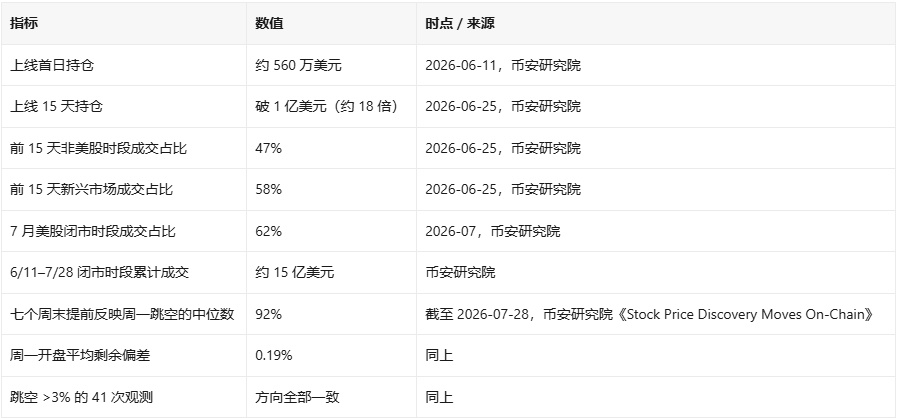
That 92% figure deserves a little more explanation: it refers to the portion of weekend on-chain price movements that had already occurred before Monday’s market open. The sample covers seven full weekends after launch, using the issuer’s research institute’s methodology. It has not been independently verified by a third party, and should not be treated as a repeatable trading pattern—the seven-week sample is too short, and the period coincided with rapid product expansion.
But the mechanism behind it is real: free, two-way 1:1 conversions effectively create an arbitrage channel. When the token trades at a premium, convert the stock into tokens and sell them; when it trades at a discount, buy the tokens and convert them back into stock. Real trades push the price gap back into line. As of July 31, about 4,777 accounts had made these reverse paired trades, totaling nearly $1.25 billion (Binance Research, Monthly Market Insights, August 2026). In traditional ETFs, only authorized participants (APs) can do this. Here, the same functionality is available through ordinary users’ account interface.
My view: bStocks’ added value is not “another way to buy U.S. stocks,” but spreading out the information that would otherwise be released all at once at 9:30 on Monday and pricing it trade by trade over the weekend. The opening bell still determines the clearing price, but it no longer has a monopoly on price discovery.
4. The cleverest part of the holding experience: Multiplier
This is what makes bStocks most different from ordinary tokens, and what beginners are most likely to find confusing.
BEP-677 lets a contract change a single on-chain multiplier—without minting or burning tokens—to adjust your effective balance as displayed in the interface:
Cash dividends → after a 30% U.S. withholding tax is deducted, the net amount is automatically reinvested in the same underlying stock, increasing the multiplier and your balance. No cash is paid out, no airdrop is made, and there is no separate on-chain dividend transaction record. It’s essentially an automatic compounding container.
Stock split → in a 4:1 forward split, the effective balance is multiplied by 4 and the price per token is divided by 4; a reverse split reduces the multiplier and raises the price proportionally. The total value remains unchanged, and you don’t need to do anything.
The benefits are convenience and fast settlement (on-chain, in seconds, with no T+1 restriction). The trade-offs are clear too: the 30% withholding tax is mandatory, you can’t choose to receive cash, and you therefore can’t make tax-planning decisions; deposits, withdrawals, and conversions may be paused while underlying corporate actions are processed.
On price tracking, let’s clear up a common misconception: bStocks are not directly connected to Nasdaq’s order book on-chain. They use “an oracle pegged to the underlying share price + conversion arbitrage to correct deviations.” When U.S. markets are closed, the peg is the most recent valid closing price; when liquidity is thin, the order-book price may temporarily diverge from the mark price. Stablecoin denomination, oracle update intervals, and gas fees can all cause small discrepancies.
5. Costs, requirements, and settlement (practical details)

The initial launch included only 5 stocks: MUB (Micron), SNDKB (SanDisk), CRCLB (Circle), NVDAB (Nvidia), and TSLAB (Tesla).
The lineup expanded to 10 on June 23, and by mid-October it was close to 100, spanning large-cap tech, semiconductors, finance, ETFs, and even 2x/3x leveraged ETFs.
For each new stock, the issuer must prepare separate documentation, obtain FSRA approval for the prospectus, and secure admission to the official list—this is also the main bottleneck to expanding the lineup quickly.
6. What it became in four months
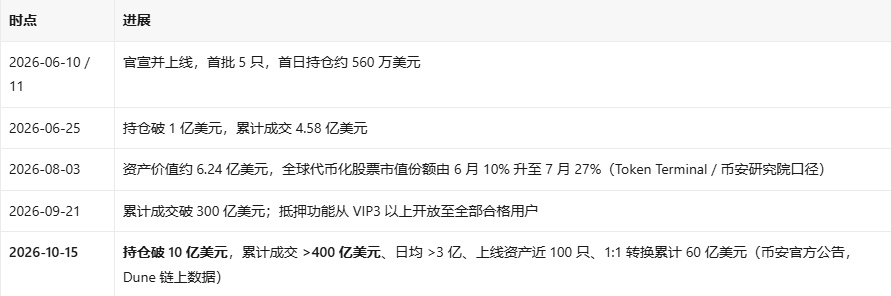
Collateralization has been the biggest change since September: supported bStocks can be used as cross-asset margin and unified-account margin collateral, with leverage of up to 5x; in portfolio margin accounts, they can even serve simultaneously as collateral and as a hedge leg against a futures short. The share of borrowing backed by deposited bStocks rose from 5.5% at the end of June to 46.2% on September 10 (according to Binance). This shows that bStocks are evolving from “trading instruments” into “assets that can be used on-chain.”
⚠️ A note on definitions: Binance reports AUM, while Ondo and xStocks often report TVL/on-chain value. The scopes differ, so don’t rank these figures directly against one another. “Fastest to reach $1 billion” refers to growth rate, not the largest absolute size.
7. Risk checklist (please don’t skip this section)
Limits on rights: You are not a shareholder and have no voting rights. The issuer may suspend redemptions for broadly defined discretionary reasons; suspended orders are queued rather than canceled. Addresses that fail compliance screening may be unable to redeem.
Strength of reserve verification: Proof of Collateral is published daily by the issuer, and the underlying assets are held in segregated custody, but there is currently no independent third-party attestation. Product documents also provide for securities lending involving the underlying stocks, while the dashboard does not distinguish between stocks “on loan” and “unencumbered stocks held outright.”
Liquidity during market closures: 24/7 trading ≠ 24/7 liquidity. Order books are thin on weekends and for less popular stocks, making premiums/discounts and slippage more pronounced; prices converge toward net asset value after the market opens.
Combined risks of collateral and leverage: Once used as margin, you are exposed to price fluctuations, changes in collateral ratios, liquidation thresholds, and the compounding effects of leverage. If stocks and crypto assets deteriorate in tandem, liquidation may happen faster than in a traditional brokerage system.
No tax choice: the 30% U.S. withholding tax is deducted automatically, and you cannot choose to receive cash instead.
Platform operational continuity: In late October 2026, Binance experienced a security incident and temporarily suspended withdrawals (as reported by Jiemian News on 2026-11-02, among others). The incident did not involve the bStocks structure itself, but it serves as a reminder: conversions, redemptions, and collateral held in accounts are highly dependent on the continuity of the platform’s custody and operations.
Geography and compliance: bStocks are not registered under the U.S. Securities Act of 1933 and are not offered to U.S. persons or within the United States. They are offered only under an ADGM prospectus, through secondary-market transactions to eligible users in permitted jurisdictions; no public offering is made outside ADGM. The Hong Kong regulator’s 2021 warning that stock tokens may constitute securities also appears to remain unchanged. Before accessing the product, it is your responsibility to confirm the laws where you live. The platform may restrict, suspend, or withdraw access at any time.
Concentration risk across issuer / broker / custodian / smart contract: The entire chain is highly concentrated within a single ecosystem.
8. In closing: What has it really changed?
Wall Street still decides where stocks are listed and cleared; but the question of “how many hours a day you can trade” is beginning to be answered by on-chain markets.
For people who are used to watching the markets, I think three ideas matter more than any trading action:
Quotes during market closures are a continuous expression of market expectations, not confirmation that “the underlying stock has already traded”;
24/7 means extended trading hours, not extended liquidity—and the gap between the two is widest on weekends;
Once an asset is allowed to serve as collateral, the risk dimension expands from “price” alone to four factors: “price × collateral ratio × liquidation threshold × leverage.”
When a tool becomes more complex, understand its limits first, then think about how to use it.
Which aspect matters more to you: “pricing in information ahead of time over the weekend” or “being able to use it as collateral”? Share your thoughts in the comments 👇
Disclaimer: This article explains product mechanisms and compiles publicly available information. It does not constitute investment advice, an offer, solicitation, or recommendation; it does not recommend any asset or promise any returns. The data in this article comes from official Binance announcements, Binance Research, and public media reports. Dates are indicated, but some figures reflect the issuer’s research methodology, have not been independently verified by a third party, and are not real-time. Please refer to the latest official disclosures. bStocks are subject to strict jurisdictional and eligibility restrictions; please confirm local laws yourself before accessing the product. Markets involve risk; invest with caution.