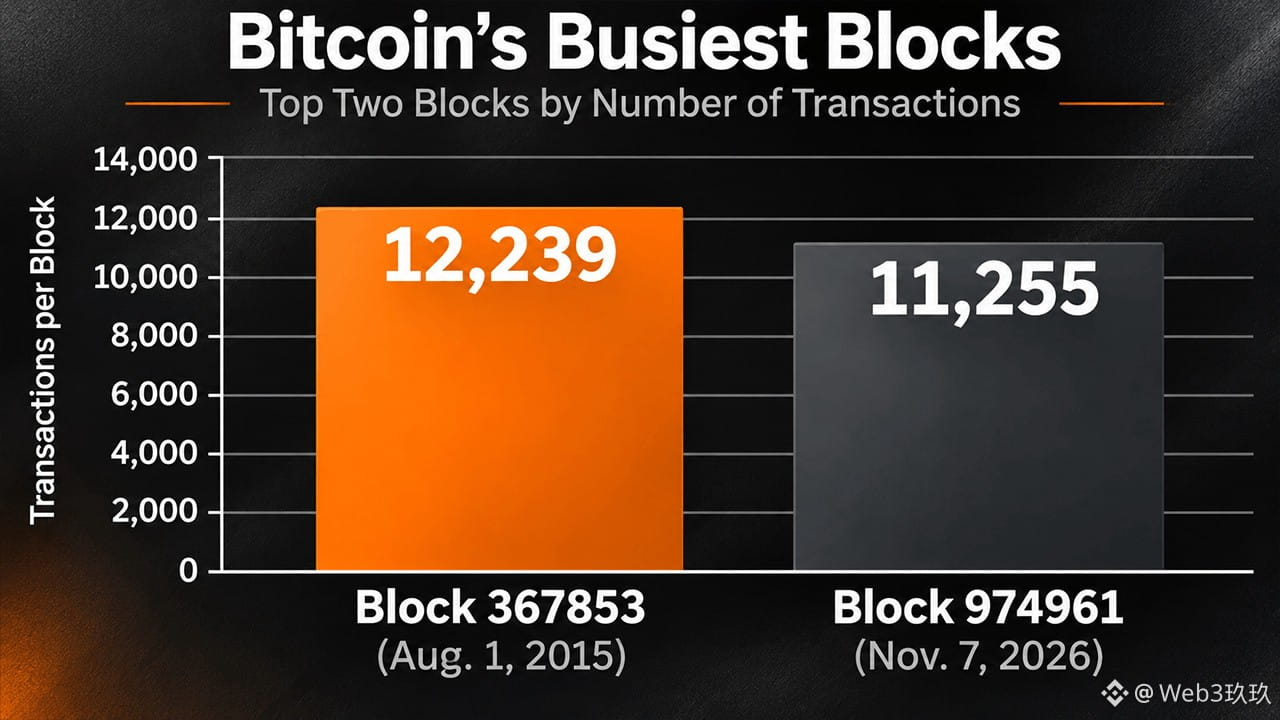
🚨 A Bitcoin block packed in 11,255 transactions, coming just 984 short of a historic record untouched for 11 years.
Group: 邀请您加入我的群组 悟空粉丝群
At 18:24:12 UTC on November 7, block 974961, mined by Antpool, included 11,255 transactions—the second-highest total in Bitcoin’s history.
📊 The hard numbers: The block was about 1.1 MB in size and used 3,993,844 weight units, reaching exactly 99.85% of Bitcoin’s block limit.
But the most counterintuitive part is the money. Fees in this block totaled only about 0.002405 bitcoin—almost negligible compared with the 3.125 bitcoin block subsidy.
🔸 11,794 inputs and 23,122 outputs—that suggests the block was full of extremely tiny transfers, not large payments waiting in line.
🔸 Just three days earlier, block 974557 had packed in 10,573 transactions, making it the second-highest ever at the time. It held that spot for only 72 hours before being overtaken.
The actual record still belongs to block 367853, mined by F2pool on August 1, 2015, with 12,239 transactions. Back then, the block limit was still 1 MB, and the backdrop was a stress test involving small-value spam outputs.
💡 What really matters isn’t “when the record will be broken,” but whether block space is expensive. A block filled to 99.85% with fees of just 0.0024 bitcoin shows that there’s no shortage of space on-chain—the shortage is demand willing to pay for it.
⚠️ This is not good news for the fee market. Miners’ block revenue depends almost entirely on the subsidy, which is cut in half every four years. When more transactions don’t bring in more fees, the gap in the security budget will only become more obvious.
A full block doesn’t mean the network is thriving—it may just mean someone is trying it out for free.
Who do you think should ultimately pay for Bitcoin’s security budget when blocks are 100% full but fees are close to zero?
Tap my profile picture to watch the livestream + join my fan group for daily strategies 🚀
#比特币 #BTC #Institutional funds