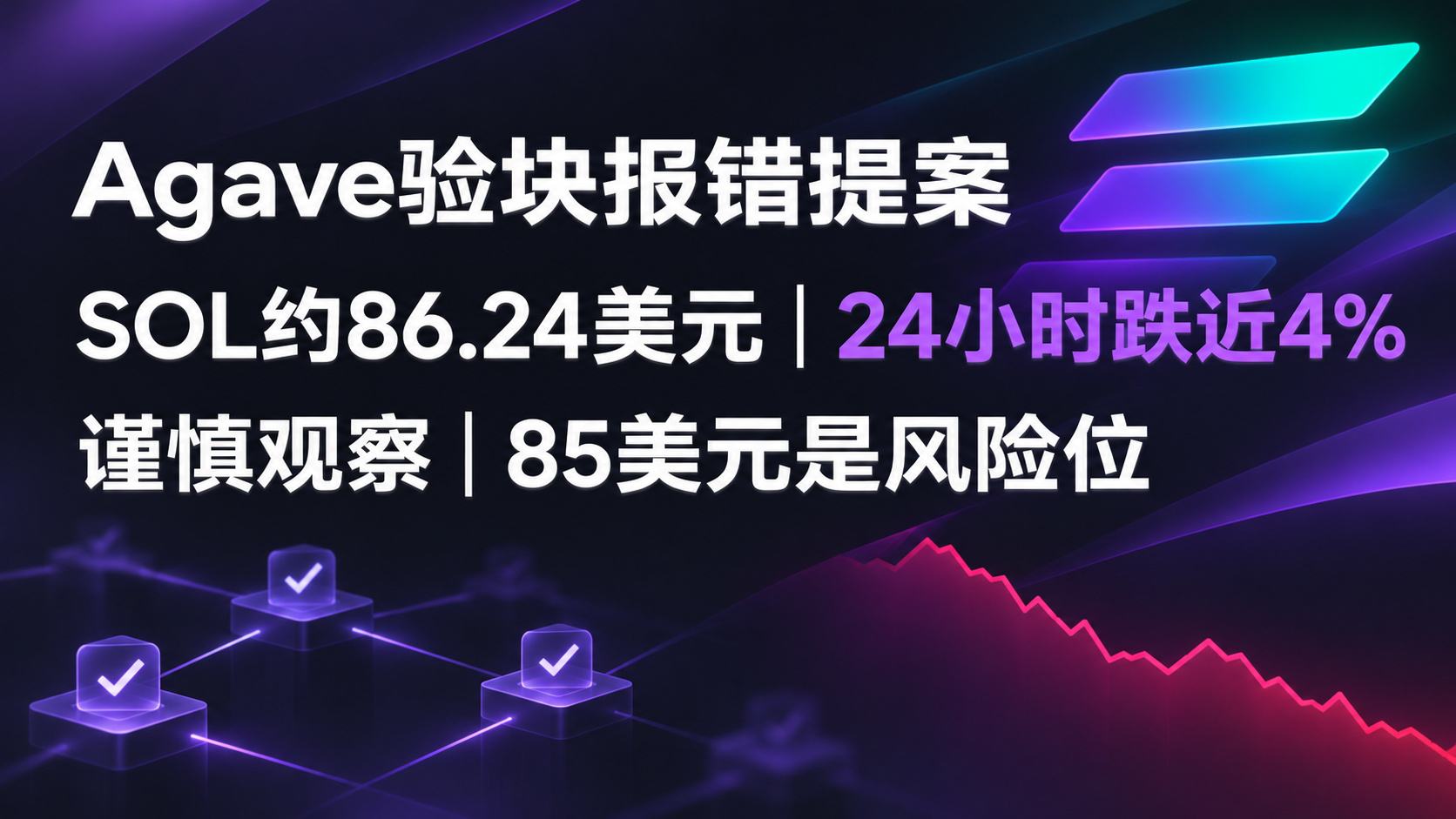
Agave aims to standardize block validation errors | SOL retreats nearly 4% | Separate operations from market action
My stance is cautious observation; I do not treat development progress as a short-term buy signal. The official repository for Solana client Agave has a PR #16850 that is still open, discussing the issue that “the same invalid block may produce different errors depending on which worker thread returns first.” The proposal explains that PoH hash verification and signature verification are handled by separate worker threads. If a block contains both types of errors, the existing process may report whichever one it receives first. The author proposes prioritizing block errors over transaction errors and adding unit tests for both return orders. The GitHub page and changed files show that this adjusts the order in which errors are reported; it has not yet been merged or deployed.
This news is more relevant to validators and troubleshooting staff: consistent error reporting can help different nodes compare logs and reduce diagnostic ambiguity caused by thread timing. It does not mean the consensus rules have been rewritten. Solana’s official status page currently lists the mainnet and RPC as operational and does not classify this round of volatility as a network incident. The PR is not grounds to conclude that “the mainnet has been fixed” or that “SOL will rise because of this”; what happens next depends on the merge, release, and runtime performance.
SOL is still listed on Binance Square’s Most Searched six-hour board, but is not marked as rapidly rising; the top trending topic is BTC falling below $75,000. This matters to SOL because if BTC continues to lose key levels, risk appetite and margin pressure may spill over into high-volatility assets. At around 07:58 Beijing time, Binance SOL/USDT was around $86.24, with a 24-hour opening reference of $89.81, a high of $90.01, and a low of $85.02, down about 3.98%. Kraken SOL/USD was around $86.13, with a low of $85; cross-checking suggests this was not an anomalous quote on a single exchange. At the same time, Binance BTC had fallen back to around $74,718, suggesting that its earlier move back above $75,000 had not held. What we can confirm is that prices were under simultaneous pressure; we cannot confirm that BTC’s drop below that level was the direct cause of every SOL sell order.
Institutional flows also need to be viewed within the context of trading-day boundaries. The latest Farside data available shows net outflows of about $24.2 million from SOL-related funds on November 6. That is last Friday’s figure, not today’s spot fund flow. On October 28, the Federal Reserve kept its target range for the policy rate at 3.75% to 4%; there is no new rate decision today that could directly explain SOL’s minute-by-minute moves. The risk level I’m watching is the 24-hour low near $85. If SOL breaks below it and cannot quickly reclaim it, the short-term rebound thesis is invalidated. To the upside, I’m watching $87.50 first, followed by the $89.80–$90 area; only after those levels are reclaimed would I talk about a recovery.
If I were trading this myself, I would not try to catch the bottom right now. My directional bias would only be for a small spot position to test the long side. I would open an initial position using 2% of total capital only if SOL closes above $87.50 for two consecutive 15-minute candles, holds $86.80 on a pullback, and BTC gets back above $75,000. I would add at most another 1% only after SOL breaks above and holds $89.80, keeping the total position at no more than 3% and avoiding high leverage. The first target would be $89.80–$90, where I would take half off; the second target would be around $92, where I would reduce half of the remaining position. I would place the initial stop below $84.80. I would close the entire remaining position if BTC falls below $73,510 again, SOL drops below $85 and fails to rebound convincingly, or officials confirm a new network issue. If these conditions are not met, I would stay out; waiting is not the same as making a profit.
#SOL #BTC
This is solely my personal market observation and does not constitute investment advice.