
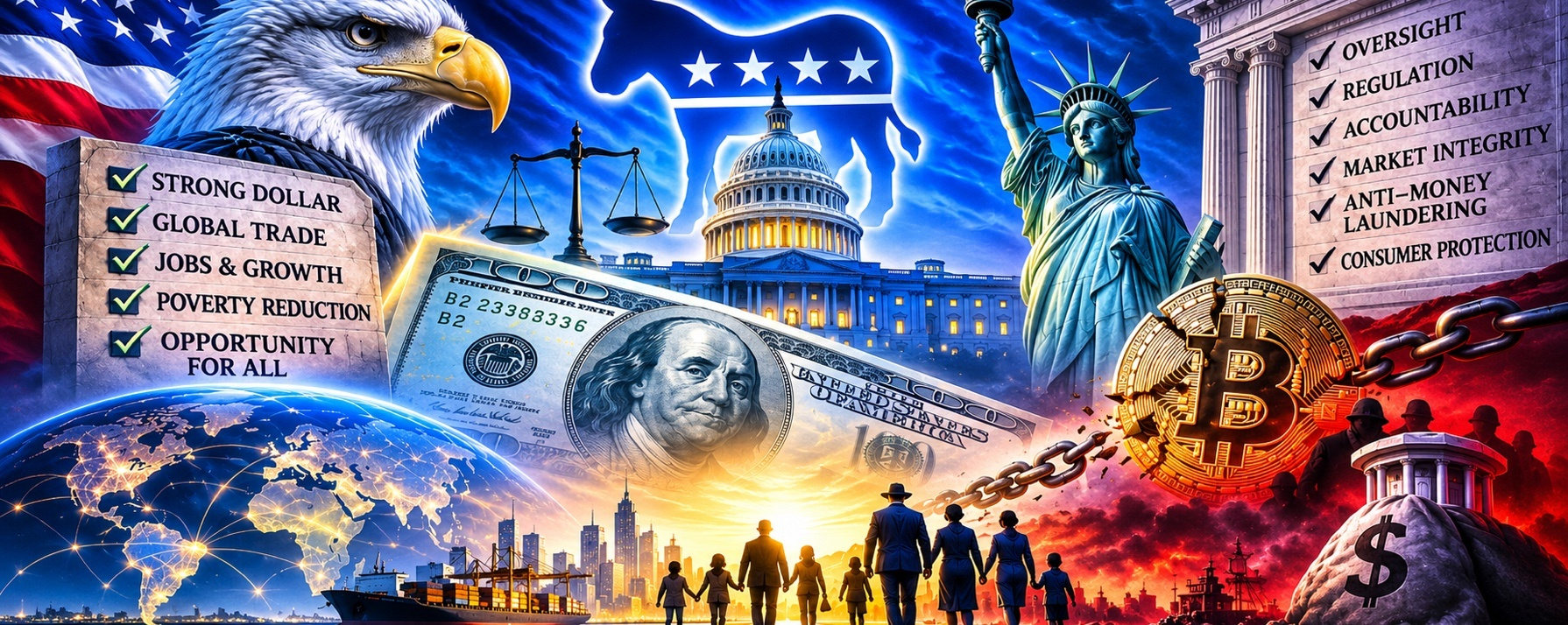

THANK YOU, AMERICA, FOR THE DOLLAR. THANK YOU FOR DEMOCRACY. IT IS TIME TO SAY GOODBYE TO CRYPTO’S UNCHECKED POWER.
As President Nixon ditched the gold rule. USA must ditch the cryptocurrency today.
The greatest financial achievement is not making a few people billionaires. It is giving millions of ordinary people a chance to escape poverty, build businesses, feed their families and participate in the world’s economy.
There is something we should remember before celebrating another Bitcoin rally, another cryptocurrency millionaire or another promise that digital money will revolutionise humanity.
Money is not supposed to be a religion.
It is not supposed to be a political weapon.
It is not supposed to be a casino in which the earliest participants become extraordinarily wealthy while everyone else is encouraged to buy their way into the dream.
Money is supposed to help human beings exchange value, produce goods, build businesses, finance development, feed families and create opportunities.
And when we discuss the modern international financial system, there is one institution that deserves recognition for its historical contribution:
The United States dollar.
Not because America has never made mistakes. Not because its financial system is perfect. Not because the dollar should remain dominant forever.
But because the dollar-based international system became one of the foundations of modern global commerce, investment and economic development.
And perhaps we should ask ourselves whether the cryptocurrency revolution is genuinely improving that system—or whether parts of the industry are simply attempting to concentrate its wealth and influence in different hands.
This is a story about money, democracy, economic development, political power and the future of financial freedom.
And it begins long before Bitcoin existed.
1. THE DOLLAR: AN IDEA THAT HELPED CONNECT THE WORLD
The modern American dollar became much more than a national currency.
It evolved into the principal international reserve and trading currency, supporting a global financial infrastructure that connected countries, businesses, banks, investors and consumers.
After the Second World War, the Bretton Woods agreement placed the dollar at the centre of the international monetary system.
Currencies were linked to the dollar, and the dollar was convertible into gold for foreign official holders at $35 per ounce.
But the global economy was growing.
International trade was expanding.
Countries needed more reserves, more financing and more flexibility.
Eventually, the gold-convertibility arrangement became increasingly difficult to maintain.
On August 15, 1971, President Richard Nixon suspended the dollar’s convertibility into gold.
The Bretton Woods system subsequently collapsed, and the world moved towards the modern system of fiat currencies and floating exchange rates.
This was one of the most consequential monetary changes in modern economic history.
The dollar was no longer constrained by the obligation to exchange foreign official holdings for a fixed quantity of American gold.
That did not mean unlimited prosperity, and it did not mean governments could create money without consequences.
It meant that monetary authorities gained greater flexibility to manage a much larger and more complicated international economy.
That flexibility comes with responsibilities.
Inflation, excessive borrowing, poor monetary policy and financial mismanagement remain real dangers.
But the ability to support a growing economy with modern monetary and financial instruments helped create an environment in which international trade, investment and credit could expand on an enormous scale.
The dollar became the financial language of much of the modern world.
And that achievement deserves recognition.
2. ASIA: THE WORLD THAT GREW THROUGH GLOBAL TRADE
Perhaps the greatest demonstration of the economic potential of global integration can be found in Asia.
Look at the transformation.
Japan rebuilt its industrial economy.
South Korea became a global manufacturing and technology powerhouse.
Taiwan developed advanced manufacturing industries.
Singapore transformed itself into a major international commercial and financial centre.
China opened its economy and became one of the world’s largest manufacturing and trading powers.
Vietnam, Malaysia, Thailand and Indonesia expanded their industrial capacity and participation in international markets.
Millions of families experienced opportunities that previous generations could hardly imagine.
How did this happen?
Not through cryptocurrency.
Not through a limited digital supply of money.
Not through an internet token whose price depended on finding another buyer.
It happened through factories, education, infrastructure, international trade, technology, investment and access to global markets.
The dollar-based financial system helped facilitate this transformation.
A manufacturer in Asia could import machinery, purchase energy, finance international operations and sell products to consumers thousands of kilometres away.
Businesses could use a widely accepted international currency to settle transactions and access global capital.
Investors could finance production.
Workers could find employment.
Entrepreneurs could build businesses.
The World Bank estimated that more than 480 million people in East Asia escaped poverty between 1981 and 2001.
Global extreme poverty also declined dramatically over subsequent decades.
These achievements had many causes, including domestic economic reforms, industrialisation, education and infrastructure.
The dollar alone did not eliminate poverty.
But international trade and the dollar-based financial architecture helped provide an environment in which economic opportunities could expand.
Think about what that means.
A family that once struggled to afford dinner could eventually have a member working in a factory, a business exporting internationally or a child receiving an education that opens doors to a different future.
That is what economic development should accomplish.
Not merely a higher market capitalisation.
Not a more expensive token.
A better life.
3. THE FREE-MARKET DOLLAR AND THE PARADOX OF GLOBALISATION
There is an interesting contradiction in today’s international financial debate.
Many Asian economies benefited enormously from access to the dollar-based global trading system.
Their factories exported to American consumers.
Their companies imported technology and machinery.
Their central banks accumulated foreign-exchange reserves.
Their businesses participated in international supply chains.
Their populations benefited from the expansion of global commerce.
Today, some governments and commentators question the dollar’s dominance and advocate alternative monetary arrangements.
There are legitimate reasons to diversify.
Dollar dependence creates exposure to American interest-rate decisions, sanctions policy and changes in international financial conditions.
Developing economies can also face serious difficulties when dollar-denominated debt becomes more expensive.
But there is a difference between reforming the international monetary system and ignoring the benefits that global financial integration helped deliver.
The objective should be a more balanced and resilient global economy, not the destruction of the infrastructure that has helped millions participate in international commerce.
And Asia is not one unified financial or political actor.
Its countries have different economic interests. Many continue to rely on dollar-based trade while also diversifying reserves and developing alternative payment arrangements.
The question is not whether the dollar should have competition.
Competition is healthy.
The question is whether the alternatives being promoted will genuinely improve economic opportunity for ordinary people.
4. THE CRYPTOCURRENCY PROMISE: FINANCIAL FREEDOM OR A NEW FORM OF WEALTH CONCENTRATION?
Then came Bitcoin.
Its original promise was powerful.
A limited supply.
No central bank.
No government issuer.
No traditional intermediary required to approve every transaction.
An alternative to a financial system that had suffered a devastating crisis in 2008.
For millions of people, the idea was attractive.
But the modern cryptocurrency industry has evolved far beyond that original experiment.
It now includes major exchanges, stablecoin issuers, investment funds, derivatives markets, custodians, venture investors, political relationships and enormous pools of speculative capital.
And that creates a question that deserves serious examination.
Does decentralised technology automatically create a decentralised distribution of wealth?
Does a fixed supply guarantee fairness?
Does a financial network become democratic simply because it uses blockchain?
Not necessarily.
A 2025 academic study published in PLOS ONE examined Bitcoin’s network evolution between 2009 and 2023.
Its findings identified increasing network centralisation and wealth concentration, describing a richer-get-richer pattern.
This does not prove that every cryptocurrency is designed to concentrate wealth.
It does, however, challenge the assumption that decentralised technology automatically prevents the concentration of economic power.
A currency can have a fixed supply and still have extremely unequal ownership.
A blockchain can be technically decentralised while its economic benefits accumulate disproportionately among early adopters, large investors and powerful intermediaries.
And an industry can advertise financial freedom while becoming increasingly dependent on a relatively small number of influential players.
That is a contradiction worth examining.
5. A FINANCIAL ASSET IS NOT THE SAME AS A PRODUCTIVE ECONOMY
Consider two different ways of measuring economic success.
In one economy, businesses borrow money to build factories.
Farmers purchase equipment.
Workers receive salaries.
Companies develop products.
Goods are transported across borders.
New businesses employ people.
Investment increases productive capacity.
In another financial environment, enormous amounts of capital circulate around speculative assets whose prices depend heavily on demand, liquidity and investor sentiment.
The second environment can create extraordinary fortunes.
But asset appreciation is not automatically equivalent to productive economic development.
A rising Bitcoin price does not necessarily mean more food is being produced.
A new cryptocurrency millionaire does not automatically mean more houses are affordable.
A trillion-dollar increase in digital-asset market capitalisation does not necessarily mean that more people have access to healthcare, education or employment.
This does not make speculation inherently wrong.
Investment and risk-taking are essential parts of modern finance.
But we should distinguish between wealth created by increasing productive capacity and wealth gained primarily through changes in the market valuation of an asset.
A society cannot live on asset appreciation alone.
It needs production, employment, trade, infrastructure and access to essential goods.
The real measure of a financial system should be what it enables people to accomplish.
6. THE SOMALIA WARNING: INSTITUTIONS MATTER
When discussing the future of money, we should remember the humanitarian catastrophe that occurred in Somalia in the early 1990s.
After the fall of the Siad Barre government in 1991, Somalia descended into civil war.
State institutions collapsed.
Armed factions fought for control of territory and resources.
Agricultural infrastructure was destroyed.
Food distribution was disrupted.
Drought intensified the humanitarian crisis.
Hundreds of thousands of people died during the famine and its aftermath.
Somalia’s catastrophe was not caused by abandoning the gold standard or by cryptocurrency.
It was caused by war, institutional collapse, destruction of economic infrastructure and the breakdown of food distribution.
But it teaches an essential lesson.
A society needs institutions.
It needs security.
It needs functioning markets.
It needs roads, ports, transport, food production, enforceable contracts and systems capable of delivering essential services.
When those foundations disappear, the poorest people suffer first.
Wealthy people can sometimes protect themselves.
Poor families have far fewer alternatives.
That is why financial and economic stability matters.
The objective of a monetary system should not be to make a handful of investors unimaginably wealthy.
It should be to support an economy in which ordinary families can work, save, invest and afford the necessities of life.
7. THE DOLLAR UNDER POLITICAL PRESSURE
The American financial system is not immune to political instability.
During Trump’s second administration, the Federal Reserve faced repeated public pressure over interest rates and monetary policy.
The independence of the central bank matters because controlling inflation sometimes requires unpopular decisions.
When investors question whether monetary policy is being influenced by short-term political interests, confidence can deteriorate.
The dollar experienced a substantial decline during 2025, although currency movements reflected several economic and international factors rather than one political decision.
At the same time, Elon Musk’s Department of Government Efficiency became involved in controversial access arrangements involving sensitive Treasury payment systems.
Federal litigation raised concerns about access, security and accountability.
There was no judicial finding that DOGE had stolen money or taken control of the entire Treasury system.
But the controversy demonstrated how sensitive government financial infrastructure can become when institutional boundaries are challenged.
Then came the war with Iran.
The Congressional Budget Office estimated that the conflict had cost the Department of Defense approximately $38 billion as of August 1, 2026.
The war also disrupted energy markets and contributed to inflationary pressure.
The dollar did not automatically weaken because of these events, but the combination of geopolitical uncertainty, fiscal costs, monetary-policy pressure and institutional controversy became part of a wider debate about American economic credibility.
And here is the question:
Who benefits when confidence in traditional financial institutions becomes weaker?
One industry that has consistently marketed itself as an alternative to conventional money is cryptocurrency.
That does not prove that anyone deliberately weakened the dollar to benefit crypto businesses.
But the commercial incentives deserve scrutiny.
8. THE POLITICAL CRYPTO CONNECTION: WHEN THE ALTERNATIVE SEEKS THE ESTABLISHMENT
The modern cryptocurrency industry increasingly seeks political access, institutional capital and government recognition.
This creates a contradiction.
An industry that markets itself as an alternative to traditional financial power is now seeking influence within the political and financial structures it once criticised.
Consider the Binance investigation.
In November 2023, Binance pleaded guilty to federal offences involving anti-money-laundering requirements, unlicensed money transmission and sanctions-related violations.
The company agreed to a resolution worth approximately $4.3 billion.
Its founder, Changpeng Zhao, also pleaded guilty personally to failing to maintain an effective anti-money-laundering programme.
These were established legal outcomes, not merely allegations.
The SEC’s separate civil lawsuit against Binance was dismissed in May 2025, with prejudice as to the conduct alleged in the amended complaint.
But that dismissal did not erase the earlier criminal plea or other compliance obligations.
Then came new congressional scrutiny.
In February 2026, Senator Richard Blumenthal opened an inquiry following investigative reporting alleging approximately $1.7 billion in transfers connected to Iranian-linked entities and Russia’s sanctions-evading oil trade.
The inquiry raised questions about intermediaries, suspicious transactions and internal compliance investigations.
These are serious allegations, but they are not a judicial finding that every transaction involved money laundering or that Binance knowingly participated in every underlying activity.
On November 5, 2026, Blumenthal renewed demands for records from Binance, warning that failure to cooperate by January 4, 2027, could lead to alternative measures to obtain compliance.
This is an important development.
Congress is not merely revisiting old headlines.
It is asking for information about compliance, transactions, internal investigations and possible failures after the original settlement.
The USD1 transaction
Another important question concerns the reported $2 billion investment in Binance, with the transaction reportedly settled using USD1, a stablecoin associated with the Trump family’s crypto venture.
Senators Elizabeth Warren and Jeff Merkley requested records concerning the transaction and potential conflicts of interest.
The question is straightforward.
If a major investment in a cryptocurrency exchange is settled using a stablecoin associated with the family of a sitting president, who benefits economically?
What commercial relationships are created?
Could political decisions affect businesses in which the president’s family has financial interests?
These are legitimate questions.
They do not automatically prove corruption, but they deserve transparent answers.
The pardon
On October 21, 2025, President Trump pardoned Changpeng Zhao.
The pardon is recorded in the Department of Justice’s official clemency register.
A presidential pardon is a constitutional power.
But when the recipient is a major participant in an industry with substantial political and financial relationships, the public has a legitimate interest in understanding the reasons behind the decision and whether conflicts of interest were considered.
A pardon does not prove a secret financial agreement.
But transparency should not be optional simply because the decision involves a powerful person.
9. TETHER, STABLECOINS AND THE NEW SHADOW BANKING QUESTION
Stablecoins have become a critical part of the cryptocurrency ecosystem.
They facilitate trading, international transfers and dollar-denominated settlement.
They may also increase the global reach of the dollar.
But they raise questions about reserves, sanctions, financial supervision and the identity of counterparties.
A September 2026 Senate report examined USDT transactions involving 846 wallets associated with Iran and regional proxies.
The report stated that 84% of those selected wallets had transacted exclusively or almost exclusively in USDT.
It described the stablecoin as an important component of Iran’s shadow banking network.
This is a serious allegation, but it needs to be understood in context.
It does not mean that 84% of all USDT transactions are illicit.
Nor does it establish that every transaction was knowingly facilitated by the issuer.
Tether has publicly defended its compliance record and pointed to cooperation with authorities and the freezing of Iran-linked assets.
The wider issue is whether the international financial system can effectively supervise digital dollar infrastructure operating across borders.
A digital dollar is not automatically a transparent dollar.
A stablecoin is not automatically a safe financial instrument simply because it is designed to maintain a one-dollar value.
The world needs payment innovation.
It also needs accountability.
10. THE WALL STREET FINANCIAL POWER BLOC: A RETURN TO INSTITUTIONAL DISCIPLINE?
There is another important participant in this financial struggle.
The Wall Street Financial Power Bloc.
This is not a single company, cartel or coordinated organisation.
It describes the wider ecosystem of major asset managers, banks, pension investment structures, custodians, institutional investors and financial intermediaries.
These institutions depend on functioning Treasury markets, predictable monetary policy, reliable custody, enforceable contracts and transparent regulation.
Their ethical frameworks commonly address:
Conflicts of interest.
Anti-money-laundering controls.
Sanctions compliance.
Anti-bribery and corruption.
Business-partner due diligence.
Fiduciary responsibilities.
Asset protection.
Risk management.
Investment stewardship and disclosure.
There is no single ethical code shared by the entire group.
Each institution has its own policies and governance responsibilities.
And publishing an ethics policy does not prove that every institution applies it effectively.
But institutional investors are increasingly demanding stronger standards in digital assets.
A 2026 Coinbase and EY-Parthenon survey found that 49% of surveyed institutions had strengthened their emphasis on risk management, liquidity and position sizing.
It also reported that 66% considered regulatory compliance important when selecting digital-asset custodians.
This is significant.
Institutional capital is not necessarily rejecting digital assets.
It is demanding that they meet financial standards.
The next phase could separate companies that can operate under transparent, well-governed rules from businesses that depend on regulatory loopholes, political access or weak controls.
The Wall Street Financial Power Bloc does not need Bitcoin to disappear.
It needs a financial system in which capital can be allocated, protected and monitored according to predictable rules.
And if those institutions regain credibility, some of the arguments used to justify speculative crypto valuations could become less persuasive.
11. THE DEMOCRATIC VICTORY AND THE RETURN OF CONGRESSIONAL OVERSIGHT
November 3, 2026, marked a major change in the American political balance.
Democrats won control of both the House and Senate.
The new congressional majority can conduct investigations, demand records, issue subpoenas through its committees and scrutinise government decisions.
The incoming majority has signalled that investigations into crypto-related political relationships, government conduct and potential conflicts of interest will be among its priorities.
This does not mean Congress controls the Federal Reserve.
It does not mean Democrats can dictate monetary policy.
It does not mean every investigation will lead to a criminal prosecution.
But stronger congressional oversight can change the environment in which political and financial decisions are made.
The Treasury can face greater scrutiny.
Regulatory decisions can be examined.
Potential conflicts of interest can be investigated.
Crypto businesses with political relationships can be asked to explain their transactions and compliance arrangements.
The public can demand answers.
That is an important function of democracy.
And it is worth remembering that democratic institutions are not simply political obstacles to business.
They are part of the system that provides accountability, legal certainty and public legitimacy.
12. WHY A MORE CREDIBLE DOLLAR COULD BECOME A PROBLEM FOR SPECULATIVE CRYPTO
Now consider a possible scenario.
American institutions regain public confidence.
The Federal Reserve operates with greater independence.
The Treasury faces stronger oversight.
Financial regulators apply consistent rules.
Inflation expectations decline.
Institutional investors gain confidence in conventional financial markets.
What happens to cryptocurrency?
The consequences could be substantial.
First, the argument that the traditional financial system is fundamentally broken may lose some of its force.
Second, conventional assets could become more attractive if real interest rates and risk-adjusted returns favour them.
Third, stricter enforcement could increase the cost of doing business for exchanges and intermediaries with weak compliance systems.
Fourth, a stronger dollar could reduce some of the monetary-debasement narrative supporting Bitcoin.
Fifth, speculative liquidity could become less supportive if investors prefer lower-risk alternatives.
This does not guarantee that Bitcoin will collapse.
It does mean that the economic conditions supporting its valuation could change.
And the distinction between Bitcoin as a technology and Bitcoin as a speculative investment becomes extremely important.
Blockchain technology may continue to develop.
Tokenisation may transform financial settlement.
Digital payments may become more efficient.
But that does not guarantee that every cryptocurrency, exchange or speculative token will survive.
The future of blockchain does not depend on the survival of every crypto business model.
13. THE $3,000 QUESTION: COULD BITCOIN REALLY COLLAPSE?
Could Bitcoin fall to $3,000?
At a hypothetical reference price of $75,880, that would represent a decline of approximately 96%.
That is an extreme stress scenario, not a normal correction or a guaranteed outcome.
It would likely require several severe developments to occur together:
A major and sustained loss of institutional demand.
A severe global liquidity crisis.
Significant exchange or stablecoin failures.
Major regulatory shocks.
Excessive leverage and forced liquidations.
A widespread loss of confidence in cryptocurrency markets.
A prolonged reduction in speculative capital.
The possibility should not be confused with a prediction.
However, the market is already showing that institutional demand is not guaranteed.
On November 7, 2026, The Block reported approximately $1.28 billion in weekly net outflows from US spot Bitcoin ETFs.
The funds had moved to approximately $914 million in net outflows for the year.
One week does not establish a permanent institutional exit.
But it demonstrates that capital can move out as quickly as it moves in.
The market must eventually prove that its demand is sustainable.
It cannot depend forever on unlimited liquidity, political uncertainty and speculative enthusiasm.
14. THANK YOU, AMERICA — FOR THE DOLLAR AND FOR DEMOCRATIC ACCOUNTABILITY
There is something worth appreciating in the American experiment.
The United States helped establish an international financial architecture that supported enormous expansion in global commerce.
Its dollar became a common financial language.
Its markets helped connect businesses and investors across continents.
Its universities, technology companies, financial institutions and entrepreneurial culture contributed to economic development far beyond its borders.
And its democratic institutions created mechanisms through which government decisions could be challenged, investigated and held accountable.
America has made serious mistakes.
Its monetary system has experienced crises.
Its foreign policy has generated controversy.
Its financial institutions have sometimes failed ordinary people.
But the answer to those failures should be reform, accountability and institutional improvement—not the destruction of the foundations of international economic cooperation.
The world does not need a financial system controlled by a handful of political insiders.
It does not need a speculative industry that confuses rising token prices with human progress.
It does not need financial innovation without responsibility.
It needs competitive markets, transparent institutions, reliable money, productive investment and opportunities accessible to ordinary people.
That is what a functioning financial system should strive to deliver.
15. THE FINAL MESSAGE: IT IS TIME TO SAY GOODBYE TO CRYPTO’S UNCHECKED POWER
Perhaps cryptocurrency has taught the world some valuable lessons.
Blockchain technology deserves serious research.
Digital payment systems deserve innovation.
Financial access should be expanded.
And individuals should have choices about how they save, invest and transfer money.
But innovation should never become an excuse for financial irresponsibility.
A currency with limited supply is not automatically fair.
A decentralised network is not automatically democratic.
A billionaire who became wealthy through an early investment is not automatically a champion of ordinary people.
And a financial industry that promises to liberate humanity should be willing to answer difficult questions about ownership, accountability, political influence and the distribution of wealth.
The objective should not be to destroy useful technology.
It should be to end the unchecked power of speculative financial interests, demand consistent regulation and ensure that digital innovation serves the wider economy.
The world needs money that supports production.
It needs institutions that protect confidence.
It needs markets that create opportunities.
It needs democracy that can hold powerful people accountable.
And it needs an economy in which a working family can afford dinner without having to gamble its future on the next financial revolution.
So, thank you, America, for the contribution of the dollar to the modern international financial system.
Thank you for the economic opportunities created through global trade.
And thank you for the democratic institutions that allow citizens and elected representatives to question those in power.
The future should belong to productive economies, transparent markets and people—not to unchecked financial speculation.
Perhaps it is time to say goodbye, not to technological innovation, but to the idea that cryptocurrency speculation is humanity’s inevitable financial future.
Money should serve humanity. Humanity should never become the exit liquidity for money.
SOURCES AND DOCUMENTS
The following are primary historical records, government documents, congressional investigations and research. Allegations are attributed to the relevant authorities and are not presented as final judicial findings.
The dollar and the end of gold convertibility
US Department of State — Nixon and the End of the Bretton Woods System: https://history.state.gov/milestones/1969-1976/nixon-shock
Federal Reserve History — Nixon Ends Convertibility of US Dollars to Gold: https://www.federalreservehistory.org/essays/gold-convertibility-ends
Federal Reserve History — Creation of the Bretton Woods System: https://www.federalreservehistory.org/essays/bretton-woods-created
Poverty reduction and economic development
World Bank — Poverty and Shared Prosperity historical data: https://openknowledge.worldbank.org/
World Bank — Historical global poverty estimates: https://openknowledge.worldbank.org/bitstream/handle/10986/25078/9781464809583.pdf
Somalia and institutional collapse
United Nations — UNOSOM historical background: https://peacekeeping.un.org/sites/default/files/past/unsom1backgr1.html
US Department of State — Somalia in the 1990s: https://history.state.gov/milestones/1993-2000/somalia
Bitcoin wealth concentration
PLOS ONE — Mapping network structures and dynamics of decentralised cryptocurrencies: https://journals.plos.org/plosone/article?id=10.1371/journal.pone.0329617
Federal Reserve, Treasury and the Iran war
Congressional Research Service — Federal Reserve independence: https://www.everycrsreport.com/reports/IF13146.html
Federal court — DOGE and Treasury payment systems: https://law.justia.com/cases/federal/district-courts/new-york/nysdce/1%3A2025cv01144/636609/76/
Congressional Budget Office — Cost of combat operations against Iran: https://www.cbo.gov/publication/62756
Binance and American enforcement
US Department of Justice — Binance guilty plea and $4.3 billion resolution: https://www.justice.gov/archives/opa/pr/binance-and-ceo-plead-guilty-federal-charges-4b-resolution
SEC — Binance civil case dismissal: https://www.sec.gov/enforcement-litigation/litigation-releases/lr-26316
Senate — February 24, 2026, Binance inquiry: https://www.blumenthal.senate.gov/newsroom/press/release/blumenthal-opens-inquiry-after-new-reporting-reveals-binance-allowed-17-billion-in-money-laundering-to-iran-proxies-and-russias-shadow-fleet
Senate — November 5, 2026, renewed records demand: https://www.blumenthal.senate.gov/download/2026-11-05_letter_from_sen_richard_blumenthal_to_binance
Stablecoins and political conflicts
Senate — September 28, 2026, report concerning USDT and Iran: https://www.blumenthal.senate.gov/newsroom/press/release/blumenthal-releases-psi-report-detailing-how-lutnick-linked-crypto-firm-tether-props-up-irans-shadow-banking-system
Senate — $2 billion USD1 transaction inquiry: https://www.banking.senate.gov/newsroom/minority/warren-merkley-seek-records-on-2-billion-trump-stablecoin-deal-from-uae-firm-and-binance
US Department of Justice — official presidential clemency register: https://www.justice.gov/pardon/clemency-grants-president-donald-j-trump-2025-present
Other crypto enforcement
DOJ — OKX guilty plea: https://www.justice.gov/usao-sdny/pr/okx-pleads-guilty-violating-us-anti-money-laundering-laws-and-agrees-pay-penalties
DOJ — KuCoin criminal charges: https://www.justice.gov/usao-sdny/pr/prominent-global-cryptocurrency-exchange-kucoin-and-two-its-founders-criminally
DOJ — BitMEX guilty plea: https://www.justice.gov/usao-sdny/pr/global-cryptocurrency-exchange-bitmex-pleads-guilty-bank-secrecy-act-offense
Institutional investor research
Coinbase and EY-Parthenon — 2026 Institutional Investor Digital Assets Survey: https://www.coinbase.com/institutional/research-insights/research/insights-reports/2026-institutional-investor-survey-e-and-y
November 2026 political developments and market data
Associated Press — Democrats win control of Congress: https://apnews.com/article/f126e12e05b579a327b98481c0ae2226
Senate — November 5, 2026, renewed investigation notices: https://www.blumenthal.senate.gov/newsroom/press/release/blumenthal-sends-warning-to-targets-of-investigations-into-crypto-corruption-immigration-abuses-big-tech-and-more
The Block — November 7, 2026, Bitcoin ETF outflows: https://www.theblock.co/news/markets/2026-11-07-bitcoin-etfs-flip-negative-for-2026-after-1-28-billion-outflow-week-worst-since-june
Disclaimer: This article expresses an economic and institutional critique. It does not establish that cryptocurrency was designed to cause poverty or famine, nor that political actors deliberately weakened the dollar to benefit crypto businesses. Congressional allegations remain subject to verification and due process. The $3,000 Bitcoin scenario is hypothetical, not a forecast or investment recommendation.