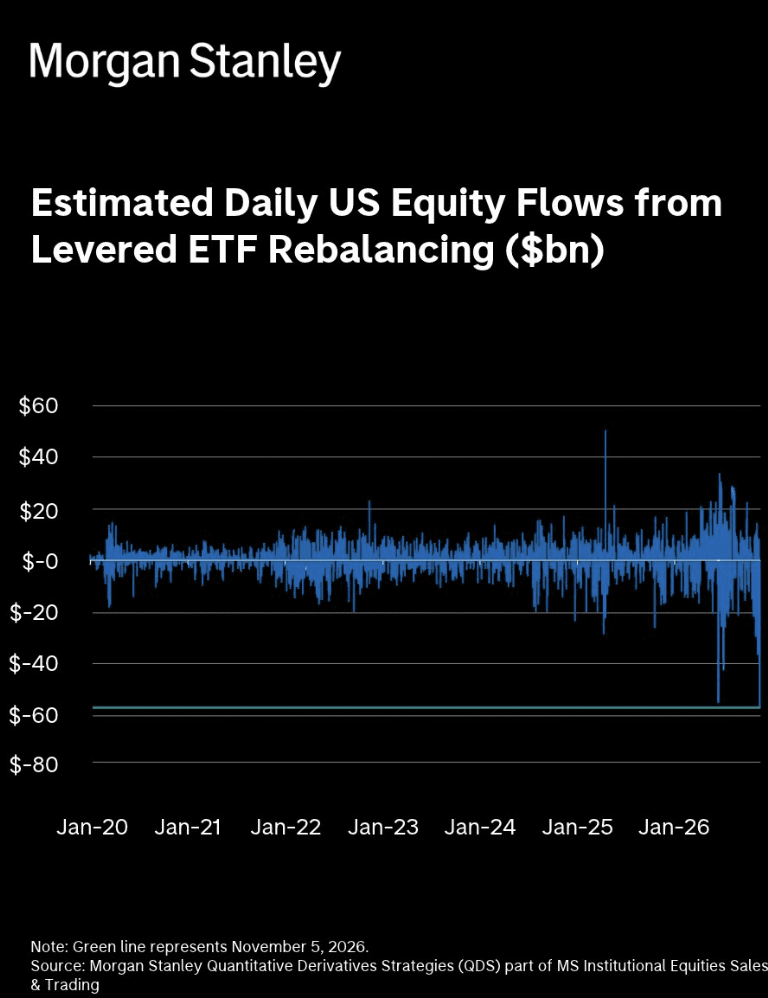
Leveraged ETFs sold $57 billion of US stocks on November 5, the largest amount since data began in 2007, according to Morgan Stanley’s derivatives team. The selling came as hedge funds cut leverage sharply and retail investors sold heavily in the first hour and a half of trading.
The Nasdaq fell about 5.5% that day.
Leveraged ETF Selling Hits a Record
Leveraged ETFs are funds that aim to deliver a multiple of an index’s daily move. When markets fall sharply, they must sell at the end of the day to rebalance. On November 5, that selling added $57 billion of supply to the US stock market, the most in data going back to 2007.
Hedge Funds Cut Leverage at One of the Fastest Rates Since 2010
Net leverage at US long-short hedge funds fell by 5 points in a single day, the fifth-largest one-day decline since 2010, according to Morgan Stanley. Net leverage now sits in the bottom 10% of its historical range.
Since June, active selling by long-short funds has cut their exposure by the equivalent of 10.7% of their end-June holdings, the largest reduction in at least 10 years.
AI Still Makes Up 32% of Hedge Fund Exposure
Hedge funds are underweight AI stocks relative to their share of the market, but AI stocks still account for 32% of their absolute exposure, Morgan Stanley said. The bank defines AI stocks using its MSXXAI index, which covers:
Companies that benefit from AI technology
AI-related power companies
Major hyperscale cloud providers
Retail Investors Sold Early
Retail investors’ selling of US stocks in the first 90 minutes of trading on November 5 was the second-largest since 2016, according to estimates by Morgan Stanley’s Quantitative and Derivative Strategies team based on public data.
Rising Correlations Signal Broader Risk-Cutting
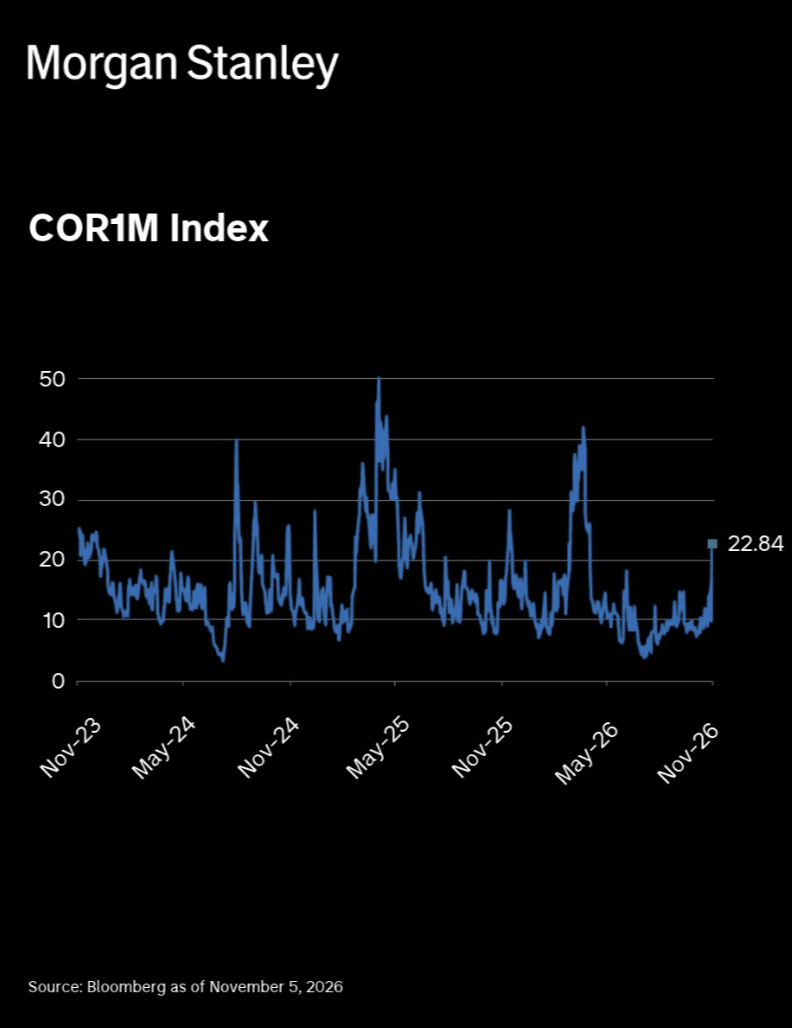
Morgan Stanley also noted that stocks are starting to move more closely together. Rising correlations typically signal that risk-cutting is spreading more broadly across the market.