South Korea isn’t making minor tweaks this time—it’s moving exchanges directly from a “registration” system to a “licensing” system.
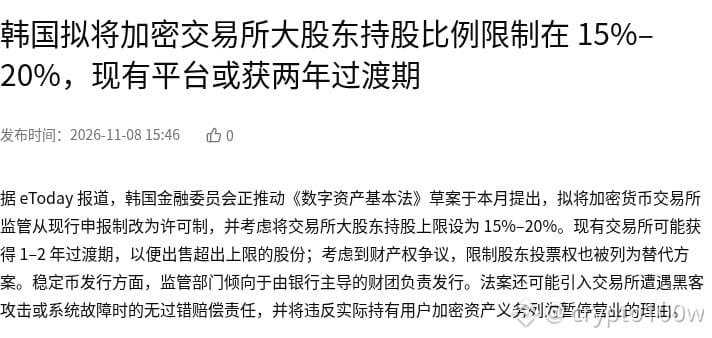
According to a report by eToday cited by Wu Blockchain, South Korea’s Financial Services Commission is pushing for a draft of the Digital Asset Basic Act to be introduced this month. The proposal would change crypto exchange oversight from the current registration system to a licensing system, and considers setting a 15%–20% cap on the shareholdings of major exchange shareholders. Existing platforms may be given a 1–2 year transition period to sell shares exceeding the cap. Given concerns over property rights, restricting shareholders’ voting rights has also been raised as an alternative.
The same report also notes that regulators favor having bank-led consortia issue stablecoins. The bill may also introduce no-fault liability for compensation when exchanges suffer hacks or system failures, and make violations of the obligation to actually hold users’ crypto assets grounds for suspending operations.
Scenario to watch 1: If the final cap is set at 15%, leading platforms such as Upbit will need to restructure their ownership, M&A plans, and pace of expansion. Scenario to watch 2: If the cap is set at 20% with additional remediation requirements, compliance costs and valuation pressures during the transition period will remain key variables.
Are you more focused on whether the cap lands at 15% or 20%, or on whether the transition period will come with remediation requirements?
Source: Wu Blockchain
Image 1: South Korea proposes capping major shareholders’ stakes in exchanges at 15%–20%, with a possible two-year transition period · Screenshot of the source page
Image source: https://www.wublock123.com/news/south-korea-plans-to-limit-the-shareholding-ratio-of-major-shareholders-in-cryptocurrency-exchanges-to-15-20-and-existing-platforms-may-receive-a-two-year-transition-period-71553