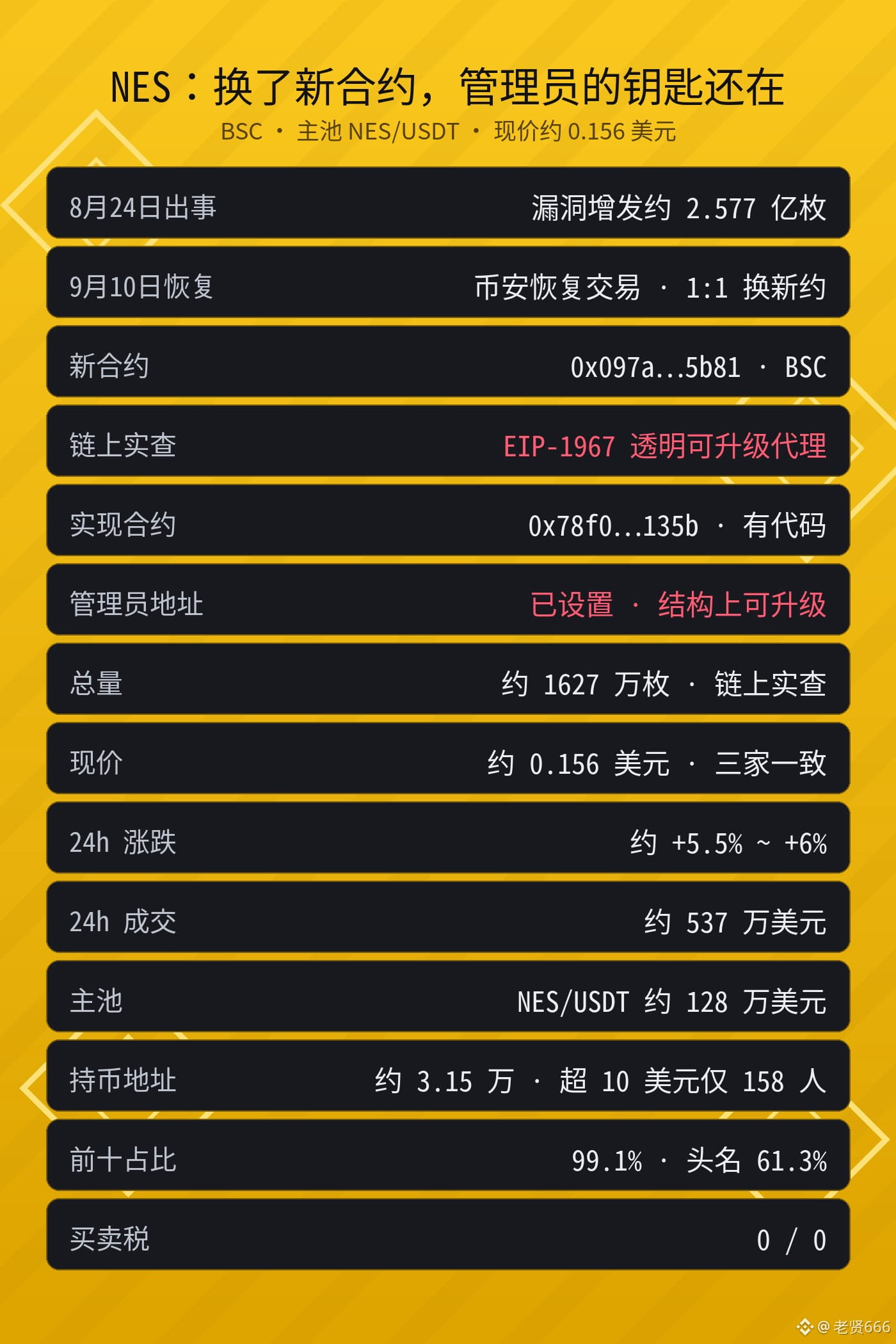
$NES switched to a new contract, but the administrator still hasn’t handed over the key
Here’s my take: make a note of this coin and keep an eye on it—don’t rush into anything. In the August 24 exploit, the hacker minted 257.7 million tokens out of thin air. The on-paper value was $50 million, but they only managed to cash out around $60,000 because the pool was too shallow to sell into. Binance resumed trading on September 10, and the tokens were migrated 1:1 to a new contract. Everyone thought that chapter was closed.
On-chain, the new contract is an EIP-1967 transparent upgradeable proxy. The implementation contract has a separate address, and the administrator’s address is visible too. In plain English: the contract logic can be changed at any time. The migration changed the implementation, but it didn’t remove the underlying ability to change it. The key is still in the administrator’s hands, so the contract can be upgraded at any time.
Now, the market: the current price is about $0.156. Quotes from three platforms are broadly in line. It’s up around 5.5%–6% over 24 hours, with about $5.37 million in trading volume—more than twice its $2.55 million market cap—for turnover of roughly 211%. The main NES/$USDT pool has about $1.28 million in liquidity. It started with 500,000 $USDT and now has 641,000; on the NES side, the pool has 3.25 million left, down from 4.17 million. There are 31,500 holder addresses, but only 158 hold more than $10 worth. The top ten hold 99.1%, and the largest holder alone has 61.3%. Buy and sell taxes are 0.
What should holders check now? Just one thing: look on-chain to see whether the administrator’s address has made any moves, and whether the implementation contract has changed. If the implementation contract address changes, an upgrade has taken place. What would change my assessment? If the project team publicly discloses a multisig administrator or a renunciation plan, I’ll take another look. If the implementation contract is quietly switched to a new version, this post is no longer valid.
Risk warning: This is not investment advice. Alpha projects are high-risk and could go to zero. $NES is not listed on Binance spot; the main pool is the NES/$USDT pair.
What do you think about this contract migration—is changing the implementation enough, or is the administrator’s key the real thing to worry about? Follow me, and I’ll be back to chat when I dig up something interesting.
#BinanceAlpha #NES #合约变化 #BSC