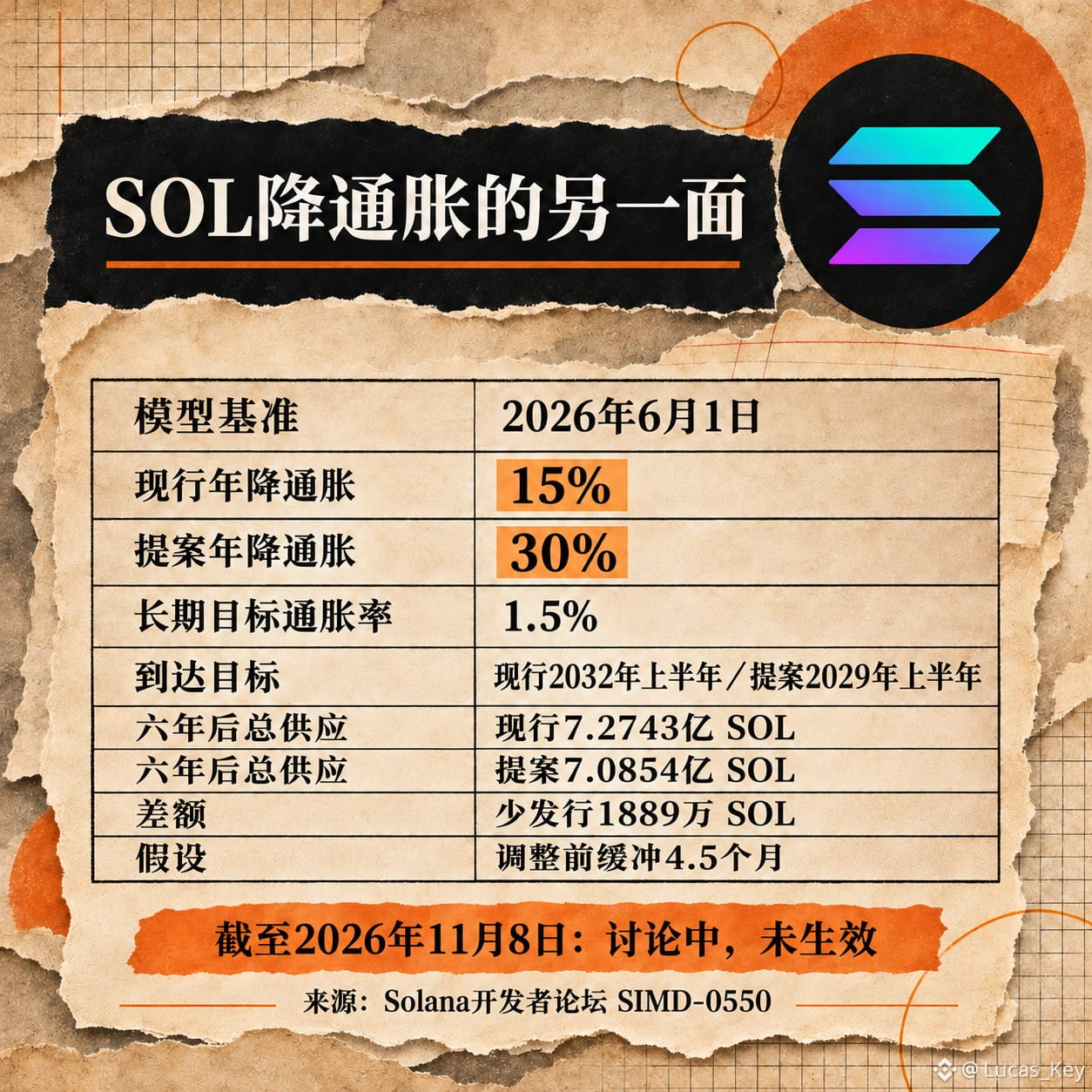
The disinflation proposal from $SOL is still under discussion. Reading “fewer tokens issued” as “prices will rise” overlooks the other side of the equation for validators and stakers.
SIMD-0550 on the Solana developer forum proposes increasing the annual inflation reduction rate from 15% to 30%, while keeping the long-term target inflation rate at 1.5%. In the proposal author’s model, using June 1, 2026 as the baseline and assuming a 4.5-month adjustment buffer, total supply after six years would be about 727.43 million SOL under the current path and about 708.54 million SOL under the proposed path—a difference of about 18.89 million SOL. The time to reach 1.5% would also move forward from the first half of 2032 to the first half of 2029. These are scenario estimates, not a reduction in supply that has already happened.
Supporters see the benefits as lower new supply and the possibility that, as staking yields fall, capital may be more inclined to flow into on-chain lending and trading. Critics point out that lower staking income could also squeeze smaller validators’ operating margins. If that leads to a less distributed validator set, the narrative gains from “scarcity” could be offset by the cost of network security. The proposal author’s own model flags this possibility too.
Comparing $BTC and $ETH makes the different mechanisms clearer: BTC constrains new issuance through block halvings; ETH’s net supply depends on staking issuance and transaction-fee burns. This SOL proposal changes the rate at which the existing inflation curve declines. The three cannot be ranked using the single label “deflationary.” My points to watch are the formal vote outcome, the staking rate and validator count, and whether actual on-chain demand can absorb lower staking yields. As of November 8, the proposal had not taken effect. Sources: Solana developer forum, bitcoin.org, ethereum.org. Prices and staking both involve risks. This is not investment advice.