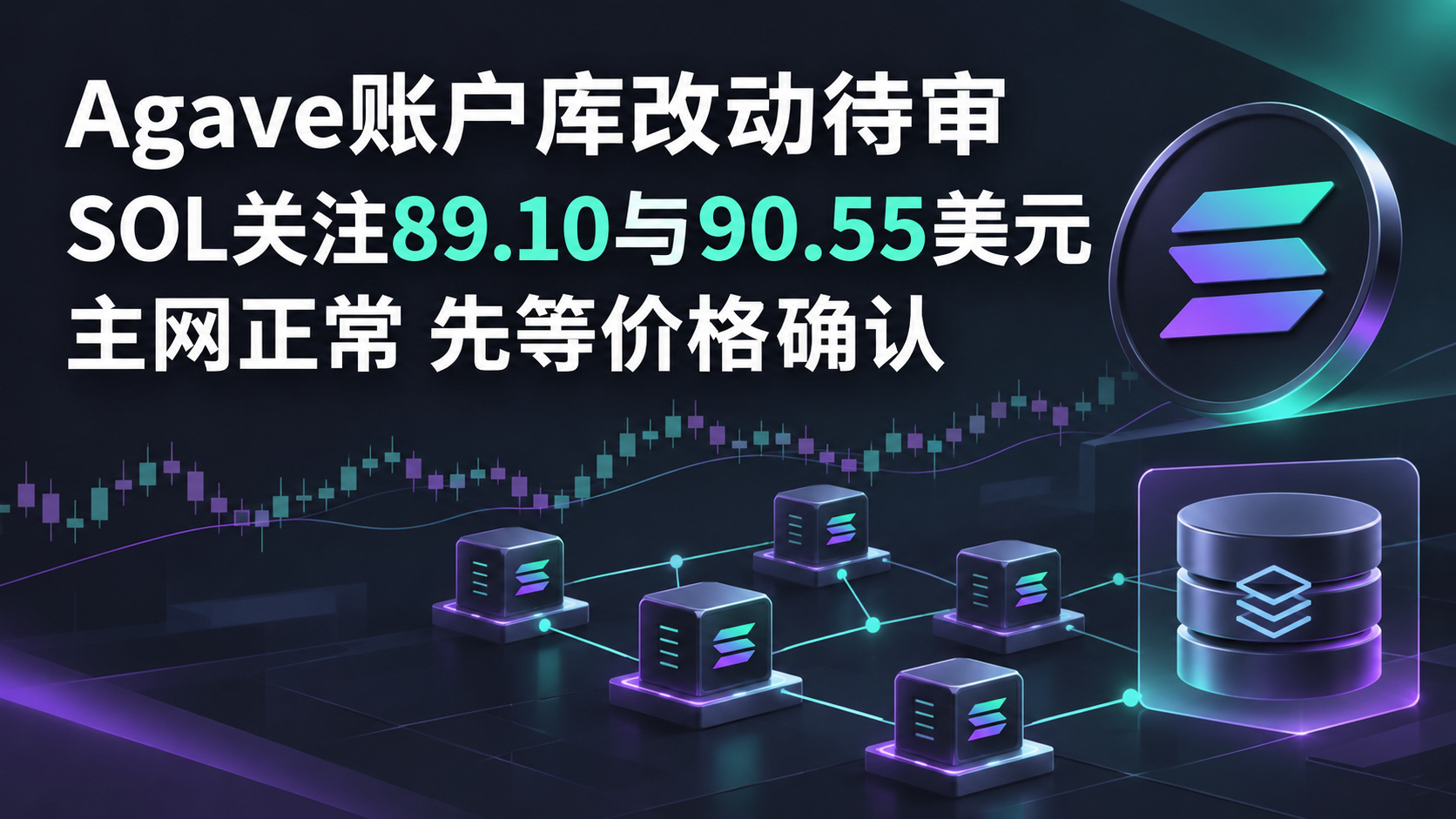
SOL remains at $89.56 | Agave proposes changes to account database structure | Discussing the market after validator progress
My stance is to wait and see. SOL is among the most searched terms on Binance Square over the past six hours, but the page has not labeled it a Rapid Riser, and the current trending topics have no tag that accurately corresponds to this development work. I won’t force a connection to employment or Bitcoin topics. In the official Agave validator client repository for Solana, a change submitted on November 6 proposes moving mutable settings into a configuration after the account database is created, and having the constructor return a shared reference, preparing the structure for future prefetching work. The submitter wrote in the PR description that “prefetching will require weak references”—not that prefetching has already been enabled on mainnet. The PR is still open, and reviewers have asked to discuss the design of the overall prefetching project first; it has not been merged, released, or deployed. It concerns the validator’s internal account-reading architecture. It does not mean Solana protocol parameters have changed, nor does it claim that TPS will therefore increase.
Why is the account database worth watching? Validators process a large amount of account state, and well-designed read and prefetch paths could reduce wait times and improve future node resource usage. But if interfaces or lifecycles are handled poorly, they could also introduce complexity in memory management and operations. Questions raised about the design approach during code review underscore that its engineering value remains to be validated. I’ll track whether there are benchmark tests, regression results, official release notes, and node upgrade guidance before factoring it into a long-term infrastructure assessment. The Solana official status page currently shows the mainnet cluster and RPC as operational, with no incidents reported on November 7; therefore, this open PR is no reason to suggest that the entire network is down or account data is faulty. The technical event’s impact on SOL spot prices is very indirect; short-term moves are more affected by risk appetite, fund flows, and liquidity.
Market data also does not support the claim that “positive development news will immediately drive prices up.” When I checked SOL/USD on Kraken, the last price was around $89.56, below the daily open of $90.02, with an intraday low of $89.10 and high of $90.55. Farside’s filled-in figures for U.S. SOL funds on November 6 show a combined net outflow of about $24.2 million, with BSOL, MSOL, and GSOL accounting for the main negative figures. This is an aggregate of fund subscriptions and redemptions, not evidence that an equivalent amount of spot SOL was directly dumped at the same time. I see $89.10 as near-term support; a break below it that cannot be recovered on a rebound would invalidate my stabilization thesis. Around $90.55 is the day’s resistance; only a move back above it and a sustained hold would be worth watching further. If the official status deteriorates, fund outflows accelerate, or spreads on major venues widen, I would lower my position limit further.
If I were trading this myself, I would stay out for now. The only direction I’d consider is a small spot long, and my current position is 0%. Only if SOL moves above $90.55, holds around $90.20 on a pullback, the status page remains normal, and order-book spreads are manageable would I test a position using 0.35% of total capital, with no leverage. The first target is $91.50, where I’d sell half; if price and volume continue to align, I’d look to $92.40 for the remainder and exit in batches upon reaching it. I’d set a stop-loss at $89.75; if price breaks below $89.10 decisively, I’d close the entire position and cancel any subsequent buys. If the PR is ultimately rewritten or closed, I still would not treat that as a trading plan being triggered, much less count unrealized development benefits as actual trading gains.
#SOL
The above is solely my personal market observation and does not constitute investment advice.