


According to disclosures filed with the U.S. Securities and Exchange Commission (SEC), $谷歌-A (GOOGL.US)$ parent company Alphabet filed its U.S. equity holdings report (13F) for the third quarter ended September 30, 2026.
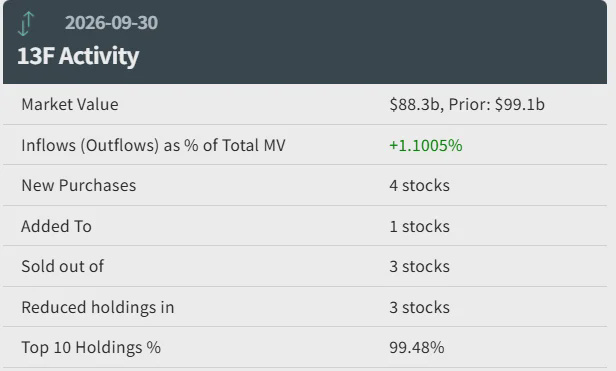
According to statistics, the total market value of $谷歌-C (GOOG.US)$ parent company Alphabet's 13F holdings at the end of the third quarter was approximately $88.3 billion, down about 10.9% from approximately $99.1 billion in the previous quarter. During the quarter, it added four new stock positions, increased one position, reduced three positions, and liquidated three positions. Its top 10 holdings accounted for 99.48% of the portfolio. This portfolio is highly concentrated, and changes in its market value are largely driven by price fluctuations in its core holdings. Therefore, the approximately $10.8 billion decline in market value should not be interpreted directly as an equivalent amount of capital withdrawn.
Alphabet’s latest 13F filing shows that it held approximately $548 million in $高通 (QCOM.US)$ stock. This was Alphabet’s first new position, and it immediately ranked as its sixth-largest holding. The continued increase in its SpaceX stake was also a major highlight of the updated 13F disclosure. As smartphone demand comes under pressure and Qualcomm accelerates its expansion into AI data-center CPUs and related data-center AI chip businesses, the position adds a capital link between Alphabet and its longtime chip partner.
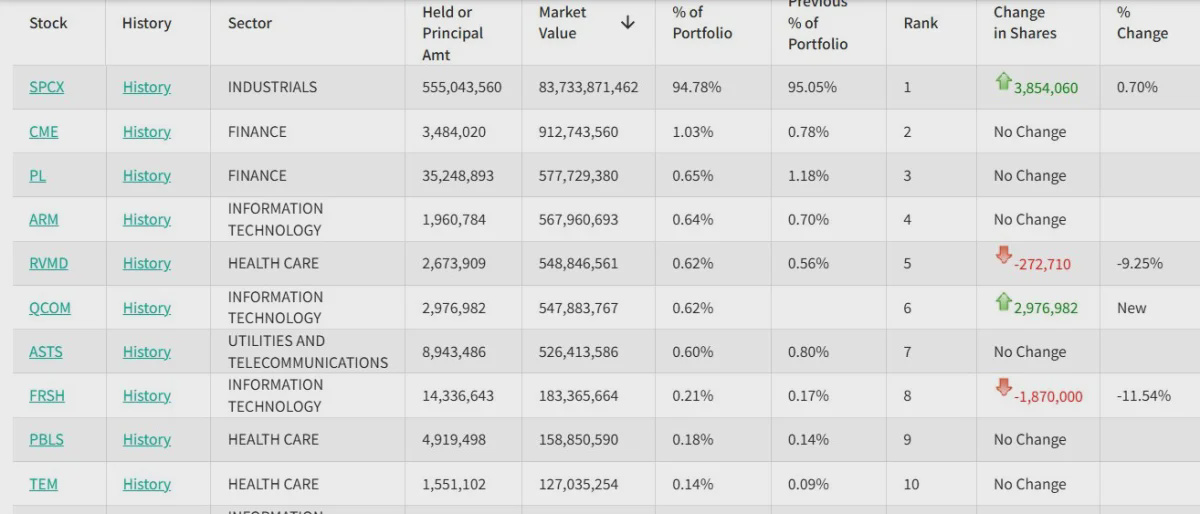
Commercial spaceflight and satellite communications giant $SpaceX (SPCX.US)$ remained Alphabet’s largest holding. Alphabet held approximately 555.04 million shares, with a quarter-end market value of about $83.734 billion, representing 94.78% of its 13F portfolio. It added approximately 3.8541 million shares from the previous quarter, an increase of 0.70%. Although the position’s portfolio weight declined from 95.05% to 94.78%, the number of shares actually increased, indicating that Alphabet retained and slightly expanded this core investment rather than trimming it because of the decline in its portfolio weight.
Derivatives exchange giant $芝加哥商品交易所 (CME.US)$ ranked second, with approximately 3.484 million shares valued at about $913 million, or 1.03% of the portfolio. The share count was unchanged from the previous quarter. Earth-observation satellite and data services provider $Planet Labs PBC (PL.US)$ ranked third, with approximately 35.2489 million shares valued at about $578 million, or 0.65% of the portfolio. Its share count was also unchanged.
Chip architecture and processor intellectual property company $Arm Holdings (ARM.US)$, which owns the ARM architecture, ranked fourth, with approximately 1.9608 million shares valued at about $568 million, or 0.64% of the portfolio. The share count was unchanged. Oncology drug developer $Revolution Medicines (RVMD.US)$ ranked fifth, with approximately 2.6739 million shares valued at about $549 million, or 0.62% of the portfolio. Alphabet reduced its position by approximately 272,700 shares during the quarter, a 9.25% trim. Despite the lower share count, the position’s portfolio weight rose from 0.56% to 0.62%, reflecting the fact that portfolio weight is also affected by changes in the stock’s price and the portfolio’s total market value.
Wireless communications and computing chip giant Qualcomm was the quarter’s most significant new position, immediately becoming Alphabet’s sixth-largest holding. At quarter-end, Alphabet held approximately 2.977 million shares, with a reported value of about $548 million, representing 0.62% of the portfolio. The industrial context for the investment is clear: Qualcomm has long served the Android smartphone ecosystem, and the companies’ partnership has expanded to Googlebook laptops powered by Qualcomm processors, as well as automotive AI chips and software. The new equity stake builds on their existing partnership and further aligns their interests, but the disclosure itself does not indicate that Google has placed an order with Qualcomm for data-center chips.
Qualcomm is seeking to reduce its dependence on the smartphone cycle through its data-center business. The company has set a target of generating more than $15 billion in data-center revenue in fiscal 2029 and has secured business support from tech giants including Amazon, Microsoft, and Meta. Its arrangement with Amazon involves potential purchases of up to $60 billion in chips and related products, along with warrants. For the market, Alphabet’s investment reinforces the narrative of Qualcomm expanding from end-user devices into AI infrastructure: competition is shifting beyond smartphone chip market share to cloud providers’ demand for customized computing, energy efficiency, and lower computing costs. On November 6, after news of the position was disclosed, Qualcomm shares rose about 3% premarket. In the previous trading session, the stock had fallen more than 9% amid its earnings performance and a broader sell-off in tech stocks, showing that near-term earnings pressures and its long-term business transformation continue to jointly influence its valuation.
Related securities
SpaceX (SPCX.US)
134.270
+8.62%
Among the top ten holdings in Alphabet’s third-quarter portfolio, positions ranked seventh through tenth were $AST SpaceMobile (ASTS.US)$, $Freshworks (FRSH.US)$, $Parabilis Medicines (PBLS.US)$, and $Tempus AI (TEM.US)$. Satellite-to-phone communications company AST SpaceMobile accounted for approximately 8.9435 million shares valued at $526 million, or 0.60% of the portfolio. Enterprise software company Freshworks accounted for approximately 14.3366 million shares valued at $183 million, or 0.21%. Biopharmaceutical company Parabilis Medicines accounted for approximately 4.9195 million shares valued at $159 million, or 0.18%. Healthcare AI company Tempus AI accounted for approximately 1.5511 million shares valued at $127 million, or 0.14%. The share counts for all three companies other than Freshworks were unchanged; Freshworks was trimmed by 11.54%.
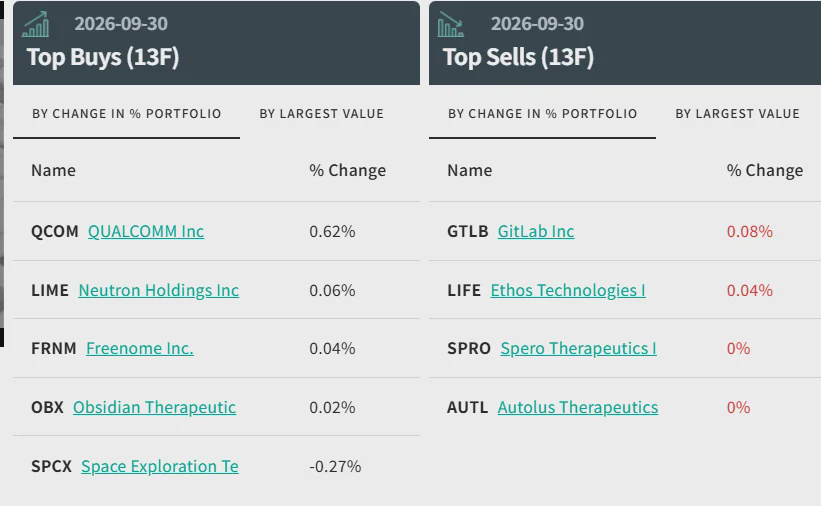
Among the newly disclosed positions, Qualcomm accounted for the vast majority, while the other additions were in shared mobility and biopharmaceuticals. $Neutron Holdings (LIME.US)$, the parent company of shared electric mobility platform Lime, had a newly disclosed position of approximately 1.8989 million shares, with a quarter-end value of $53.4934 million. Cancer early-detection company $Freenome (FRNM.US)$ accounted for approximately 2.0221 million shares valued at $31.8486 million, while tumor cell therapy developer $Obsidian Therapeutics (OBX.US)$ accounted for approximately 1.2249 million shares valued at $16.8175 million. The combined quarter-end value of the four new positions was approximately $650 million, with Qualcomm accounting for about 84.3% of the total. The other three companies went public or completed their listings through mergers during the third quarter, so the changes in the list may also reflect existing private investments becoming publicly traded securities; they should not all be interpreted as new purchases on the public market during the quarter.
On the reduction side, Alphabet mainly adjusted some of its software, insurtech, and biopharmaceutical holdings. In addition to trimming $Revolution Medicines (RVMD.US)$ by 9.25%, it reduced its $Freshworks (FRSH.US)$ position by 1.87 million shares, or 11.54%. Digital life insurance technology company $Ethos Technologies (LIFE.US)$ was reduced by approximately 3.0507 million shares, an 84.21% cut, leaving approximately 571,900 shares worth about $19.1989 million at quarter-end. WhaleWisdom’s sell rankings, which are compiled based on changes in portfolio weight, also list software development platform $Gitlab (GTLB.US)$, $Spero Therapeutics (SPRO.US)$, and $Autolus Therapeutics (AUTL.US)$. The portfolio-weight rankings do not fully correspond to the list of positions with actual share reductions: although $Revolution Medicines (RVMD.US)$ and $Freshworks (FRSH.US)$ were trimmed, their portfolio weights both increased.
The portfolio changes in this disclosure show that Alphabet continued to maintain an investment structure centered on SpaceX and spanning chips, satellite communications, enterprise software, and life sciences, with Qualcomm standing out as the quarter’s clearest new direction. The investment implication is that Alphabet maintained its core holdings while increasing its equity exposure to a longtime partner expanding into AI data centers, and selectively adjusted other investments. These changes took place in the third quarter and reflect its investment positioning during that period; they should not be viewed as an immediate trading response to the November election results or the subsequent sharp decline in tech stocks.