

A week in the markets: a sell-off, not a catastrophe
On Thursday, the S&P 500 fell 4.4%, the Nasdaq 100 fell 6.4%, and the semiconductor index SOX fell 12.3%.
For SOX, it was the second-worst day in its history.
The week’s overall losses were moderate: S&P 500 -2.7%, Nasdaq -3.4%, Dow -0.9%. Since the start of the year, the S&P is up almost 8%.
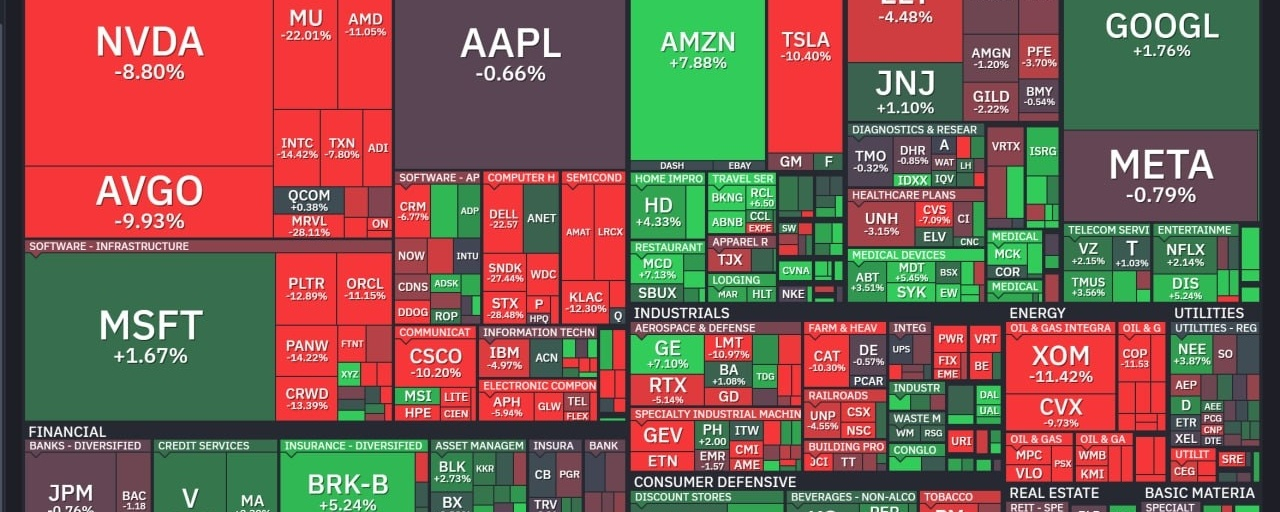
The map shows the losses concentrated in three blocks:
Memory and data storage:
STX -28%, SNDK -27%, DELL -23%, MU -22%.
AI semiconductors and AI software:
MRVL -28%, INTC -14%, PLTR -13%, ORCL -11%, AMD -11%, AVGO -10%, NVDA -9%.
Oil stocks: COP -12%, XOM -11%, CVX -10% on expectations of a deal with Iran; WTI fell 13% over the week.
The rest of the market was in the green or near flat. Five of 11 sectors were up, with communications at +4.9%. AMZN +7.9%, MCD +7.1%, BRK-B +5.2%, COST +4.1%, GOOGL +1.8%, MSFT +1.7%. Gold +4.6%.
Money flowed out of borrowers and AI construction suppliers and into companies that live off their own cash flow, as well as defensive assets.
Timeline
September
10-year UST yields at 5.2–5.3%, 30-year yields at their highest since 2004
Hyperscalers issued nearly $300 billion in bonds over the year; total AI debt for 2026 is around $500 billion. Credit spreads remained near 25-year lows, even though the cost of money was the highest in 19 years.
14–15.10. The starting point.
Hot CPI revived expectations of rate hikes. CoreWeave bonds fell below 80% of par, with yields of 15–16%. CDS above 1,000 bps, implying about a 63% probability of default over five years. Oracle lost 10% in a day, and its CDS hit a record 288 bps. CDS on Amazon, Alphabet, Meta, and Nvidia also reached historic highs.
Stress was confined to AI credit. Nasdaq fell 4.5% over the week.
22.10. All major hedge fund strategies lost at the same time. This was the first sign of overcrowding in shared positions.
30.10. Intel dragged semiconductors lower; Nasdaq fell 2.9% for the day, marking its third consecutive losing week.
02.11. Brent fell 7.6% on signals of a deal with Iran.
The war premium is starting to come out of oil stocks.
04.11. Democrats won both chambers of Congress
Hinojosa was elected governor of Texas, promising a moratorium on new data centers. ERCOT’s interconnection queue stands at 440–470 GW, about 90% of it data centers.
Indexes rose (Dow +3%, S&P +1.6%), but selling was already underway beneath the surface: CoreWeave -7%, Oracle -4%, memory stocks -7–9%
05.11.
Texas was joined by Arm’s weak forecast (-13%) and Micron’s pause on its Taiwan plant. Every stock in SOXX fell more than 6%.
Data center CDS above 500 bps, CoreWeave’s spread above 1,200 bps.
The decline was accelerated by:
leveraged ETFs, which sold about $47 billion before the close
volatility-control funds, about $61 billion
negative dealer gamma: about $7 billion in sales for every 1% decline in the S&P.
QQQ trading volume hit a record, at about $80 billion
VIX around 28, +67% for the day
06.11
Employment +165K versus a forecast of 60K, unemployment at 4.1%
Expectations of a December rate hike strengthened.
Semiconductors rebounded 4%, S&P +0.3%, but 318 of the index’s 500 stocks fell. Korea and Japan played catch-up on the downside
Mechanism
Cost of money
UST yields around 5% make debt financing for AI construction expensive.
Weak borrowers. Stress began among highly leveraged companies: CoreWeave and Oracle are at the lower end of investment grade.
Their CDS are being bought as a hedge against the entire AI position, and that itself is widening spreads.
Policy
Texas is hitting construction timelines, and timelines determine the cost of debt. Every quarter of delay means a quarter of interest on an unfinished data center. This was the link that had already made the credit market nervous.
Leverage.
The most overcrowded positions of the year are the first to be sold:
At its peak, SNDK was up 650% year to date, MU was up 250%.
Multi-strategy funds are cutting gross exposure, leveraged ETFs and volatility-control funds are selling mechanically, and negative gamma is turning the decline into a cascade.
Why this isn’t a catastrophe
10-year USTs fell 8 bps over the week, to 4.86%
Money flowed into quality; there are no signs of a credit crisis.
Semiconductor multiples have fallen by about half from their June–July peaks
Capital stayed in the market and rotated into platforms, financials, consumer stocks, and gold.
The main risk: on Thursday, sales exceeded purchases by about 5 to 1. In a true capitulation, that would be 8–10 to 1, so the cleanup was not complete.
Thursday was a liquidation of one overcrowded position.
In terms of mechanics, this is closer to 1998 than to 2000.